Nadeem Ahmed, Obiefuna Peter C M, Wilson Constance N, Mustafa S Jamal
Department of Pharmacology, East Carolina University, Greenville, NC, United States.
Eur J Pharmacol. 2006 Dec 3;551(1-3):116-24. doi: 10.1016/j.ejphar.2006.08.059. Epub 2006 Sep 8.
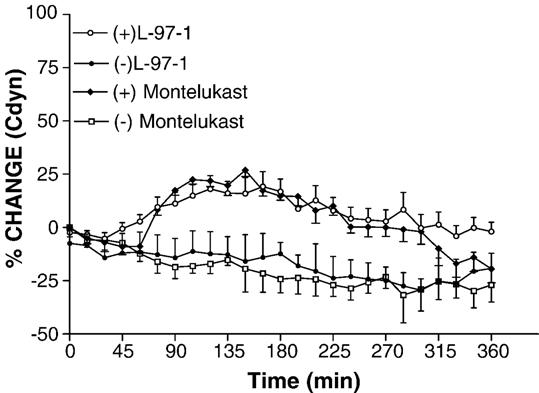
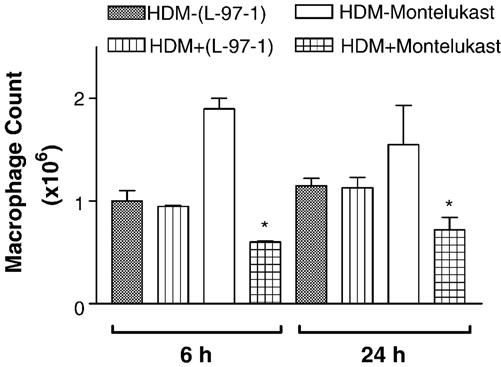
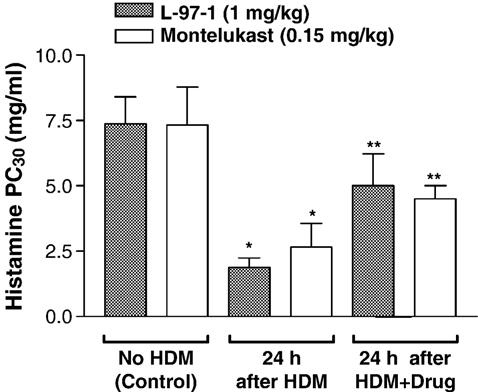
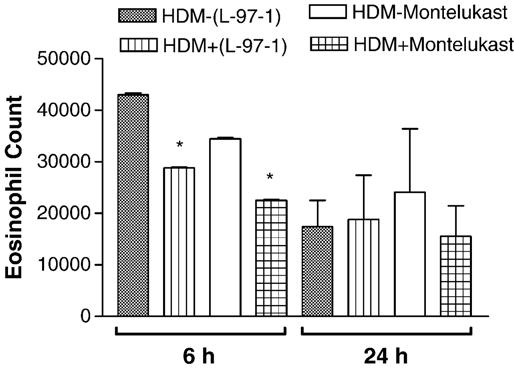
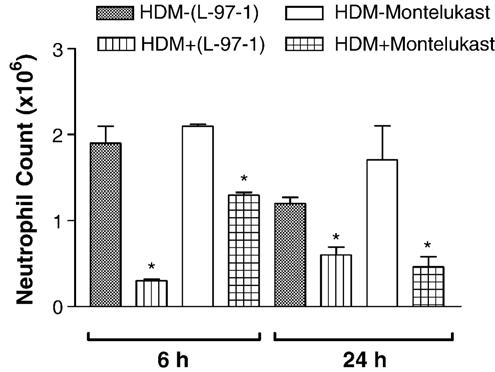
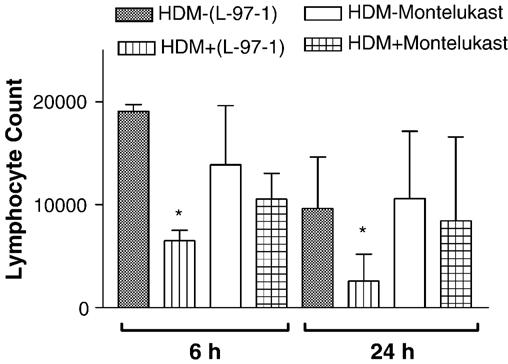
Adenosine produces bronchoconstriction in allergic rabbits, primates, and humans by activating adenosine A(1) receptors. Previously, it is reported that a high dose of L-97-1, a water-soluble, small molecule adenosine A(1) receptor antagonist, blocks early and late allergic responses, and bronchial hyper-responsiveness to histamine in a hyper-responsive rabbit model of allergic asthma. Effects of a lower dose of L-97-1 are compared to montelukast, a cysteinyl leukotriene-1 receptor antagonist on early allergic response, late allergic response, bronchial hyper-responsiveness, and inflammatory cells in bronchoalveolar lavage (BAL) fluid following house dust mite administration. Rabbits received intraperitoneal injections of house dust mite extract within 24 h of birth followed by booster house dust mite injections. Hyper-responsive rabbits received aerosolized house dust mite (2500 allergen units), 1 h after intragastric administration of L-97-1 (1 mg/kg) or montelukast (0.15 mg/kg) and lung dynamic compliance was measured for 6 h. Lung dynamic compliance was significantly higher following L-97-1 at all time points and with montelukast at 60-300 min following house dust mite (P<0.05). L-97-1 blocks both early and late allergic responses. Montelukast blocks only the late allergic response. Both L-97-1 and montelukast significantly blocked bronchial hyper-responsiveness at 24 h (P<0.05). Both L-97-1 and montelukast significantly reduced BAL eosinophils at 6 h and neutrophils at 6 and 24 h (P<0.05). L-97-1 significantly reduced BAL lymphocytes at 6 and 24 h (P<0.05). Montelukast significantly reduced BAL macrophages at 6 and 24 h (P<0.05). By blocking both bronchoconstriction and airway inflammation, L-97-1 may be an effective oral anti-asthma treatment.
腺苷通过激活腺苷A(1)受体,使过敏性兔、灵长类动物和人类出现支气管收缩。此前有报道称,高剂量的L-97-1(一种水溶性小分子腺苷A(1)受体拮抗剂)可阻断早期和晚期过敏反应,以及在过敏性哮喘高反应性兔模型中对组胺的支气管高反应性。将较低剂量的L-97-1与孟鲁司特(一种半胱氨酰白三烯-1受体拮抗剂)对早期过敏反应、晚期过敏反应、支气管高反应性以及在给予屋尘螨后支气管肺泡灌洗(BAL)液中的炎症细胞的影响进行比较。兔子在出生后24小时内腹腔注射屋尘螨提取物,随后进行加强注射屋尘螨。高反应性兔在胃内给予L-97-1(1毫克/千克)或孟鲁司特(0.15毫克/千克)1小时后,雾化吸入屋尘螨(2500个过敏原单位),并测量肺动态顺应性6小时。在所有时间点,L-97-1给药后肺动态顺应性均显著升高,屋尘螨给药后60 - 300分钟孟鲁司特给药后肺动态顺应性也显著升高(P<0.05)。L-97-1可阻断早期和晚期过敏反应。孟鲁司特仅阻断晚期过敏反应。L-97-1和孟鲁司特在24小时时均显著阻断支气管高反应性(P<0.05)。L-97-1和孟鲁司特在6小时时均显著减少BAL嗜酸性粒细胞,在6小时和24小时时均显著减少中性粒细胞(P<0.05)。L-97-1在6小时和24小时时显著减少BAL淋巴细胞(P<0.05)。孟鲁司特在6小时和24小时时显著减少BAL巨噬细胞(P<0.05)。通过阻断支气管收缩和气道炎症,L-97-1可能是一种有效的口服抗哮喘治疗药物。