Wadelius Mia, Chen Leslie Y, Eriksson Niclas, Bumpstead Suzannah, Ghori Jilur, Wadelius Claes, Bentley David, McGinnis Ralph, Deloukas Panos
Department of Medical Sciences, Clinical Pharmacology, University Hospital, 751 85 Uppsala, Sweden.
Hum Genet. 2007 Mar;121(1):23-34. doi: 10.1007/s00439-006-0260-8. Epub 2006 Oct 18.
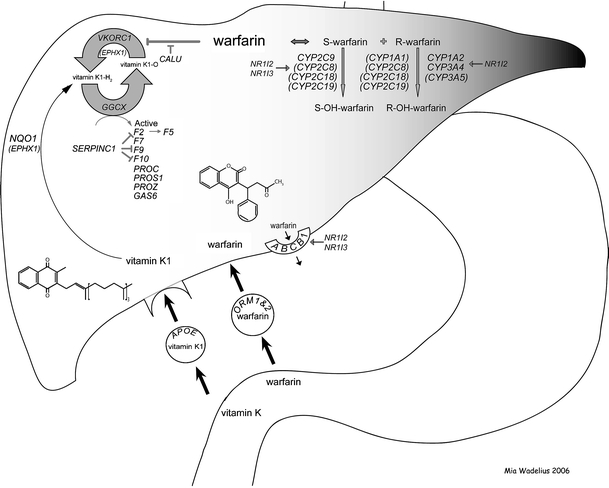
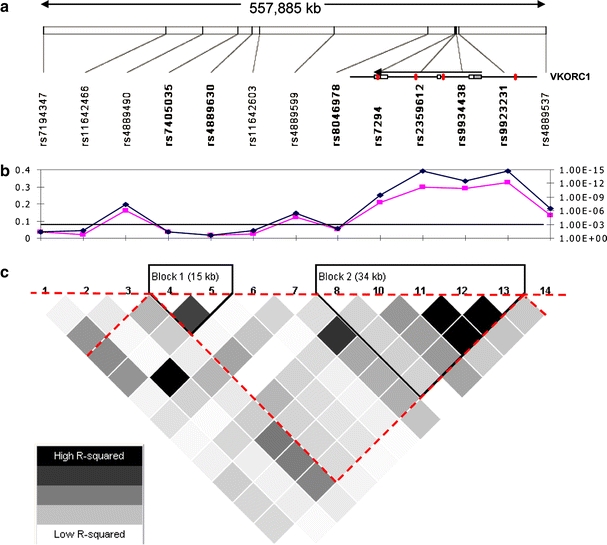
We report an extensive study of variability in genes encoding proteins that are believed to be involved in the action and biotransformation of warfarin. Warfarin is a commonly prescribed anticoagulant that is difficult to use because of the wide interindividual variation in dose requirements, the narrow therapeutic range and the risk of serious bleeding. We genotyped 201 patients for polymorphisms in 29 genes in the warfarin interactive pathways and tested them for association with dose requirement. In our study, polymorphisms in or flanking the genes VKORC1, CYP2C9, CYP2C18, CYP2C19, PROC, APOE, EPHX1, CALU, GGCX and ORM1-ORM2 and haplotypes of VKORC1, CYP2C9, CYP2C8, CYP2C19, PROC, F7, GGCX, PROZ, F9, NR1I2 and ORM1-ORM2 were associated with dose (P < 0.05). VKORC1, CYP2C9, CYP2C18 and CYP2C19 were significant after experiment-wise correction for multiple testing (P < 0.000175), however, the association of CYP2C18 and CYP2C19 was fully explained by linkage disequilibrium with CYP2C9*2 and/or *3. PROC and APOE were both significantly associated with dose after correction within each gene. A multiple regression model with VKORC1, CYP2C9, PROC and the non-genetic predictors age, bodyweight, drug interactions and indication for treatment jointly accounted for 62% of variance in warfarin dose. Weaker associations observed for other genes could explain up to approximately 10% additional dose variance, but require testing and validation in an independent and larger data set. Translation of this knowledge into clinical guidelines for warfarin prescription will be likely to have a major impact on the safety and efficacy of warfarin.
我们报告了一项关于编码被认为参与华法林作用和生物转化的蛋白质的基因变异性的广泛研究。华法林是一种常用的抗凝剂,由于个体间剂量需求差异大、治疗窗窄以及严重出血风险,其使用难度较大。我们对201例患者进行了华法林相互作用途径中29个基因多态性的基因分型,并测试它们与剂量需求的关联。在我们的研究中,维生素K环氧化物还原酶复合体1(VKORC1)、细胞色素P450 2C9(CYP2C9)、细胞色素P450 2C18(CYP2C18)、细胞色素P450 2C19(CYP2C19)、蛋白C(PROC)、载脂蛋白E(APOE)、环氧化物水解酶1(EPHX1)、钙结合蛋白(CALU)、γ-谷氨酰羧化酶(GGCX)和ORM1-ORM2基因及其侧翼的多态性以及VKORC1、CYP2C9、细胞色素P450 2C8(CYP2C8)、CYP2C19、PROC、凝血因子Ⅶ(F7)、GGCX、蛋白Z(PROZ)、凝血因子Ⅸ(F9)、核受体亚家族1组I成员2(NR1I2)和ORM1-ORM2的单倍型与剂量相关(P < 0.05)。经过多重检验的实验性校正后,VKORC1、CYP2C9、CYP2C18和CYP2C19具有显著性(P < 0.000175),然而,CYP2C18和CYP2C19与CYP2C92和/或3的连锁不平衡完全解释了它们之间的关联。在每个基因内部校正后,PROC和APOE均与剂量显著相关。包含VKORC1、CYP2C9、PROC以及非基因预测因素年龄、体重、药物相互作用和治疗指征的多元回归模型共同解释了华法林剂量62%的方差。观察到的其他基因的较弱关联最多可额外解释约10%的剂量方差,但需要在独立的更大数据集中进行测试和验证。将这一知识转化为华法林处方的临床指南可能会对华法林的安全性和有效性产生重大影响。