Lindenblatt Nicole, Menger Michael D, Klar Ernst, Vollmar Brigitte
Department of Experimental Surgery, University of Rostock, Schillingallee, Rostock 18055, Germany.
Crit Care. 2006;10(5):R148. doi: 10.1186/cc5074.
Hypothermia during sepsis significantly impairs patient outcome in clinical practice. Severe sepsis is closely linked to activation of the coagulation system, resulting in microthrombosis and subsequent organ failure. Herein, we studied whether systemic hypothermia accelerates microvascular thrombus formation during lipopolysacharide (LPS)-induced endotoxemia in vivo, and characterized the low temperature-induced endothelial and platelet dysfunctions.
Ferric-chloride induced microvascular thrombus formation was analyzed in cremaster muscles of hypothermic endotoxemic mice. Flow cytometry, ELISA and immunohistochemistry were used to evaluate the effect of hypothermia on endothelial and platelet function.
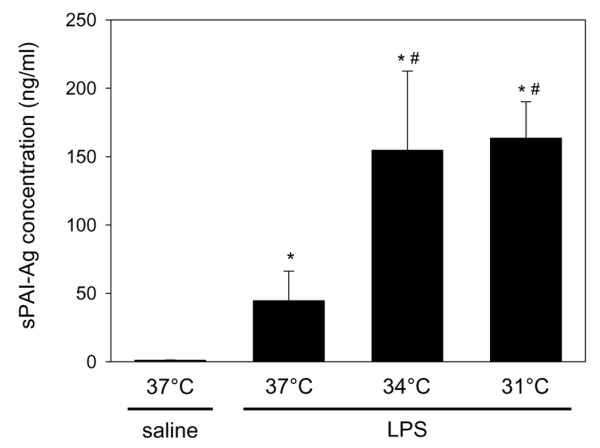
Control animals at 37 degrees C revealed complete occlusion of arterioles and venules after 759 +/- 115 s and 744 +/- 112 s, respectively. Endotoxemia significantly (p < 0.05) accelerated arteriolar and venular occlusion in 37 degrees C animals (255 +/- 35 s and 238 +/- 58 s, respectively). This was associated with an increase of circulating endothelial activation markers, agonist-induced platelet reactivity, and endothelial P-selectin and plasminogen activator inhibitor (PAI)-1 expression. Systemic hypothermia of 34 degrees C revealed a slight but not significant reduction of arteriolar (224 +/- 35 s) and venular (183 +/- 35 s) occlusion times. Cooling of the endotoxemic animals to 31 degrees C core body temperature, however, resulted in a further acceleration of microvascular thrombus formation, in particular in arterioles (127 +/- 29 s, p < 0.05 versus 37 degrees C endotoxemic animals). Of interest, hypothermia did not affect endothelial receptor expression and platelet reactivity, but increased endothelial PAI-1 expression and, in particular, soluble PAI-1 antigen (sPAI-Ag) plasma levels.
LPS-induced endotoxemia accelerates microvascular thrombus formation in vivo, most probably by generalized endothelial activation and increased platelet reactivity. Systemic hypothermia further enhances microthrombosis in endotoxemia. This effect is associated with increased endothelial PAI-1 expression and sPAI-Ag in the systemic circulation rather than further endothelial activation or modulation of platelet reactivity.
在临床实践中,脓毒症期间的体温过低会显著损害患者的预后。严重脓毒症与凝血系统的激活密切相关,会导致微血栓形成及随后的器官衰竭。在此,我们研究了全身性低温是否会加速脂多糖(LPS)诱导的体内内毒素血症期间微血管血栓的形成,并对低温诱导的内皮细胞和血小板功能障碍进行了特征描述。
在低温内毒素血症小鼠的提睾肌中分析氯化铁诱导的微血管血栓形成。采用流式细胞术、酶联免疫吸附测定(ELISA)和免疫组织化学方法评估低温对内皮细胞和血小板功能的影响。
37℃的对照动物在759±115秒和744±112秒后分别出现小动脉和小静脉完全阻塞。内毒素血症显著(p<0.05)加速了37℃动物的小动脉和小静脉阻塞(分别为255±35秒和238±58秒)。这与循环内皮激活标志物增加、激动剂诱导的血小板反应性以及内皮细胞P-选择素和纤溶酶原激活物抑制剂(PAI)-1表达增加有关。34℃的全身性低温显示小动脉(224±35秒)和小静脉(183±35秒)阻塞时间略有但不显著的缩短。然而,将内毒素血症动物的核心体温降至31℃会导致微血管血栓形成进一步加速,尤其是在小动脉中(127±29秒,与37℃内毒素血症动物相比,p<0.05)。有趣的是,低温并不影响内皮细胞受体表达和血小板反应性,但会增加内皮细胞PAI-1表达,特别是可溶性PAI-1抗原(sPAI-Ag)血浆水平。
LPS诱导的内毒素血症在体内加速微血管血栓形成,很可能是通过全身性内皮激活和血小板反应性增加实现的。全身性低温进一步增强内毒素血症中的微血栓形成。这种效应与全身循环中内皮细胞PAI-1表达和sPAI-Ag增加有关,而非进一步的内皮激活或血小板反应性调节。