Sautter Nathan B, Shick Elizabeth H, Ransohoff Richard M, Charo Israel F, Hirose Keiko
Head and Neck Institute, Cleveland Clinic, Cleveland, OH 44195, USA.
J Assoc Res Otolaryngol. 2006 Dec;7(4):361-72. doi: 10.1007/s10162-006-0051-x. Epub 2006 Oct 31.
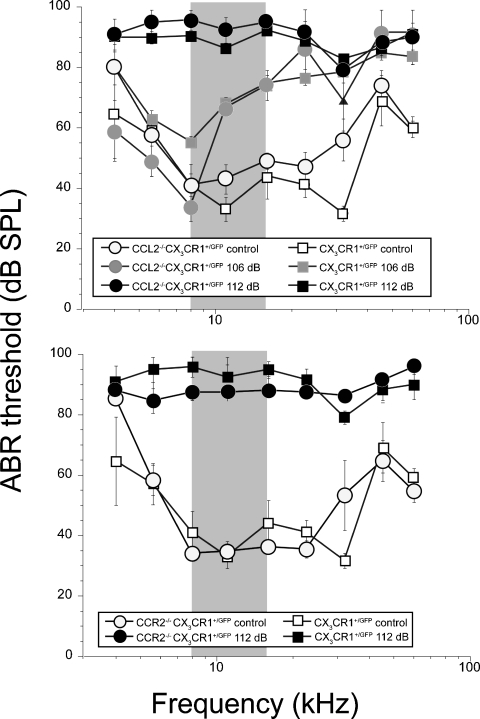
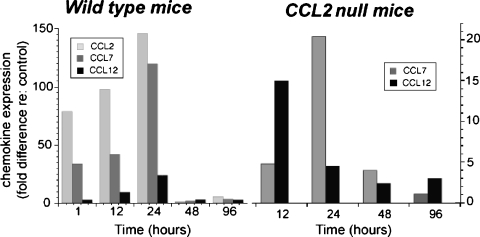
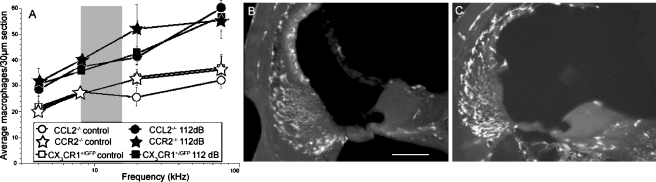
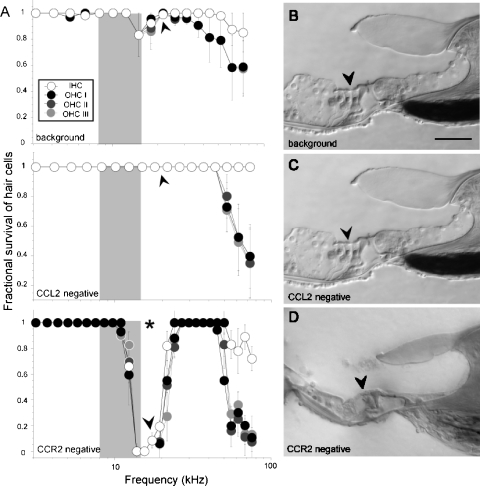
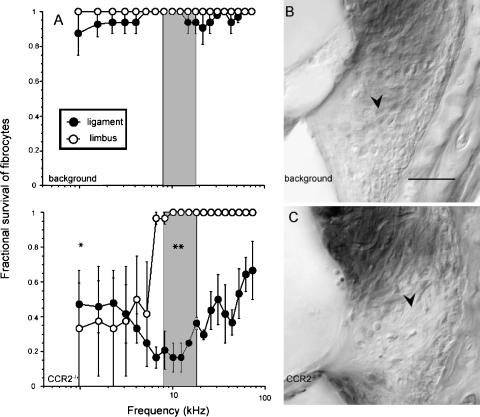
Acoustic trauma was recently shown to induce an inflammatory response in the ear characterized by rapid entry of macrophages in the spiral ligament. The current study seeks to elucidate the mechanisms involved in summoning macrophages to the cochlear lateral wall and the role macrophages play in noise-induced injury or repair. CCL2 and its primary receptor, CCR2, are the most widely validated effectors of monocyte chemotaxis in vivo. CCL2-/- and CCR2-/- mice have been used extensively in studies of monocyte activation in neuronal injury. However, the function of CCL2 and CCR2 in the cochlea has not been studied. The present study examines the role of CCL2 and CCR2 in acoustic injury. CCL2-/- and CCR2-/- mice on a CX3CR1(+/GFP) background were exposed to octave band noise (8-16 kHz) for 2 h to determine the effect of CCL2 and CCR2 on monocyte migration into the cochlea, threshold shift, and cell survival. We found that threshold shift was unchanged in the two knockout mouse strains when compared to the background strain (CX3CR1(+/GFP)). Surprisingly, we found that monocyte migration was also unchanged, despite the absence of CCL2 or CCR2. However, there was a dramatic increase in noise-induced hair cell death in the CCR2-/- strain. This observation suggests that CCR2, independent of CCL2, plays a protective role in the cochlea after noise, and neither ligand nor receptor is necessary for monocyte migration. Possible mechanisms of neuroprotection by CCR2 are discussed.
近期研究表明,声创伤可在耳内引发炎症反应,其特征为巨噬细胞迅速进入螺旋韧带。本研究旨在阐明巨噬细胞被募集至耳蜗外侧壁的相关机制,以及巨噬细胞在噪声性损伤或修复过程中所起的作用。CCL2及其主要受体CCR2是体内单核细胞趋化作用最广泛验证的效应因子。CCL2 - / - 和CCR2 - / - 小鼠已广泛应用于神经元损伤中单核细胞激活的研究。然而,CCL2和CCR2在耳蜗中的功能尚未得到研究。本研究探讨了CCL2和CCR2在声损伤中的作用。将CX3CR1(+/GFP)背景下的CCL2 - / - 和CCR2 - / - 小鼠暴露于倍频程噪声(8 - 16 kHz)2小时,以确定CCL2和CCR2对单核细胞向耳蜗迁移、阈值偏移和细胞存活的影响。我们发现,与背景品系(CX3CR1(+/GFP))相比,两种基因敲除小鼠品系的阈值偏移没有变化。令人惊讶的是,我们发现尽管缺乏CCL2或CCR2,单核细胞迁移也没有变化。然而,CCR2 - / - 品系中噪声诱导的毛细胞死亡显著增加。这一观察结果表明,CCR2在噪声后对耳蜗起保护作用,且不依赖于CCL2;单核细胞迁移既不需要配体也不需要受体。文中讨论了CCR2神经保护的可能机制。