Colón-Emeric Cathleen S, Lekan-Rutledge Deborah, Utley-Smith Queen, Ammarell Natalie, Bailey Donald, Piven Mary L, Corazzini Kirsten, Anderson Ruth A
Department of Medicine, Division of Geriatrics, and The Center for the Study of Aging and Human Development, Duke University Medical Center, Durham, NC, USA.
Health Care Manage Rev. 2006 Oct-Dec;31(4):337-46. doi: 10.1097/00004010-200610000-00009.
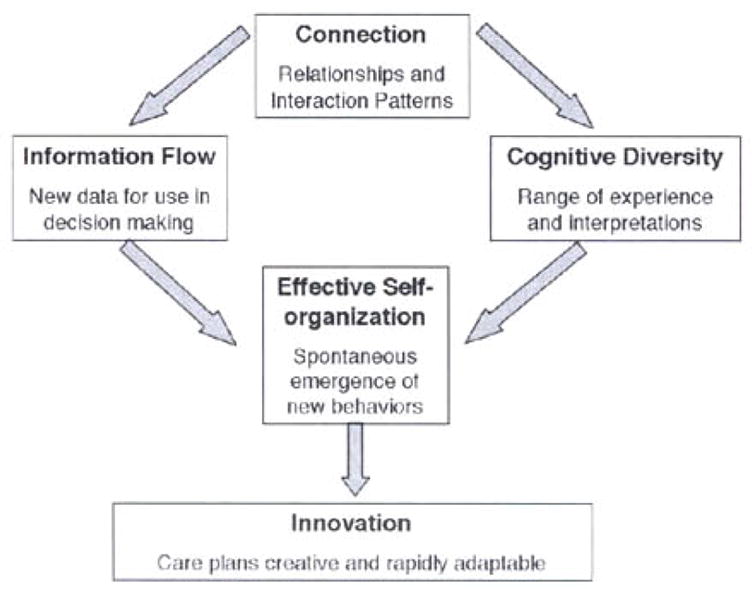
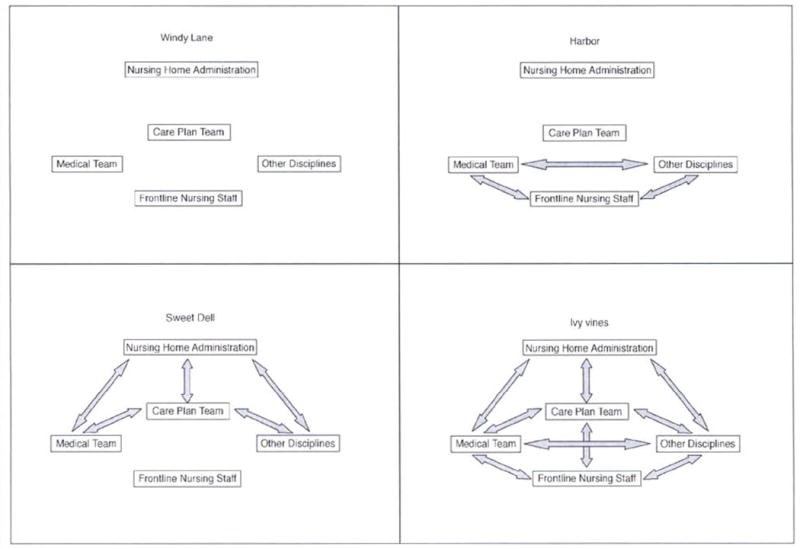
We describe how connections among nursing home staff impact the care planning process using a complexity science framework. We completed six-month case studies of four nursing homes. Field observations (n = 274), shadowing encounters (n = 69), and in-depth interviews (n = 122) of 390 staff at all levels were conducted. Qualitative analysis produced a conceptual/thematic description and complexity science concepts were used to produce conceptual insights. We observed that greater levels of staff connection were associated with higher care plan specificity and innovation. Connection of the frontline nursing staff was crucial for (1) implementation of the formal care plan and (2) spontaneous informal care planning responsive to changing resident needs. Although regulations could theoretically improve cognitive diversity and information flow in care planning, we observed instances of regulatory oversight resulting in less specific care plans and abandonment of an effective care planning process. Interventions which improve staff connectedness may improve resident outcomes.
我们描述了养老院工作人员之间的联系如何使用复杂性科学框架影响护理计划过程。我们完成了对四家养老院的为期六个月的案例研究。对各级390名工作人员进行了实地观察(n = 274)、跟班观察(n = 69)和深入访谈(n = 122)。定性分析产生了概念性/主题性描述,并使用复杂性科学概念得出概念性见解。我们观察到,更高水平的工作人员联系与更高的护理计划特异性和创新性相关。一线护理人员的联系对于(1)正式护理计划的实施以及(2)响应居民需求变化的自发非正式护理计划至关重要。虽然从理论上讲,监管可以改善护理计划中的认知多样性和信息流,但我们观察到监管监督导致护理计划不那么具体以及放弃有效的护理计划过程的情况。改善工作人员联系的干预措施可能会改善居民的结局。