Lefebvre P, Berard D S, Cordingley M G, Hager G L
Hormone Action and Oncogenesis Section, National Cancer Institute Bethesda, Maryland 20892.
Mol Cell Biol. 1991 May;11(5):2529-37. doi: 10.1128/mcb.11.5.2529-2537.1991.
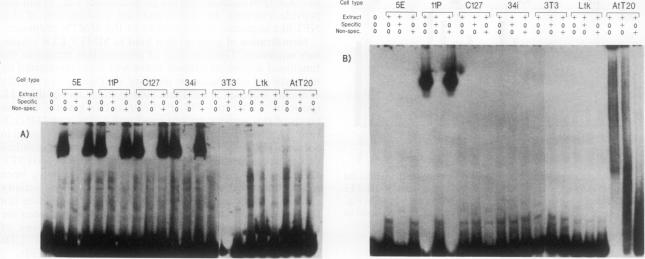
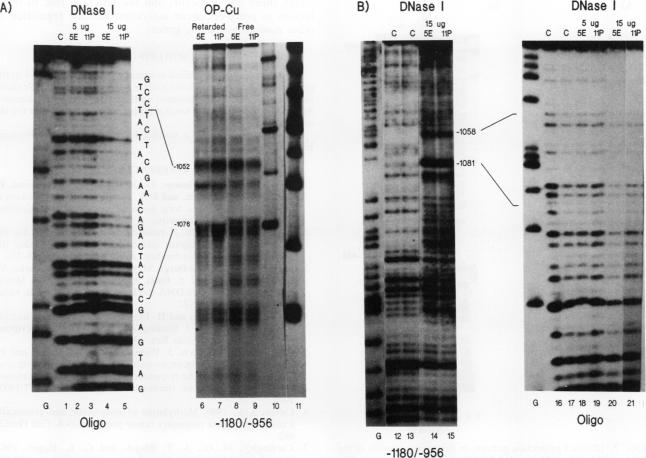
In vivo expression of the mouse mammary tumor virus (MMTV) is restricted to a few organs, with the highest rate of transcription found in the mammary gland. Using a series of mammary and nonmammary murine cell lines, we have identified two regulatory elements, located upstream of the hormone responsive element, that specifically regulate the MMTV promoter. The first element displays an enhancerlike activity and is coincident with the binding of a nuclear factor (designated MP4; position -1078 to -1052 in the long terminal repeat) whose presence is apparently restricted to mammary cell lines. The second regulatory region mediates a repressive activity and is mapped to the long terminal repeat segment from -415 to -483. This repression is specific for a particular subtype of mammary cells (RAC cells) able to grow under two differentiation states (A. Sonnenberg, H. Daams, J. Calafat, and J. Hilgers, Cancer Res. 46:5913-5922, 1986). The MMTV promoter in mammary cell lines thus appears to be modulated by two cis-acting elements that are likely to be involved in tissue-specific expression in vivo.
小鼠乳腺肿瘤病毒(MMTV)的体内表达仅限于少数器官,其中乳腺中的转录率最高。利用一系列乳腺和非乳腺小鼠细胞系,我们鉴定出了位于激素反应元件上游的两个调控元件,它们特异性地调节MMTV启动子。第一个元件表现出类似增强子的活性,并且与一种核因子(命名为MP4;位于长末端重复序列中的-1078至-1052位)的结合位点重合,该核因子的存在显然仅限于乳腺细胞系。第二个调控区域介导一种抑制活性,定位于长末端重复序列的-415至-483片段。这种抑制作用对能够在两种分化状态下生长的特定亚型乳腺细胞(RAC细胞)具有特异性(A. 索南伯格、H. 达姆斯、J. 卡拉法特和J. 希尔格斯,《癌症研究》46:5913-5922,1986年)。因此,乳腺细胞系中的MMTV启动子似乎受到两个顺式作用元件的调节,这两个元件可能参与体内的组织特异性表达。