Gilbride Susan J, Wild Cameron, Wilson Douglas R, Svenson Lawrence W, Spady Donald W
University of Alberta, Edmonton, Canada.
BMC Pediatr. 2006 Nov 9;6:30. doi: 10.1186/1471-2431-6-30.
Childhood injury is the leading cause of mortality, morbidity and permanent disability in children in the developed world. This research examines relationships between socio-economic status (SES), demographics, and types of childhood injury in the province of Alberta, Canada.
Secondary analysis was performed using administrative health care data provided by Alberta Health and Wellness on all children, aged 0 to 17 years, who had injuries treated by a physician, either in a physician's office, outpatient department, emergency room and/or as a hospital inpatient, between April 1st. 1995 to March 31st. 1996. Thirteen types of childhood injury were assessed with respect to age, gender and urban/rural location using ICD9 codes, and were related to SES as determined by an individual level SES indicator, the payment status of the Alberta provincial health insurance plan. The relationships between gender, SES, rural/urban status and injury type were determined using logistic regression.
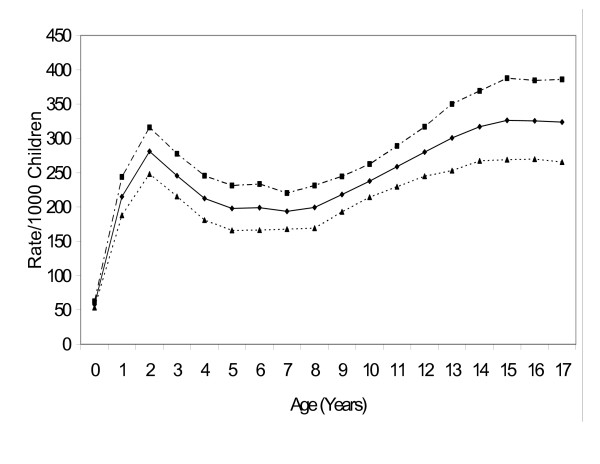
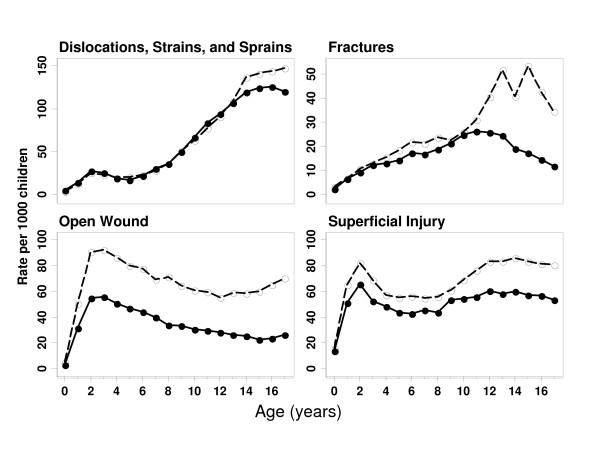
Twenty-four percent of Alberta children had an injury treated by physician during the one year period. Peak injury rates occurred about ages 2 and 13-17 years. All injury types except poisoning were more common in males. Injuries were more frequent in urban Alberta and in urban children with lower SES (receiving health care premium assistance). Among the four most common types of injury (78.6% of the total), superficial wounds and open wounds were more common among children with lower SES, while fractures and dislocations/sprains/strains were more common among children receiving no premium assistance.
These results show that childhood injury in Alberta is a major health concern especially among males, children living in urban centres, and those living on welfare or have Treaty status. Most types of injury were more frequent in children of lower SES. Analysis of the three types of the healthcare premium subsidy allowed a more comprehensive picture of childhood injury with children whose families are on welfare and those of Treaty status presenting more frequently for an injury-related physician's consultation than other children. This report also demonstrates that administrative health care data can be usefully employed to describe injury patterns in children.
在发达国家,儿童期受伤是儿童死亡、发病和永久性残疾的主要原因。本研究调查了加拿大艾伯塔省社会经济地位(SES)、人口统计学特征与儿童期受伤类型之间的关系。
利用艾伯塔省健康与福利部提供的行政医疗保健数据,对1995年4月1日至1996年3月31日期间在医生办公室、门诊部、急诊室和/或住院接受治疗的所有0至17岁受伤儿童进行二次分析。使用国际疾病分类第九版(ICD9)编码,对13种儿童期受伤类型的年龄、性别和城乡分布进行评估,并将其与由个体水平SES指标(艾伯塔省省级医疗保险计划的支付状态)确定的SES相关联。采用逻辑回归分析性别、SES、城乡地位与受伤类型之间的关系。
在这一年期间,24%的艾伯塔省儿童接受了医生治疗的损伤。受伤率高峰出现在2岁左右以及13 - 17岁。除中毒外,所有受伤类型在男性中更为常见。在艾伯塔省城市地区以及社会经济地位较低(接受医疗保健保费援助)的城市儿童中,受伤更为频繁。在四种最常见的受伤类型(占总数的78.6%)中,表浅伤口和开放性伤口在社会经济地位较低的儿童中更为常见,而骨折和脱位/扭伤/拉伤在未接受保费援助的儿童中更为常见。
这些结果表明,艾伯塔省的儿童期受伤是一个主要的健康问题,尤其是在男性、居住在城市中心的儿童以及那些依靠福利生活或具有条约地位的儿童中。大多数受伤类型在社会经济地位较低的儿童中更为频繁。对三种医疗保健保费补贴类型的分析,使我们能够更全面地了解儿童期受伤情况,与其他儿童相比,家庭依靠福利生活的儿童以及具有条约地位的儿童因受伤而寻求医生咨询的频率更高。本报告还表明,行政医疗保健数据可有效地用于描述儿童的受伤模式。