Balko Justin M, Potti Anil, Saunders Christopher, Stromberg Arnold, Haura Eric B, Black Esther P
Department of Pharmaceutical Sciences, University of Kentucky, Lexington, KY 40536-0082, USA.
BMC Genomics. 2006 Nov 10;7:289. doi: 10.1186/1471-2164-7-289.
Increased focus surrounds identifying patients with advanced non-small cell lung cancer (NSCLC) who will benefit from treatment with epidermal growth factor receptor (EGFR) tyrosine kinase inhibitors (TKI). EGFR mutation, gene copy number, coexpression of ErbB proteins and ligands, and epithelial to mesenchymal transition markers all correlate with EGFR TKI sensitivity, and while prediction of sensitivity using any one of the markers does identify responders, individual markers do not encompass all potential responders due to high levels of inter-patient and inter-tumor variability. We hypothesized that a multivariate predictor of EGFR TKI sensitivity based on gene expression data would offer a clinically useful method of accounting for the increased variability inherent in predicting response to EGFR TKI and for elucidation of mechanisms of aberrant EGFR signalling. Furthermore, we anticipated that this methodology would result in improved predictions compared to single parameters alone both in vitro and in vivo.
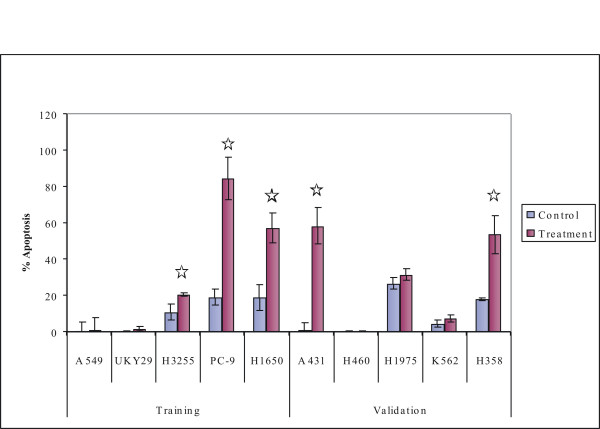
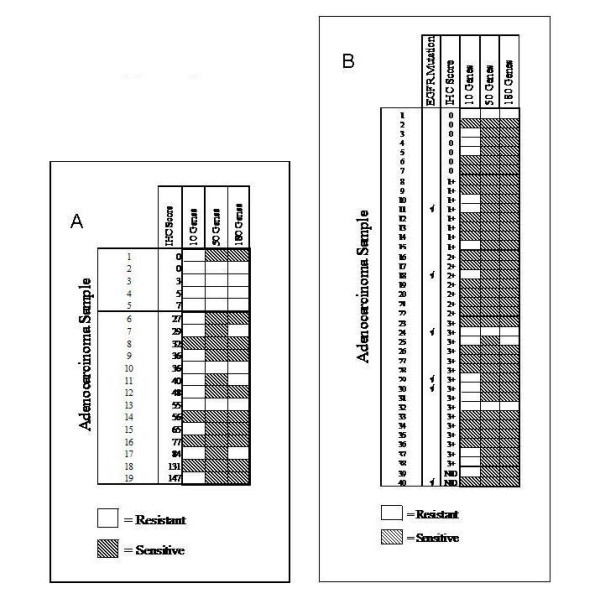
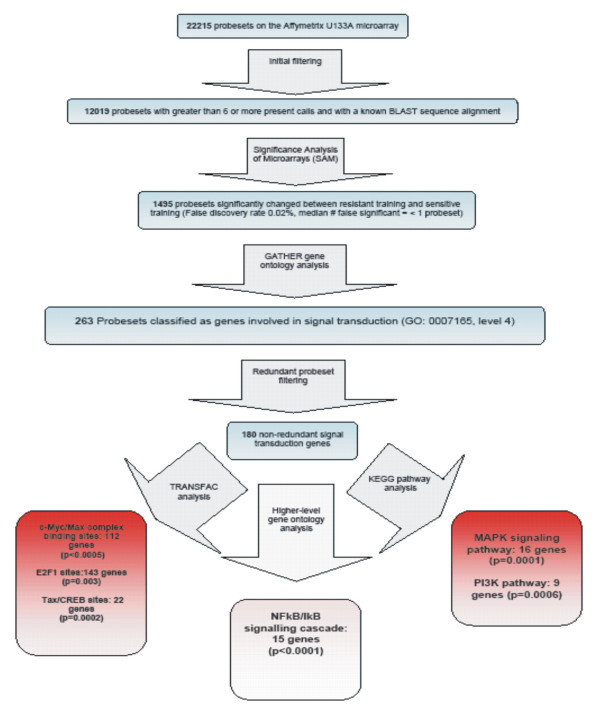
Gene expression data derived from cell lines that demonstrate differential sensitivity to EGFR TKI, such as erlotinib, were used to generate models for a priori prediction of response. The gene expression signature of EGFR TKI sensitivity displays significant biological relevance in lung cancer biology in that pertinent signalling molecules and downstream effector molecules are present in the signature. Diagonal linear discriminant analysis using this gene signature was highly effective in classifying out-of-sample cancer cell lines by sensitivity to EGFR inhibition, and was more accurate than classifying by mutational status alone. Using the same predictor, we classified human lung adenocarcinomas and captured the majority of tumors with high levels of EGFR activation as well as those harbouring activating mutations in the kinase domain. We have demonstrated that predictive models of EGFR TKI sensitivity can classify both out-of-sample cell lines and lung adenocarcinomas.
These data suggest that multivariate predictors of response to EGFR TKI have potential for clinical use and likely provide a robust and accurate predictor of EGFR TKI sensitivity that is not achieved with single biomarkers or clinical characteristics in non-small cell lung cancers.
越来越多的关注集中在识别那些将从表皮生长因子受体(EGFR)酪氨酸激酶抑制剂(TKI)治疗中获益的晚期非小细胞肺癌(NSCLC)患者。EGFR突变、基因拷贝数、ErbB蛋白和配体的共表达以及上皮-间质转化标志物均与EGFR TKI敏感性相关,虽然使用任何一种标志物预测敏感性确实能识别出反应者,但由于患者间和肿瘤间的高度变异性,单个标志物并不能涵盖所有潜在反应者。我们假设基于基因表达数据的EGFR TKI敏感性多变量预测指标将提供一种临床上有用的方法,以解释预测EGFR TKI反应中固有的增加的变异性,并阐明异常EGFR信号传导的机制。此外,我们预计这种方法与单独的单一参数相比,在体外和体内都能带来更好的预测效果。
从对EGFR TKI(如厄洛替尼)表现出不同敏感性的细胞系中获得的基因表达数据被用于生成反应的先验预测模型。EGFR TKI敏感性的基因表达特征在肺癌生物学中显示出显著的生物学相关性,因为相关的信号分子和下游效应分子都存在于该特征中。使用该基因特征进行对角线性判别分析在根据对EGFR抑制的敏感性对样本外癌细胞系进行分类方面非常有效,并且比仅根据突变状态进行分类更准确。使用相同的预测指标,我们对人肺腺癌进行了分类,并捕获了大多数具有高水平EGFR激活以及在激酶结构域中携带激活突变的肿瘤。我们已经证明,EGFR TKI敏感性的预测模型可以对样本外细胞系和肺腺癌进行分类。
这些数据表明,EGFR TKI反应的多变量预测指标具有临床应用潜力,并且可能提供一种强大而准确的EGFR TKI敏感性预测指标,这是单个生物标志物或非小细胞肺癌的临床特征所无法实现的。