Chenot Jean-François, Becker Annette, Leonhardt Corinna, Keller Stefan, Donner-Banzhoff Norbert, Baum Erika, Pfingsten Michael, Hildebrandt Jan, Kochen Michael M, Basler Heinz-Dieter
Dpt, of General Practice, University of Göttingen, Humboldtallee 38, 37073 Goettingen, Germany.
BMC Health Serv Res. 2006 Nov 17;6:149. doi: 10.1186/1472-6963-6-149.
Acupuncture is a frequently used but controversial adjunct to the treatment of chronic low back pain (LBP). Acupuncture is now considered to be effective for chronic LBP and health care systems are pressured to make a decision whether or not acupuncture should be covered. It has been suggested that providing such services might reduce the use of other health care services. Therefore, we explored factors associated with acupuncture treatment for LBP and the relation of acupuncture with other health care services.
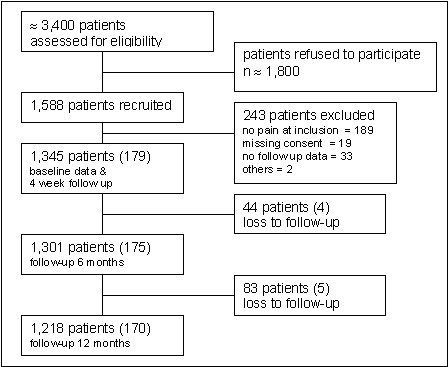
This is a post hoc analysis of a longitudinal prospective cohort study. General practitioners (GPs) recruited consecutive adult patients with LBP. Data on physical function, subjective mood and utilization of health care services was collected at the first consultation and at follow-up telephone interviews for a period of twelve months.
A total of 179 (13 %) out of 1,345 patients received acupuncture treatment. The majority of those (59 %) had chronic LBP. Women and elderly patients were more likely to be given acupuncture. Additional determinants of acupuncture therapy were low functional capacity and chronicity of pain. Chronic (vs. acute) back pain OR 1.6 (CL 1.4-2.9) was the only significant disease-related factor associated with the treatment. The strongest predictors for receiving acupuncture were consultation with a GP who offers acupuncture OR 3.5 (CL 2.9-4.1) and consultation with a specialist OR 2.1 (CL 1.9-2.3). After adjustment for patient characteristics, acupuncture remained associated with higher consultation rates and an increased use of other health care services like physiotherapy.
Receiving acupuncture for LBP depends mostly on the availability of the treatment. It is associated with increased use of other health services even after adjustment for patient characteristics. In our study, we found that receiving acupuncture does not offset the use of other health care resources. A significant proportion of patients who received did not meet the so far only known selection criterion (chonicity). Acupuncture therapy might be a reflection of helplessness in both patients and health care providers.
针灸是治疗慢性下腰痛(LBP)常用但存在争议的辅助疗法。目前认为针灸对慢性下腰痛有效,医疗保健系统面临着是否应涵盖针灸治疗的决策压力。有人提出提供此类服务可能会减少其他医疗保健服务的使用。因此,我们探讨了与针灸治疗下腰痛相关的因素以及针灸与其他医疗保健服务的关系。
这是一项纵向前瞻性队列研究的事后分析。全科医生(GPs)招募连续的成年下腰痛患者。在首次就诊时以及为期12个月的随访电话访谈中收集有关身体功能、主观情绪和医疗保健服务利用情况的数据。
1345名患者中有179名(13%)接受了针灸治疗。其中大多数(59%)患有慢性下腰痛。女性和老年患者更有可能接受针灸治疗。针灸治疗的其他决定因素是功能能力低下和疼痛的慢性化。慢性(与急性相比)背痛的比值比为1.6(可信区间1.4 - 2.9)是与治疗相关的唯一显著疾病相关因素。接受针灸治疗的最强预测因素是咨询提供针灸服务的全科医生,比值比为3.5(可信区间2.9 - 4.1),以及咨询专科医生,比值比为2.1(可信区间1.9 - 2.3)。在对患者特征进行调整后,针灸治疗仍与更高的就诊率以及增加使用其他医疗保健服务(如物理治疗)相关。
接受针灸治疗下腰痛主要取决于治疗的可及性。即使在对患者特征进行调整后,它仍与增加使用其他医疗服务相关。在我们的研究中,我们发现接受针灸治疗并不能抵消对其他医疗保健资源的使用。接受治疗的患者中有很大一部分不符合目前仅有的已知选择标准(慢性化)。针灸治疗可能反映了患者和医疗保健提供者双方的无助。