Wang Bin, Brenner Robert
Department of Physiology, University of Texas Health Science Center at San Antonio, San Antonio, TX 78229, USA.
J Gen Physiol. 2006 Dec;128(6):731-44. doi: 10.1085/jgp.200609596.
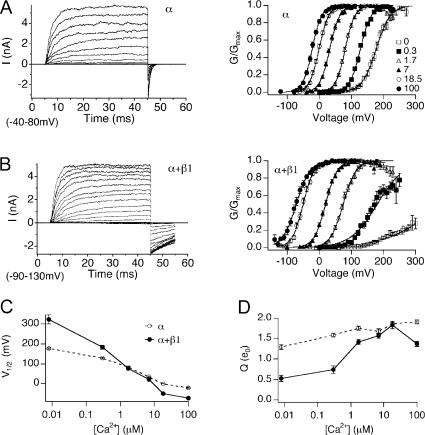
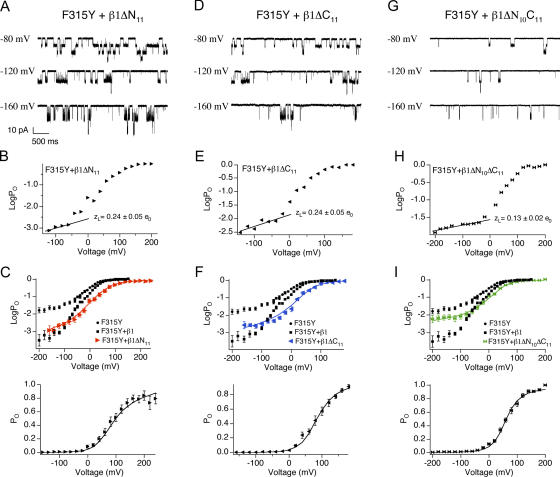
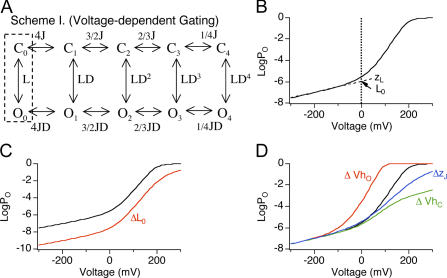
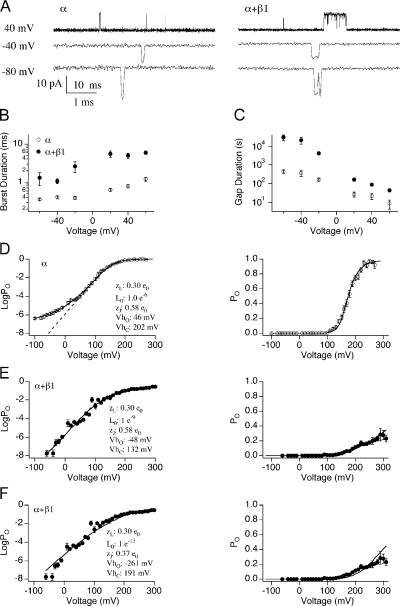
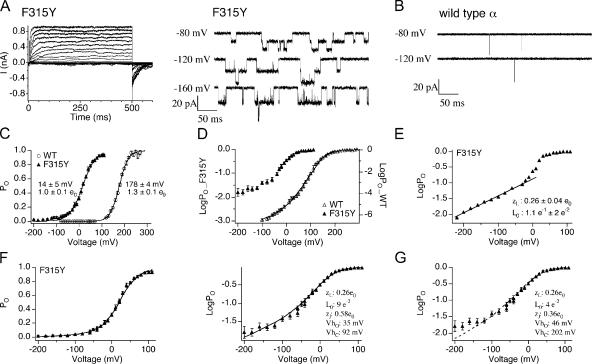
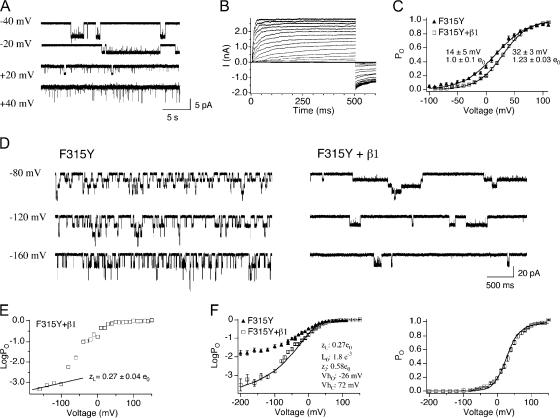
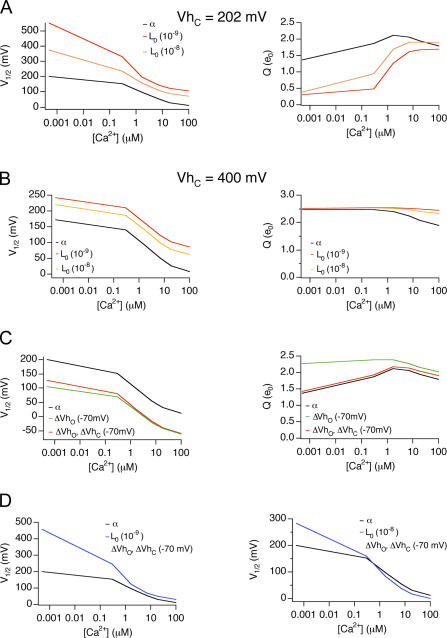
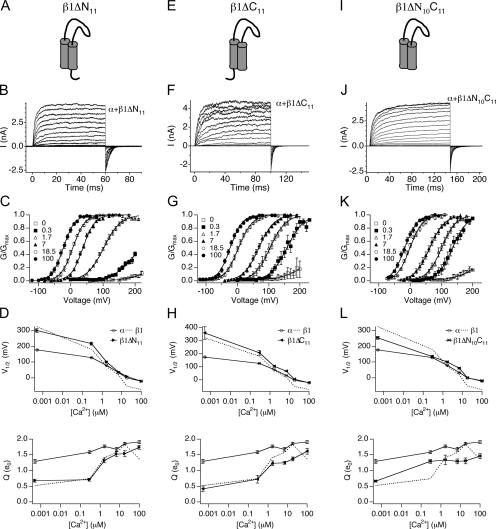
Large conductance, Ca(2+)- and voltage-activated K(+) (BK) channels are exquisitely regulated to suit their diverse roles in a large variety of physiological processes. BK channels are composed of pore-forming alpha subunits and a family of tissue-specific accessory beta subunits. The smooth muscle-specific beta1 subunit has an essential role in regulating smooth muscle contraction and modulates BK channel steady-state open probability and gating kinetics. Effects of beta1 on channel's gating energetics are not completely understood. One of the difficulties is that it has not yet been possible to measure the effects of beta1 on channel's intrinsic closed-to-open transition (in the absence of voltage sensor activation and Ca(2+) binding) due to the very low open probability in the presence of beta1. In this study, we used a mutation of the alpha subunit (F315Y) that increases channel openings by greater than four orders of magnitude to directly compare channels' intrinsic open probabilities in the presence and absence of the beta1 subunit. Effects of beta1 on steady-state open probabilities of both wild-type alpha and the F315Y mutation were analyzed using the dual allosteric HA model. We found that mouse beta1 has two major effects on channel's gating energetics. beta1 reduces the intrinsic closed-to-open equilibrium that underlies the inhibition of BK channel opening seen in submicromolar Ca(2+). Further, P(O) measurements at limiting slope allow us to infer that beta1 shifts open channel voltage sensor activation to negative membrane potentials, which contributes to enhanced channel opening seen at micromolar Ca(2+) concentrations. Using the F315Y alpha subunit with deletion mutants of beta1, we also demonstrate that the small N- and C-terminal intracellular domains of beta1 play important roles in altering channel's intrinsic opening and voltage sensor activation. In summary, these results demonstrate that beta1 has distinct effects on BK channel intrinsic gating and voltage sensor activation that can be functionally uncoupled by mutations in the intracellular domains.
大电导钙激活钾(BK)通道受到精确调控,以适应其在多种生理过程中的不同作用。BK通道由形成孔道的α亚基和一系列组织特异性辅助β亚基组成。平滑肌特异性β1亚基在调节平滑肌收缩中起关键作用,并调节BK通道的稳态开放概率和门控动力学。β1对通道门控能量学的影响尚未完全了解。困难之一在于,由于在存在β1的情况下开放概率非常低,尚未能够测量β1对通道内在的关闭到开放转变(在没有电压传感器激活和Ca²⁺结合的情况下)的影响。在本研究中,我们使用α亚基的一个突变(F315Y),该突变使通道开放增加超过四个数量级,以直接比较存在和不存在β1亚基时通道的内在开放概率。使用双变构HA模型分析了β1对野生型α和F315Y突变体的稳态开放概率的影响。我们发现小鼠β1对通道门控能量学有两个主要影响。β1降低了亚微摩尔Ca²⁺浓度下BK通道开放抑制所基于的内在关闭到开放平衡。此外,在极限斜率下的P(O)测量使我们能够推断,β1将开放通道电压传感器激活转移到负膜电位,这有助于在微摩尔Ca²⁺浓度下观察到的通道开放增强。使用带有β1缺失突变体的F315Yα亚基,我们还证明了β1的小N端和C端细胞内结构域在改变通道内在开放和电压传感器激活方面起重要作用。总之,这些结果表明,β1对BK通道内在门控和电压传感器激活有不同影响,这些影响可以通过细胞内结构域的突变在功能上解偶联。