Bultink Irene E M, Hamann Dörte, Seelen Marc A, Hart Margreet H, Dijkmans Ben A C, Daha Mohamed R, Voskuyl Alexandre E
Department of Rheumatology, VU University Medical Center, Postbox 7057, Amsterdam 1007 MB, The Netherlands.
Arthritis Res Ther. 2006;8(6):R183. doi: 10.1186/ar2095.
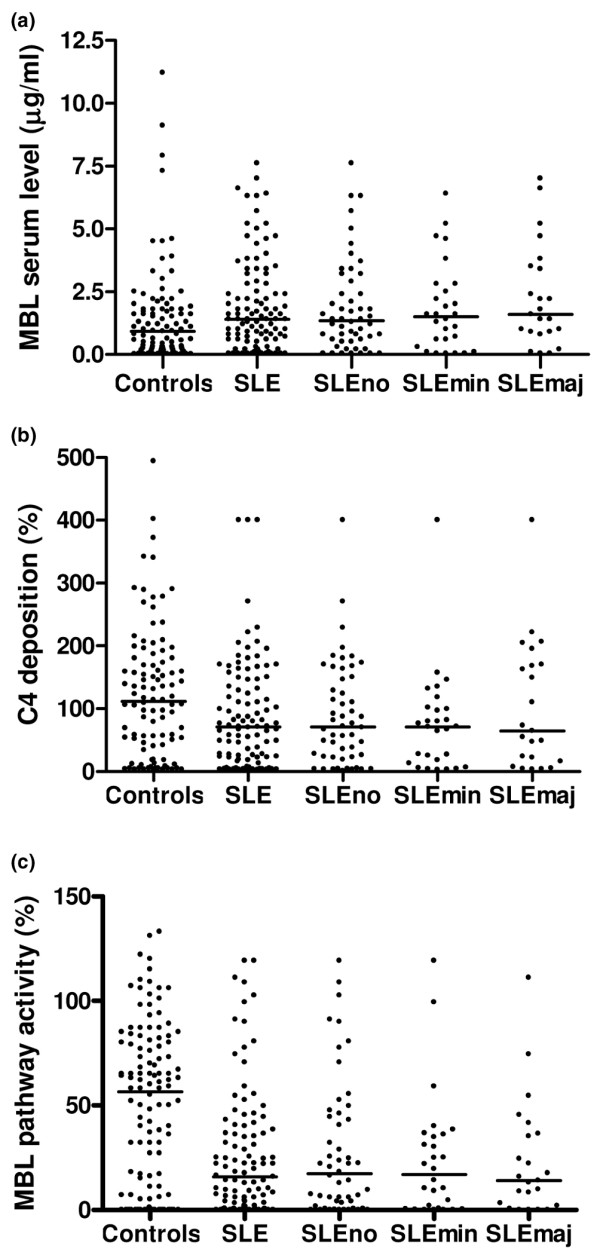
Infection imposes a serious burden on patients with systemic lupus erythematosus (SLE). The increased infection rate in SLE patients has been attributed in part to defects of immune defence. Recently, the lectin pathway of complement activation has also been suggested to play a role in the occurrence of infections in SLE. In previous studies, SLE patients homozygous for mannose-binding lectin (MBL) variant alleles were at an increased risk of acquiring serious infections in comparison with patients who were heterozygous or homozygous for the normal allele. This association suggests a correlation between functional MBL level and occurrence of infections in SLE patients. We therefore investigated the biological activity of MBL and its relationship with the occurrence of infections in patients with SLE. Demographic and clinical data were collected in 103 patients with SLE. Functional MBL serum levels and MBL-induced C4 deposition were measured by enzyme-linked immunosorbent assay using mannan as coat and an MBL- or C4b-specific monoclonal antibody. The complete MBL-dependent pathway activity was determined by using an assay that measures the complete MBL pathway activity in serum, starting with binding of MBL to mannan, and was detected with a specific monoclonal antibody against C5b-9. Charts were systematically reviewed to obtain information on documented infections since diagnosis of SLE. Major infections were defined as infections requiring hospital admission and intravenous administration of antibiotics. In total, 115 infections since diagnosis of lupus, including 42 major infections, were documented in the 103 SLE patients (mean age 41 +/- 13 years, mean disease duration 7 +/- 4 years). The percentage of SLE patients with severe MBL deficiency was similar to that in 100 healthy controls: 13% versus 14%, respectively. Although deposition of C4 to mannan and MBL pathway activity were reduced in 21% and 43% of 103 SLE patients, respectively, neither functional MBL serum levels nor MBL pathway activity was associated with infections or major infections in regression analyses. In conclusion, SLE patients frequently suffer from infections, but deficiency of functional MBL does not confer additional risk.
感染给系统性红斑狼疮(SLE)患者带来了沉重负担。SLE患者感染率增加部分归因于免疫防御缺陷。最近,补体激活的凝集素途径也被认为在SLE患者感染的发生中起作用。在先前的研究中,与正常等位基因杂合或纯合的患者相比,甘露糖结合凝集素(MBL)变异等位基因纯合的SLE患者发生严重感染的风险增加。这种关联表明功能性MBL水平与SLE患者感染的发生之间存在相关性。因此,我们研究了MBL的生物活性及其与SLE患者感染发生的关系。收集了103例SLE患者的人口统计学和临床数据。使用甘露聚糖作为包被以及MBL或C4b特异性单克隆抗体,通过酶联免疫吸附测定法测量功能性MBL血清水平和MBL诱导的C4沉积。通过使用一种测定血清中完整MBL途径活性的方法来确定完整的MBL依赖性途径活性,该方法从MBL与甘露聚糖的结合开始,并使用针对C5b - 9的特异性单克隆抗体进行检测。系统地查阅病历以获取自SLE诊断以来记录的感染信息。主要感染定义为需要住院并静脉注射抗生素的感染。在这103例SLE患者(平均年龄41±13岁,平均病程7±4年)中,自狼疮诊断以来共记录了115次感染,包括42次主要感染。严重MBL缺陷的SLE患者百分比与100名健康对照者相似:分别为(13%)和(14%)。尽管在103例SLE患者中,分别有(21%)和(43%)的患者C4与甘露聚糖的沉积以及MBL途径活性降低,但在回归分析中,功能性MBL血清水平和MBL途径活性均与感染或主要感染无关。总之,SLE患者经常遭受感染,但功能性MBL缺乏并不会带来额外风险。