Wong J T, Kim P T W, Peacock J W, Yau T Y, Mui A L-F, Chung S W, Sossi V, Doudet D, Green D, Ruth T J, Parsons R, Verchere C B, Ong C J
The Prostate Centre at Vancouver General Hospital, Vancouver Coastal Health Research Institute, 2660 Oak Street, Vancouver, BC, Canada V6H 3Z6.
Diabetologia. 2007 Feb;50(2):395-403. doi: 10.1007/s00125-006-0531-x. Epub 2006 Dec 29.
AIMS/HYPOTHESIS: Insulin controls glucose metabolism via multiple signalling pathways, including the phosphatidylinositol 3-kinase (PI3K) pathway in muscle and adipose tissue. The protein/lipid phosphatase Pten (phosphatase and tensin homologue deleted on chromosome 10) attenuates PI3K signalling by dephosphorylating the phosphatidylinositol 3,4,5-trisphosphate generated by PI3K. The current study was aimed at investigating the effect of haploinsufficiency for Pten on insulin-stimulated glucose uptake.
Insulin sensitivity in Pten heterozygous (Pten(+/-)) mice was investigated in i.p. insulin challenge and glucose tolerance tests. Glucose uptake was monitored in vitro in primary cultures of myocytes from Pten(+/-) mice, and in vivo by positron emission tomography. The phosphorylation status of protein kinase B (PKB/Akt), a downstream signalling protein in the PI3K pathway, and glycogen synthase kinase 3beta (GSK3beta), a substrate of PKB/Akt, was determined by western immunoblotting.
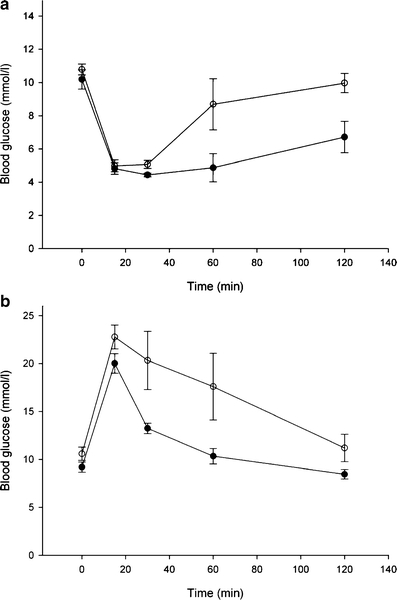
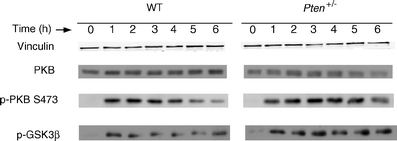
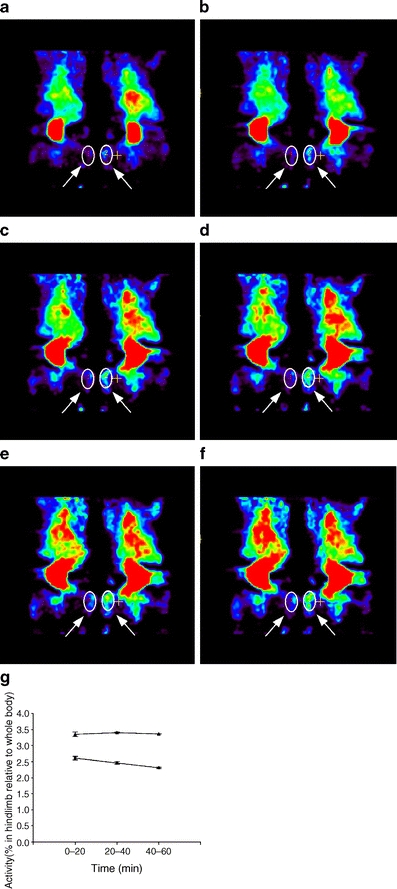
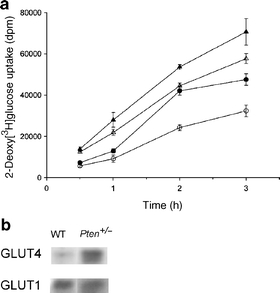
Following i.p. insulin challenge, blood glucose levels in Pten(+/-) mice remained depressed for up to 120 min, whereas glucose levels in wild-type mice began to recover after approximately 30 min. After glucose challenge, blood glucose returned to normal about twice as rapidly in Pten(+/-) mice. Enhanced glucose uptake was observed both in Pten(+/-) myocytes and in skeletal muscle of Pten(+/-) mice by PET. PKB and GSK3beta phosphorylation was enhanced and prolonged in Pten(+/-) myocytes.
CONCLUSIONS/INTERPRETATION: Pten is a key negative regulator of insulin-stimulated glucose uptake in vitro and in vivo. The partial reduction of Pten due to Pten haploinsufficiency is enough to elicit enhanced insulin sensitivity and glucose tolerance in Pten(+/-) mice.
目的/假设:胰岛素通过多种信号通路控制葡萄糖代谢,包括肌肉和脂肪组织中的磷脂酰肌醇3激酶(PI3K)通路。蛋白质/脂质磷酸酶Pten(第10号染色体缺失的磷酸酶和张力蛋白同源物)通过使PI3K产生的磷脂酰肌醇3,4,5-三磷酸去磷酸化来减弱PI3K信号传导。本研究旨在调查Pten单倍剂量不足对胰岛素刺激的葡萄糖摄取的影响。
在腹腔注射胰岛素激发试验和葡萄糖耐量试验中研究Pten杂合子(Pten(+/-))小鼠的胰岛素敏感性。在来自Pten(+/-)小鼠的原代心肌细胞培养物中体外监测葡萄糖摄取,并通过正电子发射断层扫描在体内进行监测。通过蛋白质免疫印迹法测定PI3K通路中的下游信号蛋白蛋白激酶B(PKB/Akt)和PKB/Akt的底物糖原合酶激酶3β(GSK3β)的磷酸化状态。
腹腔注射胰岛素激发后,Pten(+/-)小鼠的血糖水平在长达120分钟内持续降低,而野生型小鼠的血糖水平在约30分钟后开始恢复。葡萄糖激发后,Pten(+/-)小鼠的血糖恢复正常的速度约为野生型小鼠的两倍。通过PET观察到Pten(+/-)心肌细胞和Pten(+/-)小鼠的骨骼肌中的葡萄糖摄取均增强。Pten(+/-)心肌细胞中PKB和GSK3β的磷酸化增强且持续时间延长。
结论/解读:Pten是体外和体内胰岛素刺激的葡萄糖摄取的关键负调节因子。由于Pten单倍剂量不足导致的Pten部分减少足以在Pten(+/-)小鼠中引发增强的胰岛素敏感性和葡萄糖耐量。