School of Biological Sciences, University of Canterbury, Christchurch, New Zealand.
PLoS One. 2006 Dec 27;1(1):e125. doi: 10.1371/journal.pone.0000125.
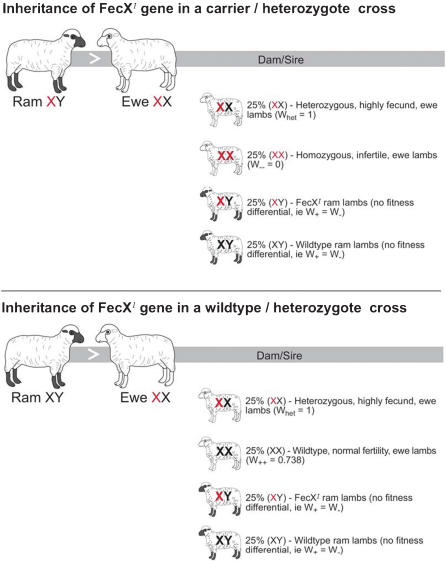
Heterozygote advantage, or overdominance, remains a popular and persuasive explanation for the maintenance of genetic variation in natural populations in the face of selection. However, despite being first proposed more than 80 years ago, there remain few examples that fit the criteria for heterozygote advantage, all of which are associated with disease resistance and are maintained only in the presence of disease or other gene-by-environment interaction. Here we report five new examples of heterozygote advantage, based around polymorphisms in the BMP15 and GDF9 genes that affect female fecundity in domesticated sheep and are not reliant on disease for their maintenance. Five separate mutations in these members of the transforming growth factor beta (TGFbeta) superfamily give phenotypes with fitness differentials characteristic of heterozygous advantage. In each case, one copy of the mutant allele increases ovulation rate, and ultimately litter size per ewe lambing, relative to the wildtype. However, homozygous ewes inheriting mutant alleles from both parents have impaired oocyte development and maturation, which results in small undeveloped ovaries and infertility. Using data collected over many years on ovulation rates, litter size, and lambing rates, we have calculated the equilibrium solution for each of these polymorphisms using standard population genetic theory. The predicted equilibrium frequencies obtained for these mutant alleles range from 0.11 to 0.23, which are amongst the highest yet reported for a polymorphism maintained by heterozygote advantage. These are amongst the most frequent and compelling examples of heterozygote advantage yet described and the first documented examples of heterozygote advantage that are not reliant on a disease interaction for their maintenance.
杂合优势,或超显性,仍然是一个流行且有说服力的解释,用于解释自然种群中遗传变异在面对选择时的维持。然而,尽管这个概念早在 80 多年前就被首次提出,但仍然很少有符合杂合优势标准的例子,所有这些例子都与疾病抗性有关,并且只有在存在疾病或其他基因与环境相互作用的情况下才得以维持。在这里,我们报告了五个新的杂合优势的例子,这些例子基于 BMP15 和 GDF9 基因的多态性,这些多态性影响着家养绵羊的雌性繁殖力,并且它们的维持并不依赖于疾病。这一家族转化生长因子β(TGFβ)超家族的五个不同成员的突变赋予了具有杂合优势特征的表型差异。在每种情况下,一个突变等位基因的拷贝都增加了排卵率,并最终增加了每只母羊的产仔数,与野生型相比。然而,从父母双方都遗传了突变等位基因的纯合母羊,其卵母细胞发育和成熟受损,导致卵巢小而未发育,不育。利用多年来收集的排卵率、产仔数和产羔率的数据,我们使用标准的群体遗传学理论,计算了这些多态性的平衡解。对于这些突变等位基因,预测的平衡频率范围从 0.11 到 0.23,这是迄今为止报道的维持杂合优势的多态性中最高的频率之一。这些是迄今为止描述的最频繁和最有说服力的杂合优势的例子,也是第一个被记录的不依赖于疾病相互作用来维持的杂合优势的例子。