Imboden Medea, Downs Sara H, Senn Oliver, Matyas Gabor, Brändli Otto, Russi Erich W, Schindler Christian, Ackermann-Liebrich Ursula, Berger Wolfgang, Probst-Hensch Nicole M
Institutes of Social and Preventive Medicine & Surgical Pathology, Molecular Epidemiology/Cancer Registry, University of Zurich & University Hospital Zurich, Switzerland.
Respir Res. 2007 Jan 11;8(1):2. doi: 10.1186/1465-9921-8-2.
Understanding the environmental and genetic risk factors of accelerated lung function decline in the general population is a first step in a prevention strategy against the worldwide increasing respiratory pathology of chronic obstructive pulmonary disease (COPD). Deficiency in antioxidative and detoxifying Glutathione S-transferase (GST) gene has been associated with poorer lung function in children, smokers and patients with respiratory diseases. In the present study, we assessed whether low activity variants in GST genes are also associated with accelerated lung function decline in the general adult population.
We examined with multiple regression analysis the association of polymorphisms in GSTM1, GSTT1 and GSTP1 genes with annual decline in FEV1, FVC, and FEF25-75 during 11 years of follow-up in 4686 subjects of the prospective SAPALDIA cohort representative of the Swiss general population. Effect modification by smoking, gender, bronchial hyperresponisveness and age was studied.
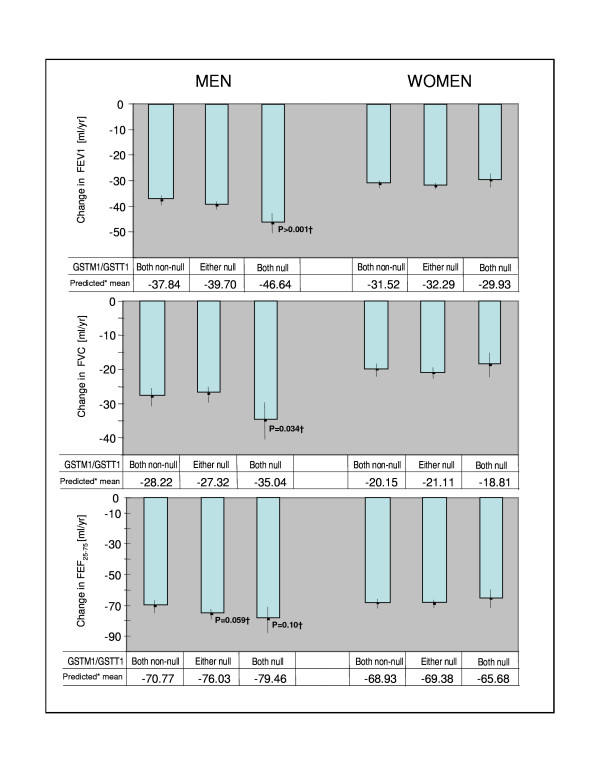
The associations of GST genotypes with FEV1, FVC, and FEF25-75 were comparable in direction, but most consistent for FEV1. GSTT1 homozygous gene deletion alone or in combination with GSTM1 homozygous gene deletion was associated with excess decline in FEV1 in men, but not women, irrespective of smoking status. The additional mean annual decline in FEV1 in men with GSTT1 and concurrent GSTM1 gene deletion was -8.3 ml/yr (95% confidence interval: -12.6 to -3.9) relative to men without these gene deletions. The GSTT1 effect on the FEV1 decline comparable to the observed difference in FEV1 decline between never and persistent smoking men. Effect modification by gender was statistically significant.
Our results suggest that genetic GSTT1 deficiency is a prevalent and strong determinant of accelerated lung function decline in the male general population.
了解普通人群肺功能加速下降的环境和遗传风险因素是预防全球慢性阻塞性肺疾病(COPD)这一不断增加的呼吸道疾病的第一步。抗氧化和解毒的谷胱甘肽S-转移酶(GST)基因缺陷与儿童、吸烟者及呼吸系统疾病患者较差的肺功能有关。在本研究中,我们评估了GST基因的低活性变异是否也与普通成年人群肺功能加速下降有关。
我们通过多元回归分析,在代表瑞士普通人群的4686名前瞻性SAPALDIA队列受试者的11年随访期间,研究了GSTM1、GSTT1和GSTP1基因多态性与FEV1、FVC和FEF25-75年下降率之间的关联。研究了吸烟、性别、支气管高反应性和年龄的效应修饰作用。
GST基因型与FEV1、FVC和FEF25-75的关联方向相似,但在FEV1方面最为一致。单独的GSTT1纯合基因缺失或与GSTM1纯合基因缺失联合,与男性(而非女性)FEV1的过度下降有关,无论吸烟状况如何。相对于没有这些基因缺失的男性,同时存在GSTT1和GSTM1基因缺失的男性FEV1每年额外下降-8.3 ml/年(95%置信区间:-12.6至-3.9)。GSTT1对FEV1下降的影响与从不吸烟和持续吸烟男性之间观察到的FEV1下降差异相当。性别效应修饰具有统计学意义。
我们的结果表明,遗传性GSTT1缺乏是男性普通人群肺功能加速下降的一个普遍且重要的决定因素。