Harrigan Jeanine A, Fan Jinshui, Momand Jamil, Perrino Fred W, Bohr Vilhelm A, Wilson David M
Laboratory of Molecular Gerontology, National Institute on Aging, National Institutes of Health, Baltimore, MD 21224, United States.
Mech Ageing Dev. 2007 Mar;128(3):259-66. doi: 10.1016/j.mad.2006.12.005. Epub 2006 Dec 20.
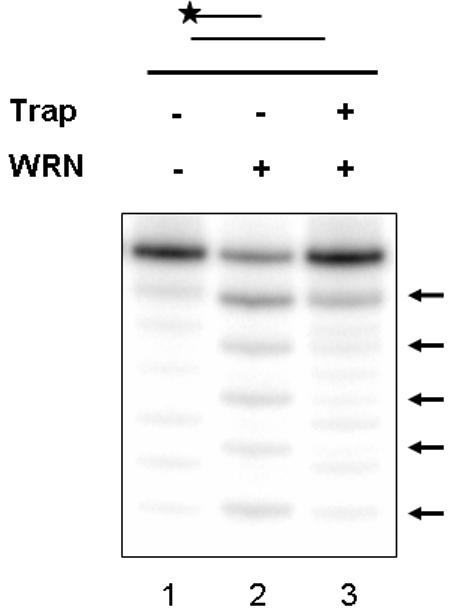
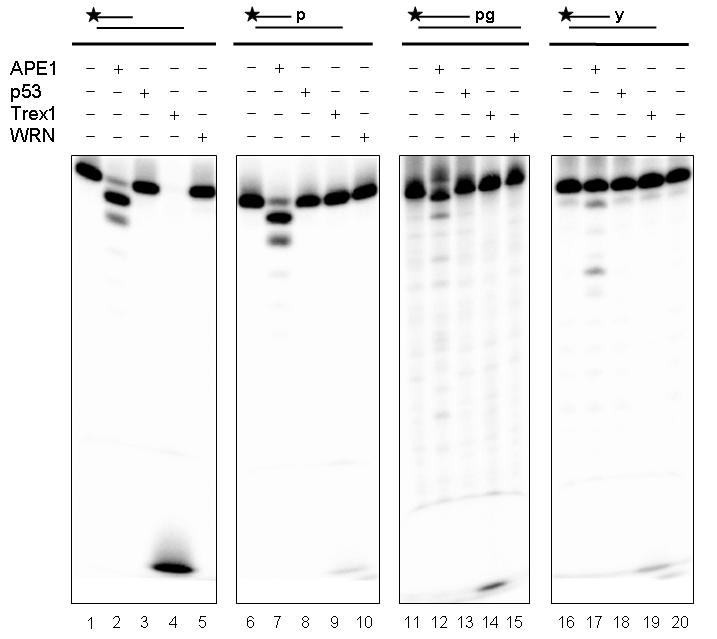
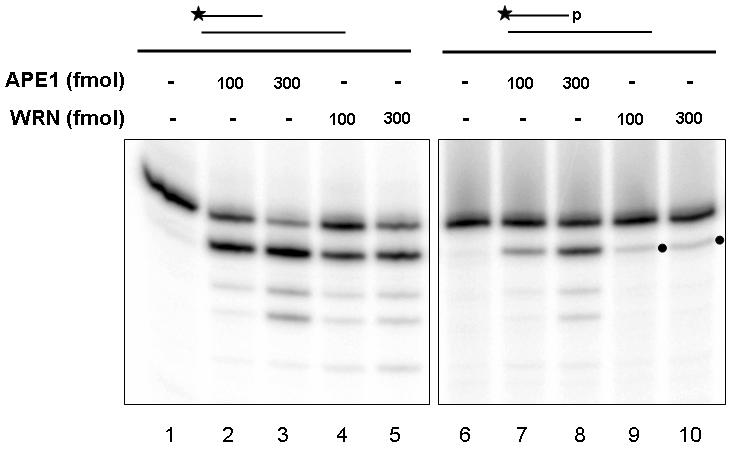
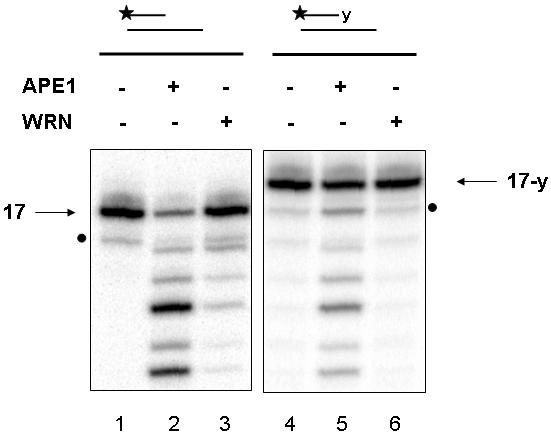
Reactive oxygen species, generated either by cellular respiration or upon exposure to environmental agents such as ionizing radiation (IR), attack DNA to form a variety of oxidized base and sugar modifications. Accumulation of oxidative DNA damage has been associated with age-related disease as well as the aging process. Single-strand breaks harboring oxidative 3' obstructive termini, e.g. 3' phosphates and 3' phosphoglycolates, must be removed prior to DNA repair synthesis or ligation. In addition, 3' tyrosyl-linked protein damage, resulting from therapeutic agents such as camptothecin (CPT), must be processed to initiate repair. Several nucleases participate in DNA repair and the excision of 3' obstructive ends. As the protein defective in the segmental progeroid Werner syndrome (WRN) possesses 3'-5' exonuclease activity, and Werner syndrome cells are hypersensitive to IR and CPT, we examined for WRN exonuclease activity on 3' blocking lesions. Moreover, we compared side-by-side the activity of four prominent human 3'-5' exonucleases (WRN, APE1, TREX1, and p53) on substrates containing 3' phosphates, phosphoglycolates, and tyrosyl residues. Our studies reveal that while WRN degrades 3' hydroxyl containing substrates in a non-processive manner, it does not excise 3' phosphate, phosphoglycolate, or tyrosyl groups. In addition, we found that APE1 was most active at excising 3' blocking termini in comparison to the disease-related exonucleases TREX1, WRN, and p53 under identical physiological reaction conditions, and that TREX1 was the most powerful 3'-5' exonuclease on undamaged oligonucleotide substrates.
活性氧由细胞呼吸产生,或在暴露于环境因素(如电离辐射(IR))时产生,会攻击DNA,形成各种氧化碱基和糖修饰。氧化性DNA损伤的积累与年龄相关疾病以及衰老过程有关。在DNA修复合成或连接之前,必须去除含有氧化性3'阻塞末端(如3'磷酸和3'磷酸乙醇酸)的单链断裂。此外,由喜树碱(CPT)等治疗剂导致的3'酪氨酰连接的蛋白质损伤,必须进行处理才能启动修复。几种核酸酶参与DNA修复和3'阻塞末端的切除。由于节段性早老性沃纳综合征(WRN)中存在缺陷的蛋白质具有3'-5'核酸外切酶活性,且沃纳综合征细胞对IR和CPT高度敏感,我们检测了WRN核酸外切酶对3'阻断损伤的活性。此外,我们还并排比较了四种主要的人类3'-5'核酸外切酶(WRN、APE1、TREX1和p53)对含有3'磷酸、磷酸乙醇酸和酪氨酰残基的底物的活性。我们的研究表明,虽然WRN以非连续方式降解含有3'羟基的底物,但它不会切除3'磷酸、磷酸乙醇酸或酪氨酰基团。此外,我们发现,在相同的生理反应条件下,与疾病相关的核酸外切酶TREX1、WRN和p53相比,APE1在切除3'阻断末端方面最具活性,并且TREX1在未受损的寡核苷酸底物上是最强大的3'-5'核酸外切酶。