Nakano Y, Tanno S, Koizumi K, Nishikawa T, Nakamura K, Minoguchi M, Izawa T, Mizukami Y, Okumura T, Kohgo Y
Third Department of Internal Medicine, Asahikawa Medical College, Asahikawa, Japan.
Br J Cancer. 2007 Feb 12;96(3):457-63. doi: 10.1038/sj.bjc.6603559. Epub 2007 Jan 16.
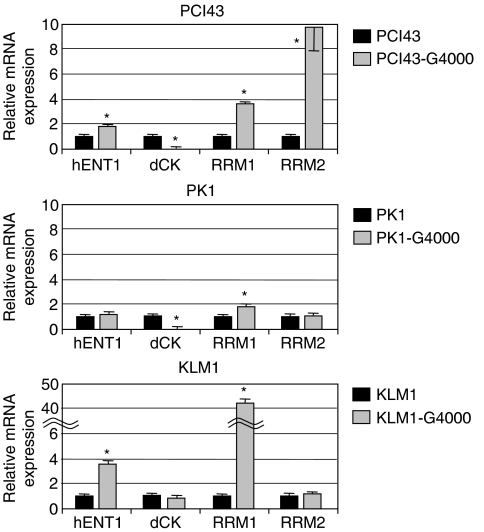
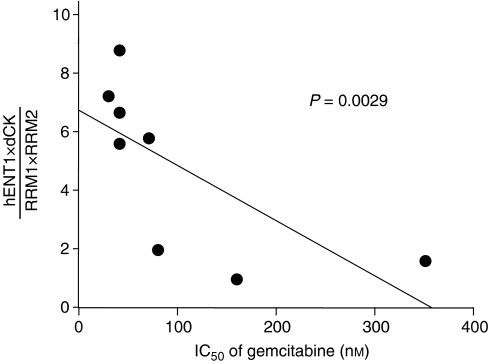
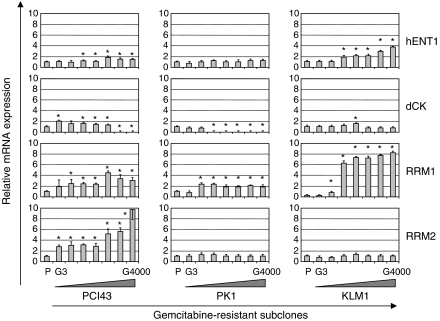
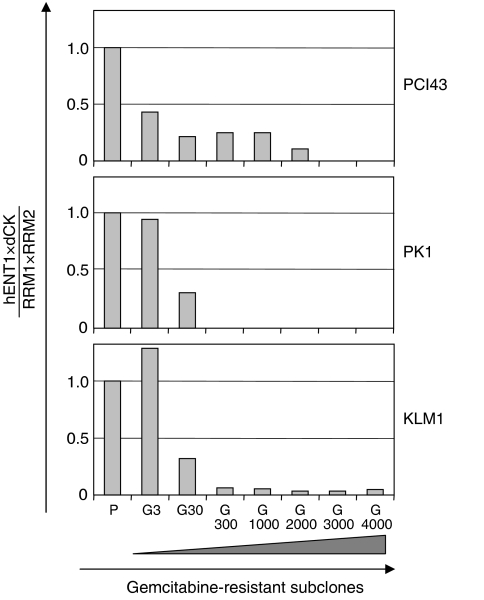
To identify predictive molecular markers for gemcitabine resistance, we investigated changes in the expression of four genes associated with gemcitabine transport and metabolism during the development of acquired gemcitabine resistance of pancreatic cancer cell lines. The expression levels of human equilibrative nucleoside transporter-1 (hENT1), deoxycytidine kinase (dCK), RRM1, and RRM2 mRNA were analysed by real-time light cycler-PCR in various subclones during the development of acquired resistance to gemcitabine. Real-time light cycler-PCR demonstrated that the expression levels of either RRM1 or RRM2 progressively increased during the development of gemcitabine resistance. Expression of dCK was slightly increased in cells resistant to lower concentrations of gemcitabine, but was decreased below the undetectable level in higher concentration-resistant subclones. Expression of hENT1 was increased in the development of gemcitabine resistance. As acquired resistance to gemcitabine seems to correlate with the balance of these four factors, we calculated the ratio of hENT1 x dCK/RRM1 x RRM2 gene expression in gemcitabine-resistant subclones. The ratio of gene expression decreased progressively with development of acquired resistance in gemcitabine-resistant subclones. Furthermore, the expression ratio significantly correlated with gemcitabine sensitivity in eight pancreatic cancer cell lines, whereas no single gene expression level correlated with the sensitivity. These results suggest that the sensitivity of pancreatic cancer cells to gemcitabine is determined by the ratio of four factors involved in gemcitabine transport and metabolism. The ratio of the four gene expression levels correlates with acquired gemcitabine-resistance in pancreatic cancer cells, and may be useful as a predictive marker for the efficacy of gemcitabine therapy in pancreatic cancer patients.
为了鉴定吉西他滨耐药的预测性分子标志物,我们研究了胰腺癌细胞系获得性吉西他滨耐药过程中与吉西他滨转运和代谢相关的四个基因表达的变化。在吉西他滨获得性耐药的发展过程中,通过实时荧光定量PCR分析了人平衡核苷转运体-1(hENT1)、脱氧胞苷激酶(dCK)、RRM1和RRM2 mRNA在各种亚克隆中的表达水平。实时荧光定量PCR表明,在吉西他滨耐药的发展过程中,RRM1或RRM2的表达水平逐渐升高。dCK的表达在对较低浓度吉西他滨耐药的细胞中略有增加,但在对较高浓度耐药的亚克隆中降至不可检测水平以下。hENT1的表达在吉西他滨耐药的发展过程中增加。由于对吉西他滨的获得性耐药似乎与这四个因素的平衡相关,我们计算了吉西他滨耐药亚克隆中hENT1×dCK/RRM1×RRM2基因表达的比值。在吉西他滨耐药亚克隆中,随着获得性耐药的发展,基因表达比值逐渐降低。此外,该表达比值与八个胰腺癌细胞系中的吉西他滨敏感性显著相关,而单个基因表达水平与敏感性无关。这些结果表明,胰腺癌细胞对吉西他滨的敏感性由参与吉西他滨转运和代谢的四个因素的比值决定。这四个基因表达水平的比值与胰腺癌细胞中获得性吉西他滨耐药相关,可能作为胰腺癌患者吉西他滨治疗疗效的预测标志物。