Guerin Philippe J, Grais Rebecca Freeman, Rottingen John Arne, Valleron Alain Jacques
Division of Infectious Disease Control, Norwegian Institute of Public Health, Oslo, Norway.
BMC Public Health. 2007 Jan 19;7:8. doi: 10.1186/1471-2458-7-8.
The volume, extent and speed of travel have dramatically increased in the past decades, providing the potential for an infectious disease to spread through the transportation network. By collecting information on the suspected place of infection, existing surveillance systems in industrialized countries may provide timely information for areas of the world without adequate surveillance currently in place. We present the results of a case study using reported cases of Shigella dysenteriae serotype 1 (Sd1) in European travellers to detect "events" of Sd1, related to either epidemic cases or endemic cases in developing countries.
We identified papers from a Medline search for reported events of Sd1 from 1940 to 2002. We requested data on shigella infections reported to the responsible surveillance entities in 17 European countries. Reports of Sd1 from the published literature were then compared with Sd1 notified cases among European travellers from 1990 to 2002.
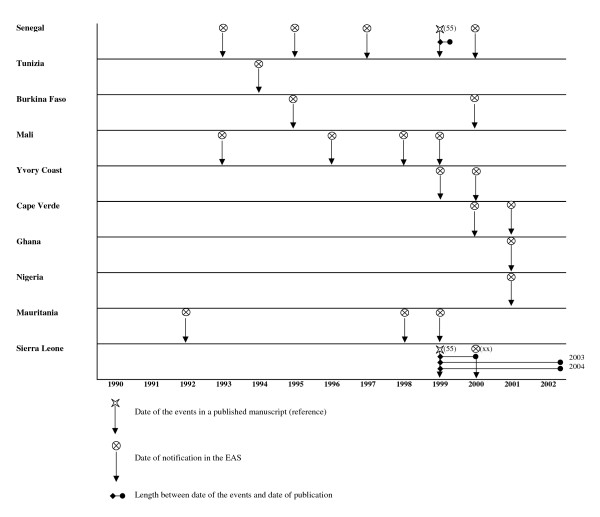
Prior to a large epidemic in 1999-2000, no cases of Sd1 had been identified in West Africa. However, if travellers had been used as an early warning, Sd1 could have been identified in this region as earlier as 1992.
This project demonstrates that tracking diseases in European travellers could be used to detect emerging disease in developing countries. This approach should be further tested with a view to the continuous improvement of national health surveillance systems and existing European networks, and may play a significant role in aiding the international public health community to improve infectious disease control.
在过去几十年中,旅行的规模、范围和速度都急剧增加,这为传染病通过交通网络传播提供了可能性。通过收集有关疑似感染地点的信息,工业化国家现有的监测系统可能为目前没有充分监测的世界其他地区及时提供信息。我们展示了一项案例研究的结果,该研究利用欧洲旅行者中报告的痢疾志贺菌1型(Sd1)病例来检测与发展中国家的流行病病例或地方病病例相关的Sd1“事件”。
我们通过对1940年至2002年期间报告的Sd1事件进行医学文献检索来确定相关论文。我们向17个欧洲国家负责监测的实体索取了志贺菌感染的数据。然后将已发表文献中的Sd1报告与1990年至2002年期间欧洲旅行者中通报的Sd1病例进行比较。
在1999 - 2000年的一次大流行之前,西非未发现Sd1病例。然而,如果将旅行者作为早期预警,早在1992年就可能在该地区发现Sd1。
该项目表明,追踪欧洲旅行者中的疾病可用于检测发展中国家出现的疾病。应进一步测试这种方法,以持续改进国家卫生监测系统和现有的欧洲网络,并且可能在帮助国际公共卫生界改善传染病控制方面发挥重要作用。