Nygård Mari, Daltveit Anne-Kjersti, Thoresen Steinar O, Nygård Jan F
Department of Screening-based Research, The Cancer Registry of Norway, Oslo, Norway.
BMC Health Serv Res. 2007 Jan 23;7:10. doi: 10.1186/1472-6963-7-10.
Almost one-third of Norwegian women aged 25-69 years invited to have a Pap smear do not attend during the recommended period, and thus constitute a population with high-risk of cervical cancer (CC). Since the incidence of precancerous lesions of the cervix peak with occurrence of pregnancies within the same decade in women aged 25 to 35 years of age, antepartum care presents an opportunity to offer a Pap smear thereby increasing the coverage of the programme. The study objective was to describe the effect of the antepartum Pap smear on the coverage of a cytological CC screening programme.
Among 2 175 762 women resident in Norway in 31.12.1996, all women who gave birth in 1996-7 were identified from the Medical Birth Registry of Norway. Attendance to the cervical cancer screening was assessed by linkage to the Cytology Registry separately for the pregnant and non-pregnant women cohorts. The results were stratified by age, history of previous Pap smear and history of invitation to the CC screening programme. Logistic regression was used to estimate the relative probabilities of having a Pap smear adjusted for age, screening history, and time since invitation, for pregnant and non-pregnant women, respectively.
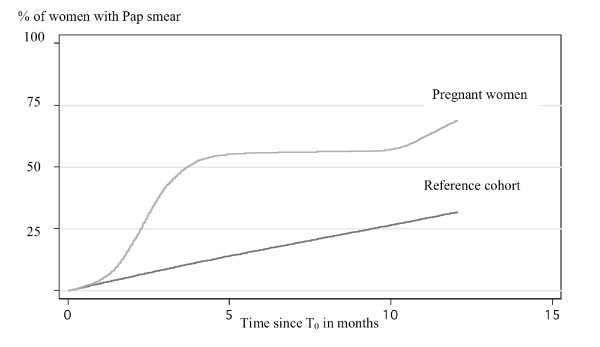
69% of the pregnant women had a Pap smear during one year of follow-up since beginning of the pregnancy with the majority taken during the antepartum period. Irrespectively of age or history of having a Pap smear, pregnant women were 4.3 times more likely to have a Pap smear during follow-up compared to non-pregnant women. 63.2% of the pregnant women had a smear as response to the invitation letter compared to 28.7% of the non-pregnant women, OR = 2.1 (95% CI 1.9 to 2.4). As an indication of "over-screening", 5397 pregnant women (57.8%) with a smear shortly before the start of follow-up also had a new Papsmear, compared to 83 023 (32.3%) in non-pregnant.
Pap smear screening during pregnancy increases the coverage of the CC screening programme. The contribution of the antepartum Pap smear to "over-screening" exists but its effect is modest in countries where women on average become pregnant after the start of recommended age of screening.
在受邀进行巴氏涂片检查的25 - 69岁挪威女性中,近三分之一的人在推荐时间内未接受检查,因此这部分人群患宫颈癌(CC)的风险很高。由于25至35岁女性宫颈前病变的发病率在同一十年内随着怀孕次数达到峰值,产前检查提供了一个进行巴氏涂片检查的机会,从而提高该项目的覆盖率。本研究的目的是描述产前巴氏涂片检查对细胞学CC筛查项目覆盖率的影响。
在1996年12月31日居住在挪威的2175762名女性中,从挪威医疗出生登记处识别出所有在1996 - 1997年分娩的女性。通过与细胞学登记处的关联,分别对孕妇和非孕妇队列的宫颈癌筛查参与情况进行评估。结果按年龄、既往巴氏涂片检查史和CC筛查项目邀请史进行分层。采用逻辑回归分别估计孕妇和非孕妇在调整年龄、筛查史和自邀请以来的时间后进行巴氏涂片检查的相对概率。
69%的孕妇在怀孕开始后的一年随访期间进行了巴氏涂片检查,大多数是在产前阶段进行的。无论年龄或是否有巴氏涂片检查史,孕妇在随访期间进行巴氏涂片检查的可能性是非孕妇的4.3倍。63.2%的孕妇因邀请信而进行了涂片检查,相比之下,非孕妇为28.7%,比值比(OR)= 2.1(95%置信区间1.9至2.4)。作为“过度筛查”的一个指标,在随访开始前不久进行涂片检查的5397名孕妇(57.8%)也进行了新的巴氏涂片检查,相比之下,非孕妇中有83023名(32.3%)。
孕期巴氏涂片检查提高了CC筛查项目的覆盖率。产前巴氏涂片检查对“过度筛查”有一定影响,但在女性平均在推荐筛查年龄开始后才怀孕的国家,其影响较小。