Schmierer Klaus, Wheeler-Kingshott Claudia A M, Boulby Phil A, Scaravilli Francesco, Altmann Daniel R, Barker Gareth J, Tofts Paul S, Miller David H
Institute of Neurology, University College London, NMR Research Unit, Box 117, Queen Square, London WC1N 3BG, UK.
Neuroimage. 2007 Apr 1;35(2):467-77. doi: 10.1016/j.neuroimage.2006.12.010. Epub 2006 Dec 16.
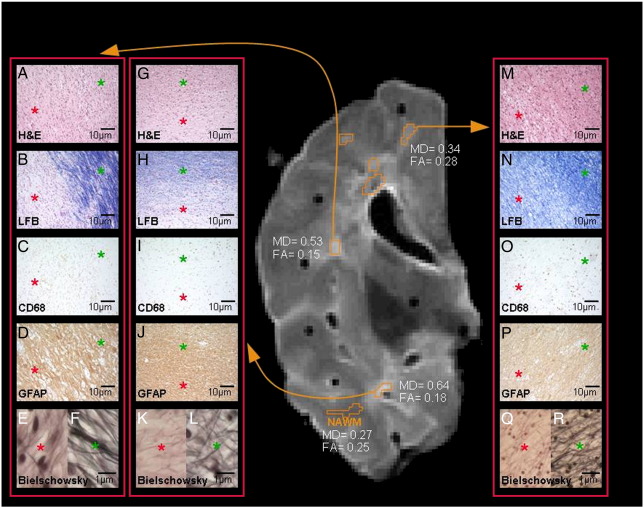
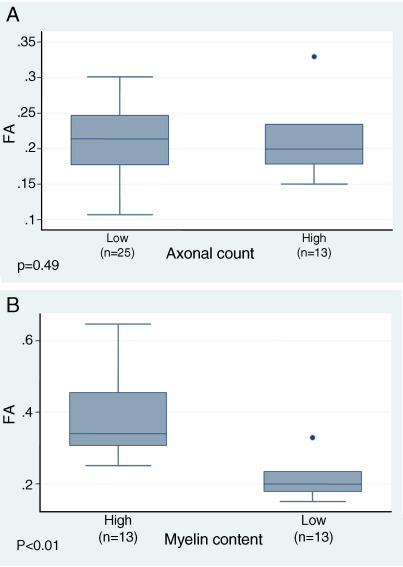
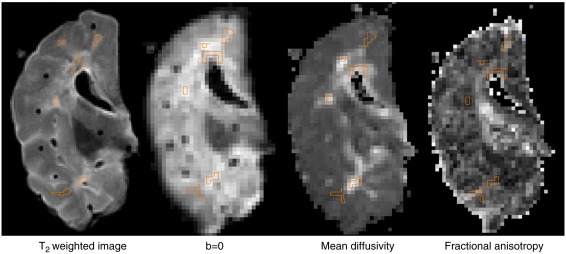
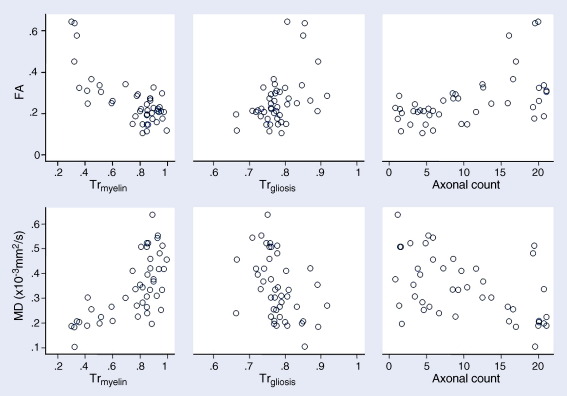
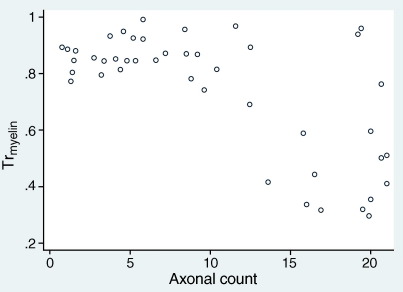
Magnetic resonance imaging (MRI) is being used to probe the central nervous system (CNS) of patients with multiple sclerosis (MS), a chronic demyelinating disease. Conventional T(2)-weighted MRI (cMRI) largely fails to predict the degree of patients' disability. This shortcoming may be due to poor specificity of cMRI for clinically relevant pathology. Diffusion tensor imaging (DTI) has shown promise to be more specific for MS pathology. In this study we investigated the association between histological indices of myelin content, axonal count and gliosis, and two measures of DTI (mean diffusivity [MD] and fractional anisotropy [FA]), in unfixed post mortem MS brain using a 1.5-T MR system. Both MD and FA were significantly lower in post mortem MS brain compared to published data acquired in vivo. However, the differences of MD and FA described in vivo between white matter lesions (WMLs) and normal-appearing white matter (NAWM) were retained in this study of post mortem brain: average MD in WMLs was 0.35x10(-3) mm(2)/s (SD, 0.09) versus 0.22 (0.04) in NAWM; FA was 0.22 (0.06) in WMLs versus 0.38 (0.13) in NAWM. Correlations were detected between myelin content (Tr(myelin)) and (i) FA (r=-0.79, p<0.001), (ii) MD (r=0.68, p<0.001), and (iii) axonal count (r=-0.81, p<0.001). Multiple regression suggested that these correlations largely explain the apparent association of axonal count with (i) FA (r=0.70, p<0.001) and (ii) MD (r=-0.66, p<0.001). In conclusion, this study suggests that FA and MD are affected by myelin content and - to a lesser degree - axonal count in post mortem MS brain.
磁共振成像(MRI)正被用于探测患有多发性硬化症(MS)的患者的中枢神经系统(CNS),多发性硬化症是一种慢性脱髓鞘疾病。传统的T(2)加权MRI(cMRI)在很大程度上无法预测患者的残疾程度。这一缺点可能是由于cMRI对临床相关病理的特异性较差。扩散张量成像(DTI)已显示出对MS病理更具特异性的前景。在本研究中,我们使用1.5-T MR系统,研究了未固定的死后MS脑内髓鞘含量、轴突计数和胶质增生的组织学指标与DTI的两项测量值(平均扩散率[MD]和分数各向异性[FA])之间的关联。与已发表的体内采集数据相比,死后MS脑内的MD和FA均显著降低。然而,在本死后脑研究中,保留了体内描述的白质病变(WMLs)和正常外观白质(NAWM)之间MD和FA的差异:WMLs中的平均MD为0.35×10(-3)mm(2)/s(标准差,0.09),而NAWM中的平均MD为0.22(0.04);WMLs中的FA为0.22(0.06),而NAWM中的FA为0.38(0.13)。在髓鞘含量(Tr(髓鞘))与(i)FA(r = -0.79,p < 0.001)、(ii)MD(r = 0.68,p < 0.001)和(iii)轴突计数(r = -0.81,p < 0.001)之间检测到相关性。多元回归表明,这些相关性在很大程度上解释了轴突计数与(i)FA(r = 0.70,p < 0.001)和(ii)MD(r = -0.66,p < 0.001)之间明显的关联。总之,本研究表明,在死后MS脑中,FA和MD受髓鞘含量影响,且在较小程度上受轴突计数影响。