Wright A C, Bataille H, Ong H H, Wehrli S L, Song H K, Wehrli F W
Laboratory for Structural NMR Imaging, Department of Radiology, 1 Silverstein, University of Pennsylvania Medical Center, 3400 Spruce Street, Philadelphia, PA 19104, USA.
J Magn Reson. 2007 May;186(1):17-25. doi: 10.1016/j.jmr.2007.01.011. Epub 2007 Jan 20.
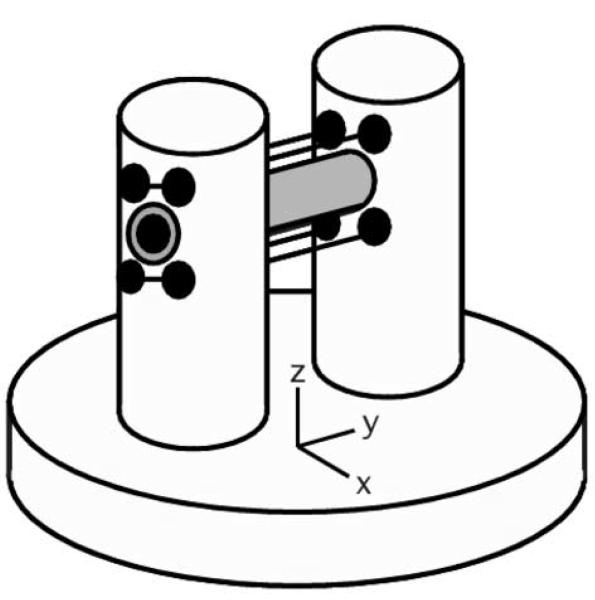
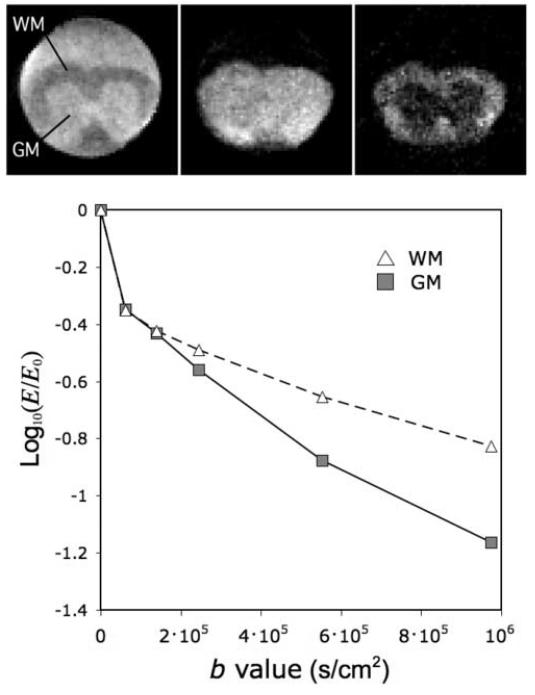
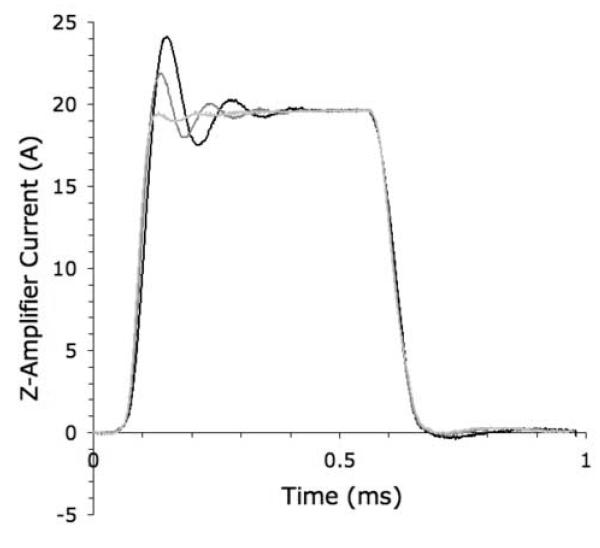
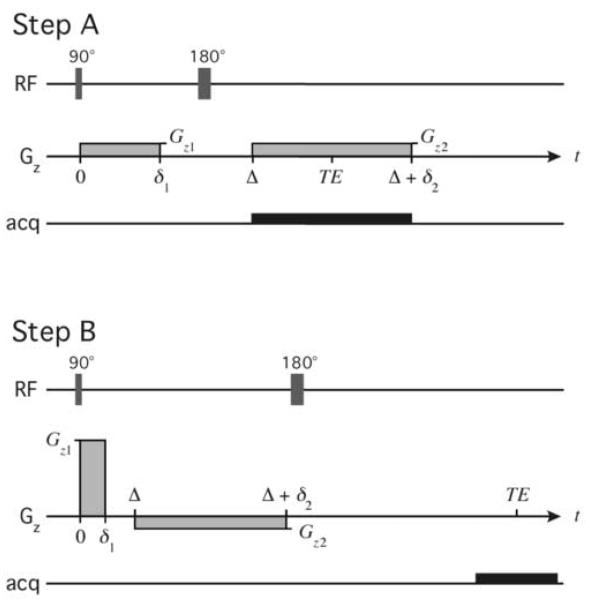
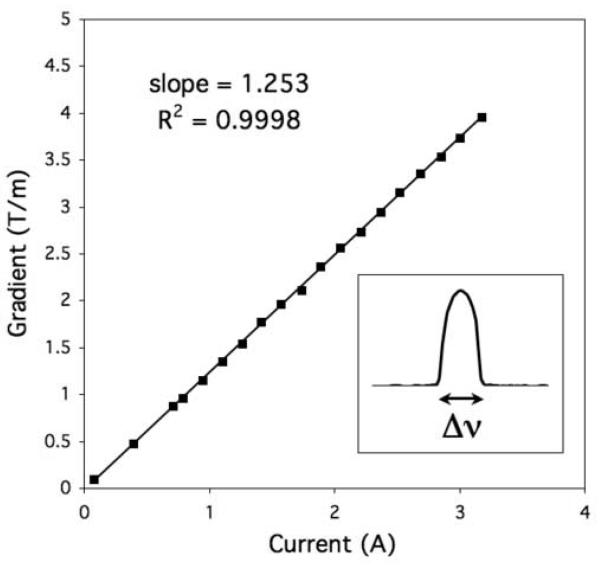
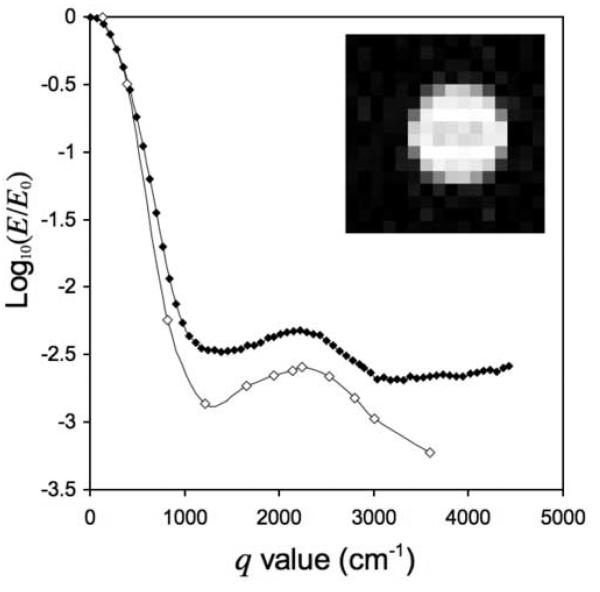
q-Space imaging is capable of providing quantitative geometrical information of structures at cellular resolution. However, the size of restrictions that can be probed hinges on available gradient amplitude and places very high demands on gradient performance. In this work we describe the design and construction of a small, high-amplitude (50 T/m) z-gradient coil, interfaced with a commercial 9.4 T microimaging system. We also describe a method to calibrate the coil for quantitative measurements of molecular diffusion at very high-gradient amplitudes. Calibration showed linear current response up to 50 T/m, with a gain=1.255 T/m/A. The z-gradient coil was combined with the commercial x- and y-gradients for tri-axial imaging, and its performance was demonstrated by ADC maps of free water and by q-space experiments on water sequestered around polystyrene microspheres (4.5 microm diameter), which showed the expected diffraction peak. In addition, diffusion-weighted images of a fixed mouse spinal cord illustrated the capability of this coil for quantitative imaging of tissue microstructure.
q空间成像能够在细胞分辨率下提供结构的定量几何信息。然而,可探测的限制尺寸取决于可用的梯度幅度,并且对梯度性能提出了非常高的要求。在这项工作中,我们描述了一种小型、高幅度(50 T/m)z梯度线圈的设计和构建,该线圈与商用9.4 T显微成像系统相连。我们还描述了一种在线圈在非常高的梯度幅度下对分子扩散进行定量测量的校准方法。校准显示,在高达50 T/m的情况下,电流响应呈线性,增益为1.255 T/m/A。z梯度线圈与商用x和y梯度相结合用于三轴成像,其性能通过自由水的表观扩散系数(ADC)图以及对围绕聚苯乙烯微球(直径4.5微米)的水进行的q空间实验得到了证明,实验显示出了预期的衍射峰。此外,固定小鼠脊髓的扩散加权图像说明了该线圈对组织微观结构进行定量成像的能力。