Andersen-Nissen Erica, Smith Kelly D, Bonneau Richard, Strong Roland K, Aderem Alan
Institute for Systems Biology, Seattle, WA 98103, USA.
J Exp Med. 2007 Feb 19;204(2):393-403. doi: 10.1084/jem.20061400. Epub 2007 Feb 5.
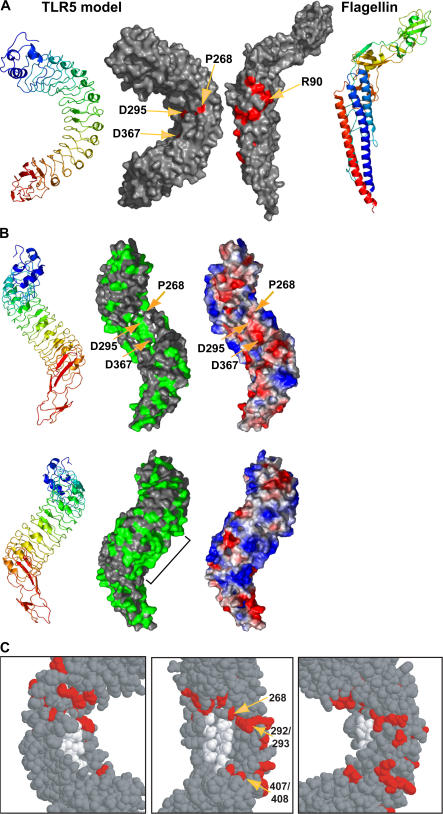
The molecular basis for Toll-like receptor (TLR) recognition of microbial ligands is unknown. We demonstrate that mouse and human TLR5 discriminate between different flagellins, and we use this difference to map the flagellin recognition site on TLR5 to 228 amino acids of the extracellular domain. Through molecular modeling of the TLR5 ectodomain, we identify two conserved surface-exposed regions. Mutagenesis studies demonstrate that naturally occurring amino acid variation in TLR5 residue 268 is responsible for human and mouse discrimination between flagellin molecules. Mutations within one conserved surface identify residues D295 and D367 as important for flagellin recognition. These studies localize flagellin recognition to a conserved surface on the modeled TLR5 structure, providing detailed analysis of the interaction of a TLR with its ligand. These findings suggest that ligand binding at the beta sheets results in TLR activation and provide a new framework for understanding TLR-agonist interactions.
Toll样受体(TLR)识别微生物配体的分子基础尚不清楚。我们证明,小鼠和人类的TLR5能够区分不同的鞭毛蛋白,并且利用这种差异将TLR5上的鞭毛蛋白识别位点定位到细胞外结构域的228个氨基酸上。通过对TLR5胞外结构域进行分子建模,我们确定了两个保守的表面暴露区域。诱变研究表明,TLR5第268位残基的天然氨基酸变异是人类和小鼠区分鞭毛蛋白分子的原因。一个保守表面内的突变确定了残基D295和D367对鞭毛蛋白识别很重要。这些研究将鞭毛蛋白识别定位到模拟的TLR5结构上的一个保守表面,为TLR与其配体的相互作用提供了详细分析。这些发现表明,β折叠处的配体结合导致TLR激活,并为理解TLR-激动剂相互作用提供了一个新框架。