Department of Biology, University of Ottawa, Ottawa, Canada.
PLoS One. 2007 Feb 7;2(2):e188. doi: 10.1371/journal.pone.0000188.
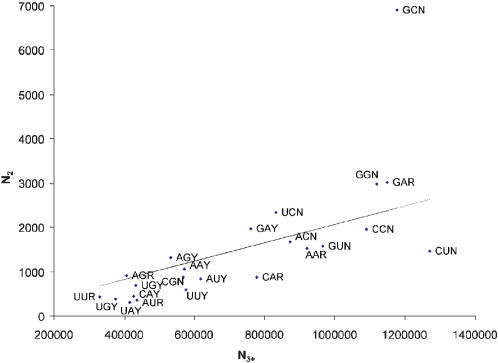
The optimal context for translation initiation in mammalian species is GCCRCCaugG (where R = purine and "aug" is the initiation codon), with the -3R and +4G being particularly important. The presence of +4G has been interpreted as necessary for efficient translation initiation. Accumulated experimental and bioinformatic evidence has suggested an alternative explanation based on amino acid constraint on the second codon, i.e., amino acid Ala or Gly are needed as the second amino acid in the nascent peptide for the cleavage of the initiator Met, and the consequent overuse of Ala and Gly codons (GCN and GGN) leads to the +4G consensus. I performed a critical test of these alternative hypotheses on +4G based on 34169 human protein-coding genes and published gene expression data. The result shows that the prevalence of +4G is not related to translation initiation. Among the five G-starting codons, only alanine codons (GCN), and glycine codons (GGN) to a much smaller extent, are overrepresented at the second codon, whereas the other three codons are not overrepresented. While highly expressed genes have more +4G than lowly expressed genes, the difference is caused by GCN and GGN codons at the second codon. These results are inconsistent with +4G being needed for efficient translation initiation, but consistent with the proposal of amino acid constraint hypothesis.
在哺乳动物中,翻译起始的最佳上下文是 GCCRCCaugG(其中 R 是嘌呤,“aug”是起始密码子),-3R 和 +4G 特别重要。+4G 的存在被解释为有效翻译起始的必要条件。积累的实验和生物信息学证据提出了一种替代解释,基于第二个密码子的氨基酸限制,即需要第二个密码子为新生肽中的 Ala 或 Gly,以裂解起始 Met,随后过度使用 Ala 和 Gly 密码子(GCN 和 GGN)导致 +4G 共识。我基于 34169 个人类蛋白质编码基因和已发表的基因表达数据,对这些替代 +4G 的假设进行了严格的测试。结果表明,+4G 的流行与翻译起始无关。在五个 G 起始密码子中,只有丙氨酸密码子(GCN)和甘氨酸密码子(GGN)在第二个密码子中过度表达,而其他三个密码子则没有过度表达。虽然高表达基因比低表达基因有更多的 +4G,但这种差异是由第二个密码子的 GCN 和 GGN 密码子引起的。这些结果与 +4G 对于有效翻译起始的必要性不一致,但与氨基酸限制假说的提出一致。