Jiang Qing, Freiser Helene, Wood Karl V, Yin Xinmin
Interdepartmental Nutrition Program, Purdue University, West Lafayette, IN 47907, USA.
J Lipid Res. 2007 May;48(5):1221-30. doi: 10.1194/jlr.D700001-JLR200. Epub 2007 Feb 13.
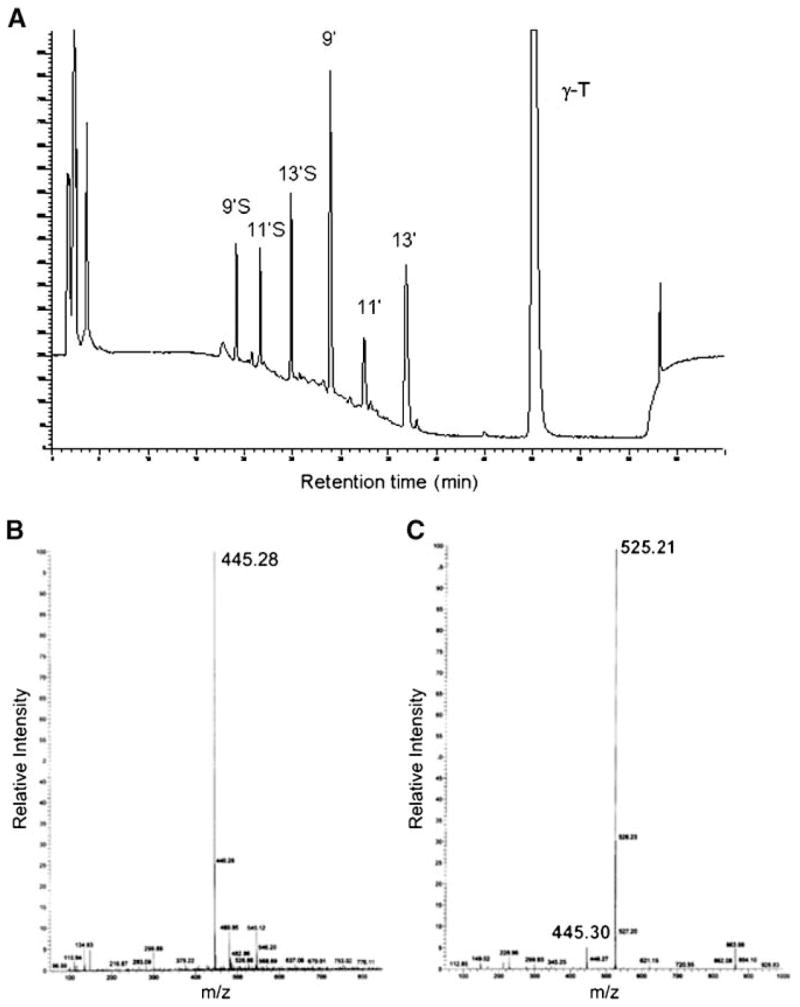
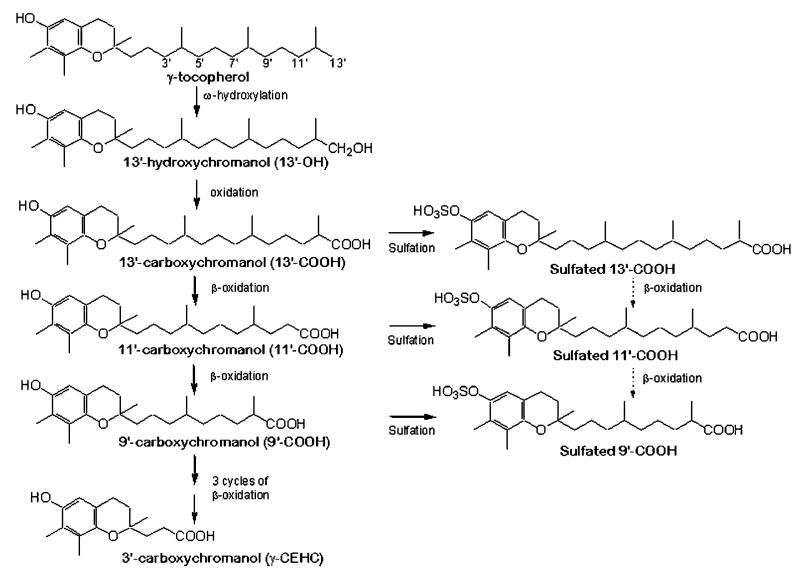
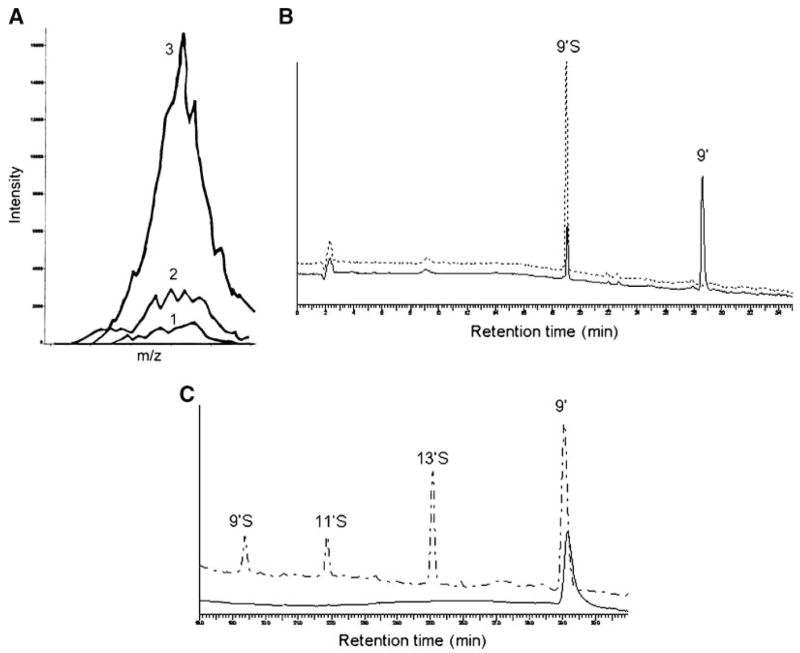
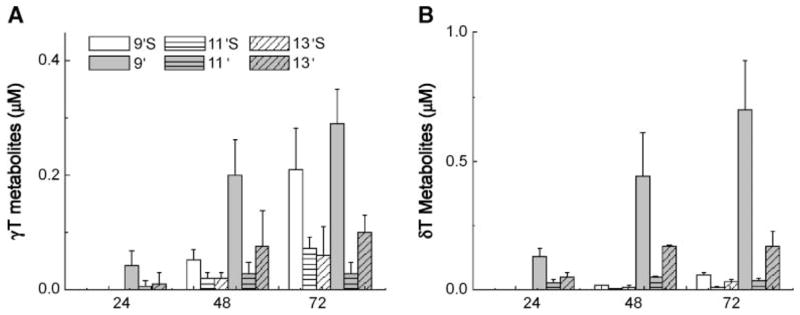
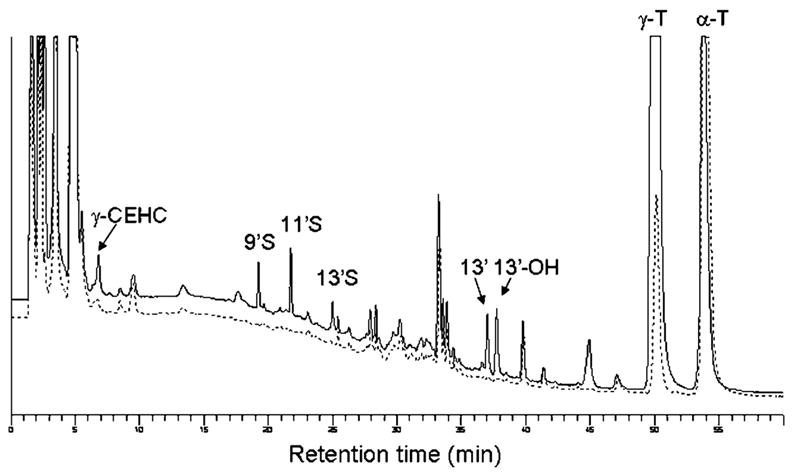
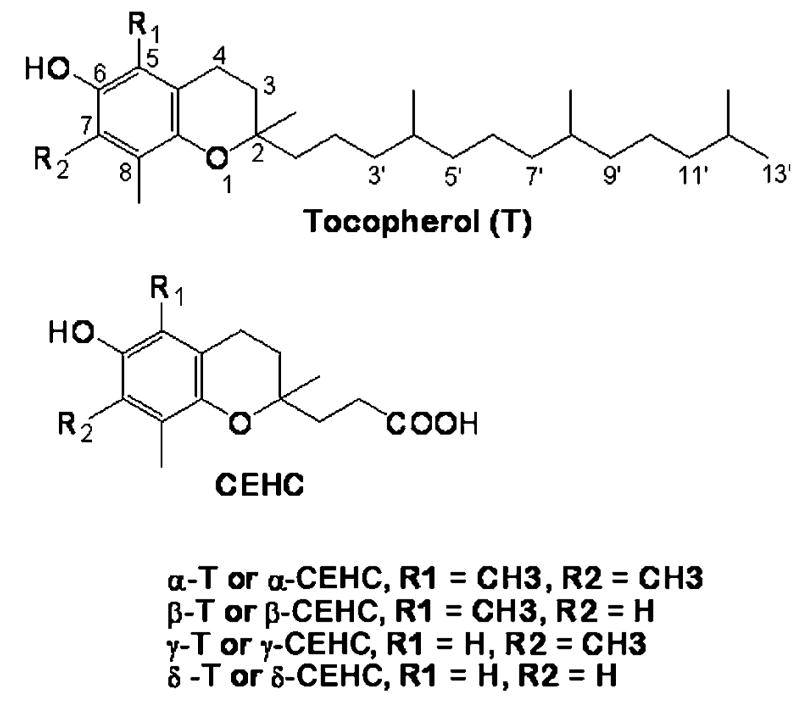
The metabolism of vitamin E involves oxidation of the phytyl chain to generate the terminal metabolite 7,8-dimethyl-2-(beta-carboxyethyl)-6-hydroxychroman (CEHC) via intermediate formation of 13'-hydroxychromanol and long-chain carboxychromanols. Conjugated (including sulfated) metabolites were reported previously but were limited to CEHCs. Here, using electrospray and inductively coupled plasma mass spectrometry, we discovered that gamma-tocopherol (gamma-T) and delta-T were metabolized to sulfated 9'-, 11'-, and 13'-carboxychromanol (9'S, 11'S, and 13'S) in human A549 cells. To further study the metabolites, we developed a HPLC assay with fluorescence detection that simultaneously analyzes sulfated and nonconjugated intermediate metabolites. Using this assay, we found that sulfated metabolites were converted to nonconjugated carboxychromanols by sulfatase digestion. In cultured cells, approximately 45% long-chain carboxychromanols from gamma-T but only 10% from delta-T were sulfated. Upon supplementation with gamma-T, rats had increased tissue levels of 9'S, 11'S, and 13'S, 13'-hydroxychromanol, 13'-carboxychromanol, and gamma-CEHC. The plasma concentrations of combined sulfated long-chain metabolites were comparable to or exceeded those of CEHCs and increased proportionally with the supplement dosages of gamma-T. Our study identifies sulfated long-chain carboxychromanols as novel vitamin E metabolites and provides evidence that sulfation may occur parallel with beta-oxidation. In addition, the HPLC fluorescence assay is a useful tool for the investigation of vitamin E metabolism.
维生素E的代谢过程包括植基链的氧化,通过13'-羟基色满醇和长链羧基色满醇的中间形成过程,生成终末代谢产物7,8-二甲基-2-(β-羧乙基)-6-羟基色满(CEHC)。之前报道过共轭(包括硫酸化)代谢产物,但仅限于CEHCs。在此,我们使用电喷雾和电感耦合等离子体质谱法发现,γ-生育酚(γ-T)和δ-T在人A549细胞中代谢为硫酸化的9'-、11'-和13'-羧基色满醇(9'S、11'S和13'S)。为了进一步研究这些代谢产物,我们开发了一种具有荧光检测功能的高效液相色谱法,可同时分析硫酸化和非共轭中间代谢产物。使用该方法,我们发现硫酸化代谢产物通过硫酸酯酶消化转化为非共轭羧基色满醇。在培养细胞中,γ-T产生的长链羧基色满醇约45%被硫酸化,而δ-T产生的仅10%被硫酸化。给大鼠补充γ-T后,其组织中9'S、11'S、13'S、13'-羟基色满醇、13'-羧基色满醇和γ-CEHC的水平升高。硫酸化长链代谢产物的血浆浓度与CEHCs相当或超过CEHCs,并随γ-T补充剂量成比例增加。我们的研究确定硫酸化长链羧基色满醇为新型维生素E代谢产物,并提供了硫酸化可能与β-氧化同时发生的证据。此外,高效液相色谱荧光分析法是研究维生素E代谢的有用工具。