Gonzalez Helena, Tarras-Wahlberg Nils, Strömdahl Birgitta, Juzeniene Asta, Moan Johan, Larkö Olle, Rosén Arne, Wennberg Ann-Marie
Department of Dermatology, Sahlgrenska University Hospital, SE-413 45 Göteborg, Sweden.
BMC Dermatol. 2007 Feb 26;7:1. doi: 10.1186/1471-5945-7-1.
Sunscreens are being widely used to reduce exposure to harmful ultraviolet (UV) radiation. The fact that some sunscreens are photounstable has been known for many years. Since the UV-absorbing ingredients of sunscreens may be photounstable, especially in the long wavelength region, it is of great interest to determine their degradation during exposure to UV radiation. Our aim was to investigate the photostability of seven commercial sunscreen products after natural UV exposure (UVnat) and artificial UV exposure (UVart).
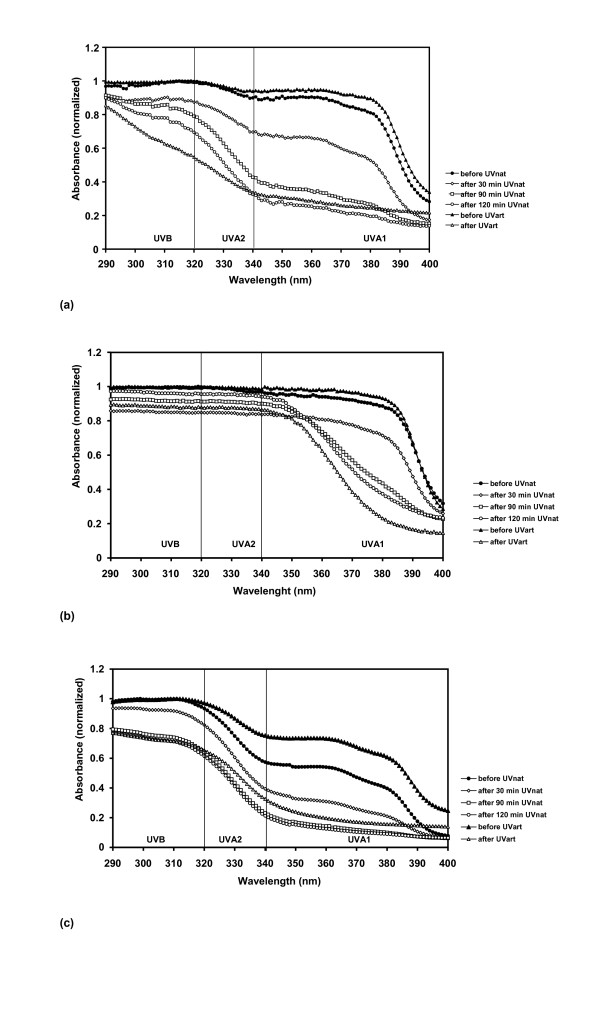
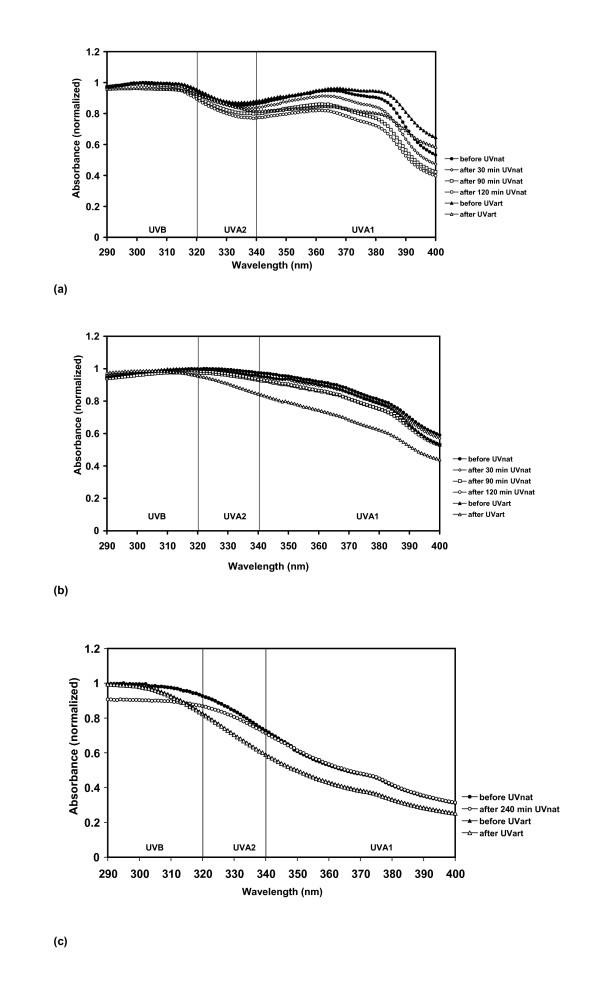
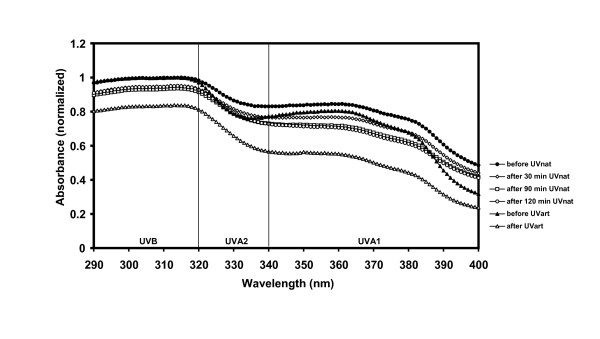
Seven commercial sunscreens were studied with absorption spectroscopy. Sunscreen product, 0.5 mg/cm2, was placed between plates of silica. The area under the curve (AUC) in the spectrum was calculated for UVA (320-400 nm), UVA1 (340-400 nm), UVA2 (320-340 nm) and UVB (290-320 nm) before (AUCbefore) and after (AUCafter) UVart (980 kJ/m2 UVA and 12 kJ/m2 of UVB) and before and after UVnat. If theAUC Index (AUCI), defined as AUCI = AUCafter/AUCbefore, was > 0.80, the sunscreen was considered photostable.
Three sunscreens were unstable after 90 min of UVnat; in the UVA range the AUCI was between 0.41 and 0.76. In the UVB range one of these sunscreens was unstable with an AUCI of 0.75 after 90 min. Three sunscreens were photostable after 120 min of UVnat; in the UVA range the AUCI was between 0.85 and 0.99 and in the UVB range between 0.92 and 1.0. One sunscreen showed in the UVA range an AUCI of 0.87 after UVnat but an AUCI of 0.72 after UVart. Five of the sunscreens were stable in the UVB region.
The present study shows that several sunscreens are photounstable in the UVA range after UVnat and UVart. There is a need for a standardized method to measure photostability, and the photostability should be marked on the sunscreen product.
防晒霜被广泛用于减少有害紫外线(UV)辐射暴露。一些防晒霜具有光不稳定性这一事实已为人所知多年。由于防晒霜的紫外线吸收成分可能具有光不稳定性,尤其是在长波长区域,因此确定其在紫外线辐射暴露期间的降解情况具有重要意义。我们的目的是研究七种市售防晒产品在自然紫外线暴露(UVnat)和人工紫外线暴露(UVart)后的光稳定性。
采用吸收光谱法对七种市售防晒霜进行研究。将0.5mg/cm²的防晒产品置于硅胶板之间。计算在UVart(980kJ/m² UVA和12kJ/m² UVB)前后以及UVnat前后,光谱中UVA(320 - 400nm)、UVA1(340 - 400nm)、UVA2(320 - 340nm)和UVB(290 - 320nm)的曲线下面积(AUC)。如果定义为AUCI = AUCafter/AUCbefore的AUC指数(AUCI)> 0.80,则认为该防晒霜具有光稳定性。
三种防晒霜在UVnat照射90分钟后不稳定;在UVA范围内,AUCI在0.41至0.76之间。在UVB范围内,其中一种防晒霜在90分钟后不稳定,AUCI为0.75。三种防晒霜在UVnat照射120分钟后具有光稳定性;在UVA范围内,AUCI在0.85至0.99之间,在UVB范围内在0.92至1.0之间。一种防晒霜在UVnat后UVA范围内的AUCI为0.87,但在UVart后为0.72。五种防晒霜在UVB区域稳定。
本研究表明,几种防晒霜在UVnat和UVart后在UVA范围内具有光不稳定性。需要一种标准化方法来测量光稳定性,并且光稳定性应在防晒产品上标明。