Gosse Philippe
Service de Cardiologie-Hypertension art6éielle, Hôpital Saint André, Bordeaux, France.
Vasc Health Risk Manag. 2006;2(3):195-201. doi: 10.2147/vhrm.2006.2.3.195.
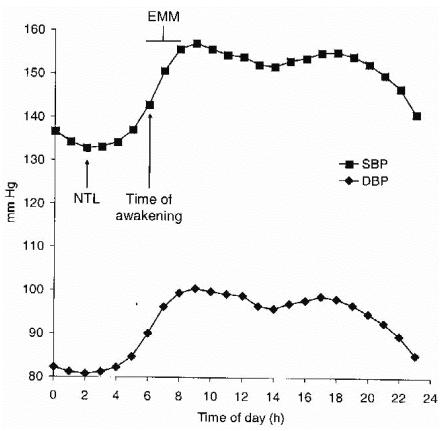
Measurement of blood pressure in the clinic may provide a false impression of blood pressure control. Ambulatory blood pressure monitoring (ABPM) allows the automatic recording of the circadian variation in blood pressure and evaluation of the efficacy of antihypertensive medication throughout the dosing interval. Ambulatory blood pressure provides more effective prediction of cardiovascular risk; blood pressure control at the time of heightened risk in the early morning after waking and before taking the next dose of medication is becoming important in order to improve long-term prognosis. To achieve blood pressure control in the early morning, a long-acting antihypertensive agent is essential. Telmisartan, an angiotensin II receptor blocker, as well as having a terminal elimination half-life of 24 h, has a large volume of distribution due to its high lipophilicity. The efficacy of telmisartan 80 mg monotherapy has been demonstrated using ABPM, with superior reduction in mean values for the last 6 h of the dosing interval compared with ramipril 10 mg and valsartan 80 mg. In addition, telmisartan 80 mg provides superior blood pressure control after a missed dose compared with valsartan 160mg. When combined with hydrochlorothiazide (HCTZ) 12.5 mg, telmisartan 40mg and 80mg is more effective than losartan/HCTZ (50/12.5 mg) at the end of the dosing interval. Furthermore, greater reductions in last 6 h mean systolic blood pressure (SBP) and diastolic blood pressure (DBP) are achieved with telmisartan/HCTZ (80/12.5 mg) than with valsartan/HCTZ (160/12.5 mg) in obese patients with type 2 diabetes and hypertension. Recent data from a large group of patients show that telmisartan 80 mg controls the early morning blood pressure surge more effectively than ramipril 5-10 mg and, thus, may have a greater beneficial effect on long-term cardiovascular risk. This supposition is being tested in the ONgoing Telmisartan Alone and in combination with Ramipril Global Endpoint Trial (ONTARGET) programme.
在诊所测量血压可能会对血压控制情况产生错误的认识。动态血压监测(ABPM)可自动记录血压的昼夜变化,并评估整个给药间隔内抗高血压药物的疗效。动态血压能更有效地预测心血管风险;为改善长期预后,在清晨醒来后、服用下一剂药物之前风险升高时控制血压变得至关重要。为在清晨实现血压控制,长效抗高血压药物必不可少。替米沙坦是一种血管紧张素II受体阻滞剂,其终末消除半衰期为24小时,由于具有高亲脂性,分布容积大。使用ABPM已证实替米沙坦80mg单药治疗的疗效,与雷米普利10mg和缬沙坦80mg相比,给药间隔最后6小时的平均值降低更显著。此外,与缬沙坦160mg相比,漏服一剂后替米沙坦80mg能提供更好的血压控制。与氢氯噻嗪(HCTZ)12.5mg联合使用时,在给药间隔结束时,替米沙坦40mg和80mg比氯沙坦/HCTZ(50/12.5mg)更有效。此外,在2型糖尿病和高血压肥胖患者中,替米沙坦/HCTZ(80/12.5mg)比缬沙坦/HCTZ(160/12.5mg)在最后6小时平均收缩压(SBP)和舒张压(DBP)降低幅度更大。一大组患者的最新数据显示,替米沙坦80mg比雷米普利5 - 10mg更有效地控制清晨血压激增,因此,可能对长期心血管风险产生更大的有益影响。这一假设正在正在进行的替米沙坦单药及与雷米普利联合应用全球终点试验(ONTARGET)项目中进行验证。