Blaney Joseph E, Sathe Neeraj S, Hanson Christopher T, Firestone Cai Yen, Murphy Brian R, Whitehead Stephen S
Laboratory of Infectious Diseases, National Institute of Allergy and Infectious Diseases, National Institutes of Health, Bethesda, MD 20892, USA.
Virol J. 2007 Feb 28;4:23. doi: 10.1186/1743-422X-4-23.
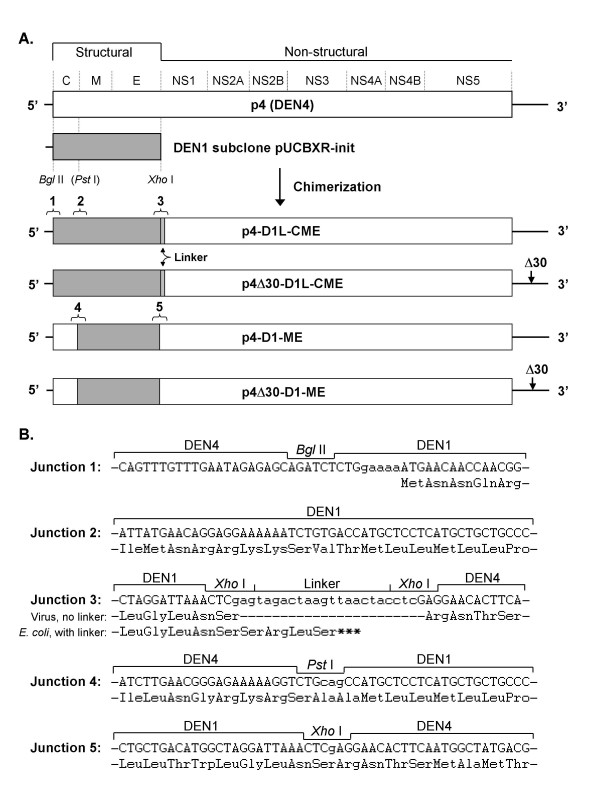
Antigenic chimeric viruses have previously been generated in which the structural genes of recombinant dengue virus type 4 (rDEN4) have been replaced with those derived from DEN2 or DEN3. Two vaccine candidates were identified, rDEN2/4Delta30(ME) and rDEN3/4Delta30(ME), which contain the membrane (M) precursor and envelope (E) genes of DEN2 and DEN3, respectively, and a 30 nucleotide deletion (Delta30) in the 3' untranslated region of the DEN4 backbone. Based on the promising preclinical phenotypes of these viruses and the safety and immunogenicity of rDEN2/4Delta30(ME) in humans, we now describe the generation of a panel of four antigenic chimeric DEN4 viruses using either the capsid (C), M, and E (CME) or ME structural genes of DEN1 Puerto Rico/94 strain.
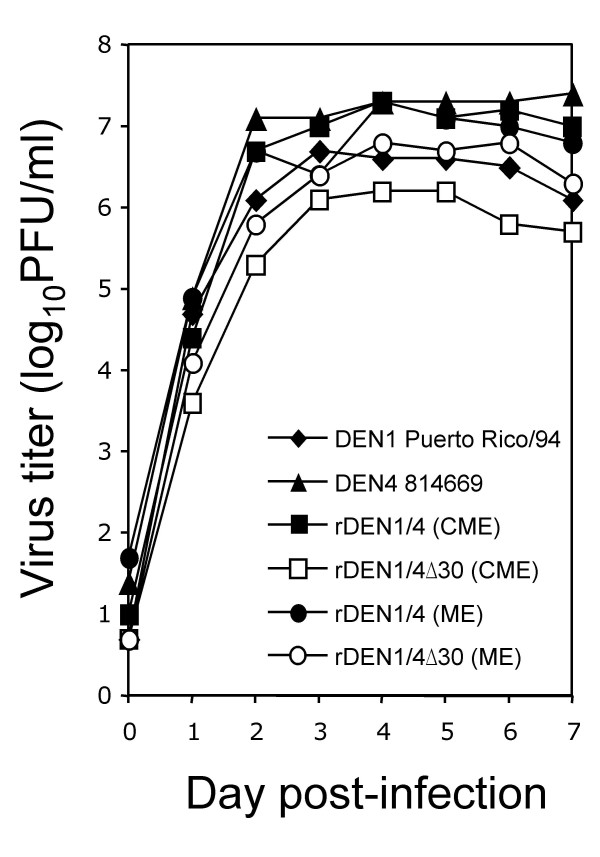
Four antigenic chimeric viruses were generated and found to replicate efficiently in Vero cells: rDEN1/4(CME), rDEN1/4Delta30(CME), rDEN1/4(ME), and rDEN1/4Delta30(ME). With the exception of rDEN1/4(ME), each chimeric virus was significantly attenuated in a SCID-HuH-7 mouse xenograft model with a 25-fold or greater reduction in replication compared to wild type DEN1. In rhesus monkeys, only chimeric viruses with the Delta30 mutation appeared to be attenuated as measured by duration and magnitude of viremia. rDEN1/4Delta30(CME) appeared over-attenuated since it failed to induce detectable neutralizing antibody and did not confer protection from wild type DEN1 challenge. In contrast, rDEN1/4Delta30(ME) induced 66% seroconversion and protection from DEN1 challenge. Presence of the Delta30 mutation conferred a significant restriction in mosquito infectivity upon rDEN1/4Delta30(ME) which was shown to be non-infectious for Aedes aegypti fed an infectious bloodmeal.
The attenuation phenotype in SCID-HuH-7 mice, rhesus monkeys, and mosquitoes and the protective immunity observed in rhesus monkeys suggest that rDEN1/4Delta30(ME) should be considered for evaluation in a clinical trial.
此前已构建出抗原嵌合病毒,其中重组4型登革病毒(rDEN4)的结构基因已被源自DEN2或DEN3的结构基因所取代。鉴定出了两种候选疫苗,即rDEN2/4Delta30(ME)和rDEN3/4Delta30(ME),它们分别包含DEN2和DEN3的膜(M)前体和包膜(E)基因,并且在DEN4骨架的3'非翻译区有一个30个核苷酸的缺失(Delta30)。基于这些病毒有前景的临床前表型以及rDEN2/4Delta30(ME)在人体中的安全性和免疫原性,我们现在描述使用DEN1波多黎各/94株的衣壳(C)、M和E(CME)或ME结构基因构建一组四种抗原嵌合DEN4病毒的过程。
构建出了四种抗原嵌合病毒,发现它们能在Vero细胞中高效复制:rDEN1/4(CME)、rDEN1/4Delta30(CME)、rDEN1/4(ME)和rDEN1/4Delta30(ME)。除rDEN1/4(ME)外,每种嵌合病毒在SCID-HuH-7小鼠异种移植模型中均显著减毒,与野生型DEN1相比,复制减少了25倍或更多。在恒河猴中,通过病毒血症的持续时间和强度测量,只有带有Delta30突变的嵌合病毒似乎减毒了。rDEN1/4Delta30(CME)似乎过度减毒,因为它未能诱导可检测到的中和抗体,也未提供针对野生型DEN1攻击的保护。相比之下,rDEN1/4Delta30(ME)诱导了66%的血清转化并提供了针对DEN1攻击的保护。Delta30突变的存在使rDEN1/4Delta30(ME)在蚊子感染性方面受到显著限制,对喂食感染性血餐的埃及伊蚊无感染性。
在SCID-HuH-7小鼠、恒河猴和蚊子中的减毒表型以及在恒河猴中观察到的保护性免疫表明,rDEN1/4Delta30(ME)应考虑在临床试验中进行评估。