Otting Nel, de Vos-Rouweler Annemiek J M, Heijmans Corrine M C, de Groot Natasja G, Doxiadis Gaby G M, Bontrop Ronald E
Department of Comparative Genetics and Refinement, Biomedical Primate Research Centre, P.O. Box 3306, 2280 GH, Rijswijk, The Netherlands.
Immunogenetics. 2007 May;59(5):367-75. doi: 10.1007/s00251-007-0201-2. Epub 2007 Mar 3.
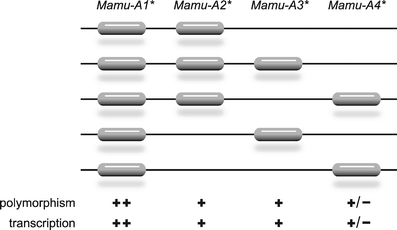
The HLA-A locus represents a single copy gene that displays abundant allelic polymorphism in the human population, whereas, in contrast, a nonhuman primate species such as the rhesus macaque (Macaca mulatta) possesses multiple HLA-A-like (Mamu-A) genes, which parade varying degrees of polymorphism. The number and combination of transcribed Mamu-A genes present per chromosome display diversity in a population of Indian animals. At present, it is not clearly understood whether these different A region configurations are evolutionarily stable entities. To shed light on this issue, rhesus macaques from a Chinese population and a panel of cynomolgus monkeys (Macaca fascicularis) were screened for various A region-linked variations. Comparisons demonstrated that most A region configurations are old entities predating macaque speciation, whereas most allelic variation (>95%) is of more recent origin. The latter situation contrasts the observations of the major histocompatibility complex class II genes in rhesus and cynomolgus macaques, which share a high number of identical alleles (>30%) as defined by exon 2 sequencing.
HLA - A基因座代表一个单拷贝基因,在人类群体中表现出丰富的等位基因多态性,而相比之下,恒河猴(猕猴属)等非人灵长类物种拥有多个HLA - A类(Mamu - A)基因,这些基因表现出不同程度的多态性。每条染色体上转录的Mamu - A基因的数量和组合在印度动物群体中呈现出多样性。目前,尚不清楚这些不同的A区域构型是否是进化上稳定的实体。为了阐明这个问题,对来自中国群体的恒河猴和一组食蟹猴(食蟹猕猴)进行了各种A区域相关变异的筛选。比较表明,大多数A区域构型是猕猴物种形成之前就存在的古老实体,而大多数等位基因变异(>95%)是较新起源的。后一种情况与恒河猴和食蟹猴中主要组织相容性复合体II类基因的观察结果形成对比,根据外显子2测序,它们共享大量相同的等位基因(>30%)。