White Tommi A, Krishnan Navasona, Becker Donald F, Tanner John J
Department of Biochemistry, University of Missouri-Columbia, Columbia, MO 65211, USA.
J Biol Chem. 2007 May 11;282(19):14316-27. doi: 10.1074/jbc.M700912200. Epub 2007 Mar 7.
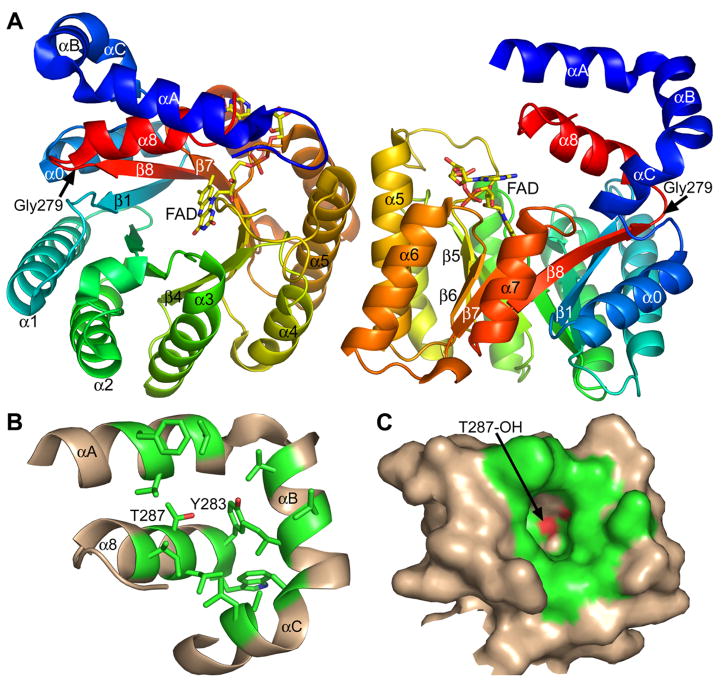
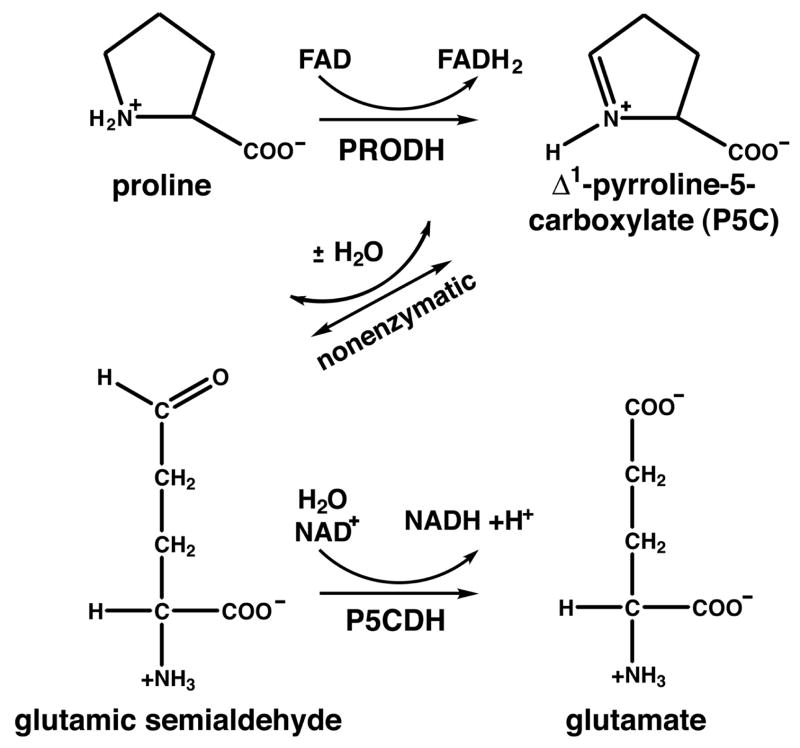
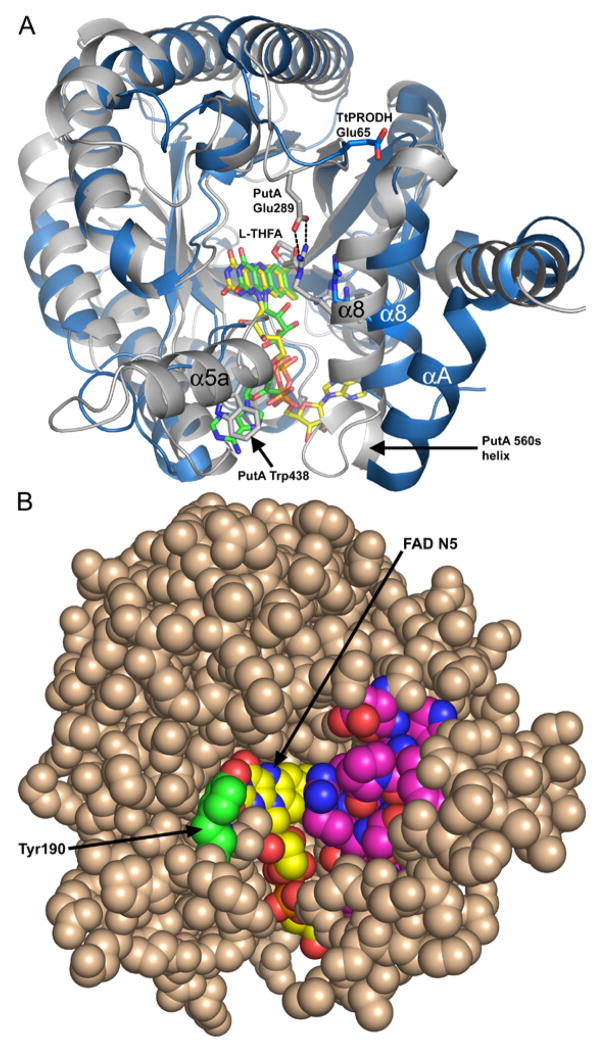
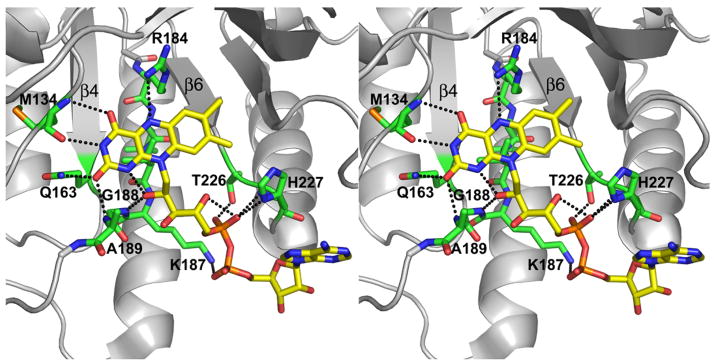
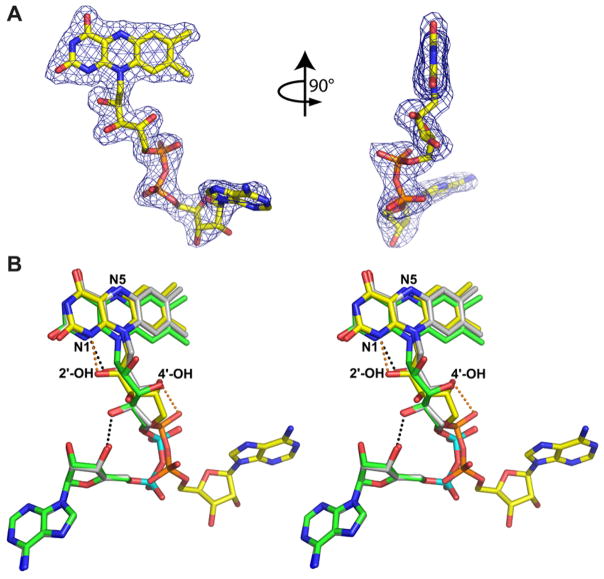
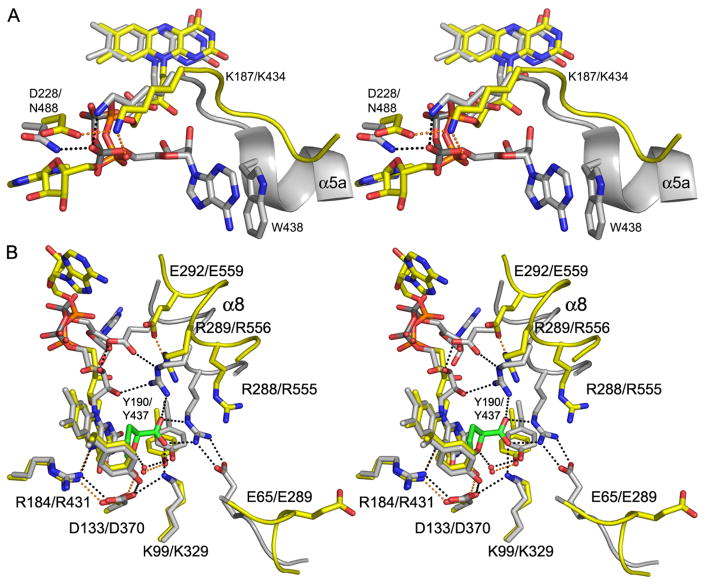
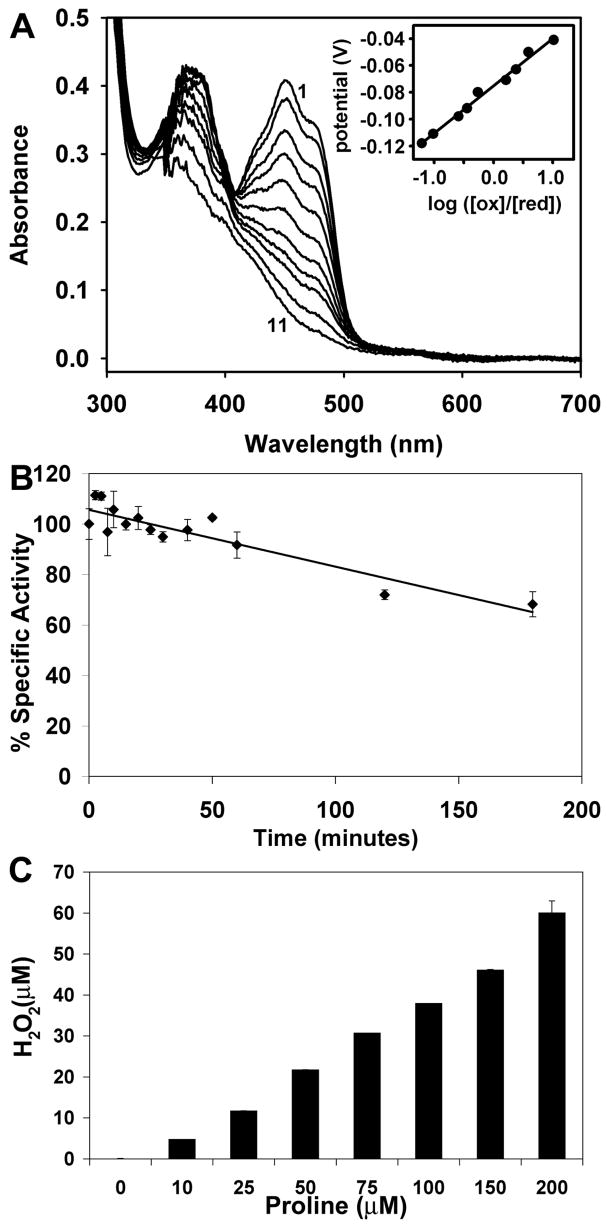
Proline dehydrogenase (PRODH) and Delta(1)-pyrroline-5-carboxylate dehydrogenase (P5CDH) catalyze the two-step oxidation of proline to glutamate. They are distinct monofunctional enzymes in all eukaryotes and some bacteria but are fused into bifunctional enzymes known as proline utilization A (PutA) in other bacteria. Here we report the first structure and biochemical data for a monofunctional PRODH. The 2.0-A resolution structure of Thermus thermophilus PRODH reveals a distorted (betaalpha)(8) barrel catalytic core domain and a hydrophobic alpha-helical domain located above the carboxyl-terminal ends of the strands of the barrel. Although the catalytic core is similar to that of the PutA PRODH domain, the FAD conformation of T. thermophilus PRODH is remarkably different and likely reflects unique requirements for membrane association and communication with P5CDH. Also, the FAD of T. thermophilus PRODH is highly solvent-exposed compared with PutA due to a 4-A shift of helix 8. Structure-based sequence analysis of the PutA/PRODH family led us to identify nine conserved motifs involved in cofactor and substrate recognition. Biochemical studies show that the midpoint potential of the FAD is -75 mV and the kinetic parameters for proline are K(m) = 27 mm and k(cat) = 13 s(-1). 3,4-Dehydro-l-proline was found to be an efficient substrate, and l-tetrahydro-2-furoic acid is a competitive inhibitor (K(I) = 1.0 mm). Finally, we demonstrate that T. thermophilus PRODH reacts with O(2) producing superoxide. This is significant because superoxide production underlies the role of human PRODH in p53-mediated apoptosis, implying commonalities between eukaryotic and bacterial monofunctional PRODHs.
脯氨酸脱氢酶(PRODH)和Δ¹-吡咯啉-5-羧酸脱氢酶(P5CDH)催化脯氨酸两步氧化生成谷氨酸。在所有真核生物和一些细菌中,它们是不同的单功能酶,但在其他细菌中融合成称为脯氨酸利用A(PutA)的双功能酶。本文报道了首个单功能PRODH的结构和生化数据。嗜热栖热菌PRODH的2.0埃分辨率结构揭示了一个扭曲的(βα)⁸桶状催化核心结构域和一个位于桶状结构链羧基末端上方的疏水α螺旋结构域。尽管催化核心与PutA的PRODH结构域相似,但嗜热栖热菌PRODH的FAD构象明显不同,可能反映了膜结合以及与P5CDH通讯的独特要求。此外,由于螺旋8发生4埃的位移,嗜热栖热菌PRODH的FAD比PutA更易暴露于溶剂中。对PutA/PRODH家族基于结构的序列分析使我们确定了九个参与辅因子和底物识别的保守基序。生化研究表明,FAD的中点电位为-75 mV,脯氨酸的动力学参数为Kₘ = 27 mM,kₑₜ = 13 s⁻¹。发现3,4-脱氢-L-脯氨酸是一种有效的底物,L-四氢-2-呋喃甲酸是一种竞争性抑制剂(Kᵢ = 1.0 mM)。最后,我们证明嗜热栖热菌PRODH与O₂反应产生超氧化物。这很重要,因为超氧化物的产生是人类PRODH在p53介导的细胞凋亡中发挥作用的基础,这意味着真核生物和细菌单功能PRODH之间存在共性。