McKinlay J B, Link C L, Freund K M, Marceau L D, O'Donnell A B, Lutfey K L
New England Research Institutes, Watertown, MA 02472, USA.
J Gen Intern Med. 2007 Mar;22(3):289-96. doi: 10.1007/s11606-006-0075-2.
Health services research has documented the magnitude of health care variations. Few studies focus on provider level sources of variation in clinical decision making-for example, which primary care providers are likely to follow clinical guidelines, with which types of patient.
To estimate: (1) the extent of primary care provider adherence to practice guidelines and the unconfounded influence of (2) patient attributes and (3) physician characteristics on adherence with clinical practice guidelines.
In a factorial experiment, primary care providers were shown clinically authentic video vignettes with actors portrayed different "patients" with identical signs of coronary heart disease (CHD). Different types of providers were asked how they would manage the different "patients" with identical CHD symptoms. Measures were taken to protect external validity.
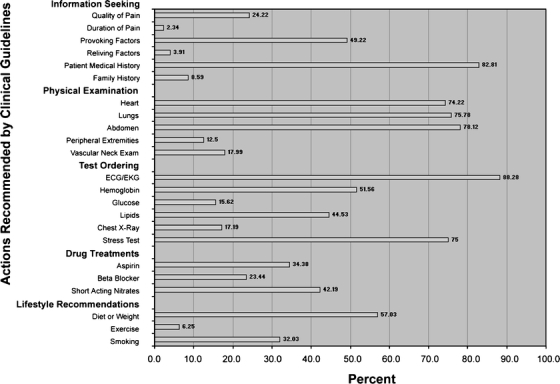
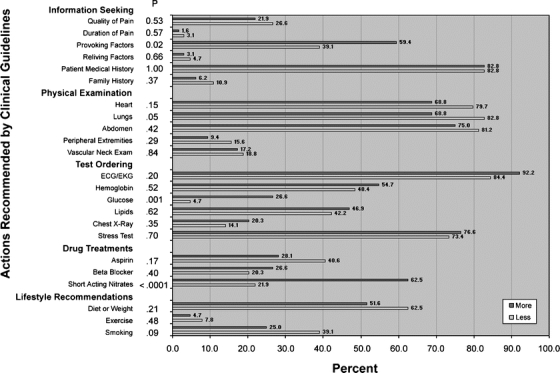
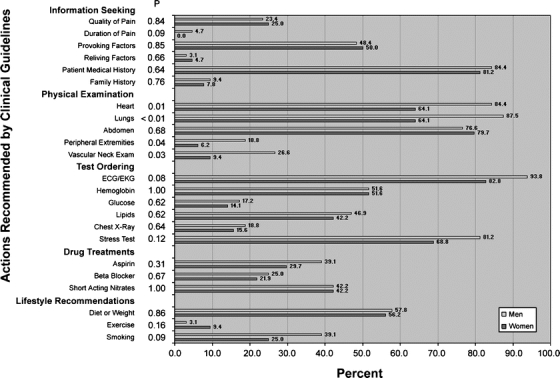
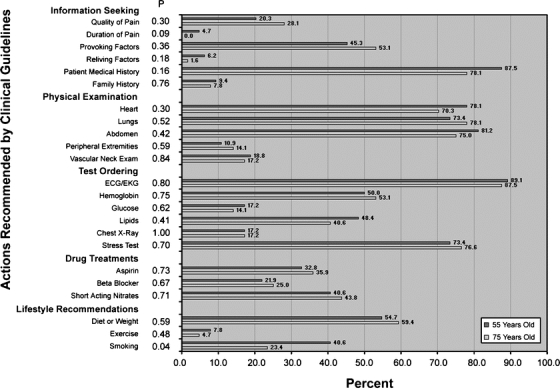
Adherence to some guidelines is high (over 50% of physicians would follow a third of the recommended actions), yet there is low adherence to many of them (less than 20% would follow another third). Female patients are less likely than males to receive 4 of 5 types of physical examination (p < .03); older patients are less likely to be advised to stop smoking (p < .03). Race and SES of patients had no effect on provider adherence to guidelines. A physicians' level of experience (age) appears to be important with certain patients.
Physician adherence with guidelines varies with different types of "patient" and with the length of clinical experience. With this evidence it is possible to appropriately target interventions to reduce health care variations by improving physician adherence with clinical guidelines.
卫生服务研究已记录了医疗保健差异的程度。很少有研究关注临床决策中提供者层面的差异来源——例如,哪些初级保健提供者可能遵循临床指南,针对哪些类型的患者。
估计:(1)初级保健提供者对实践指南的遵循程度,以及(2)患者属性和(3)医生特征对遵循临床实践指南的无混杂影响。
在一项析因实验中,向初级保健提供者展示临床真实的视频短片,其中演员扮演患有相同冠心病(CHD)体征的不同“患者”。询问不同类型的提供者他们将如何管理具有相同CHD症状的不同“患者”。采取措施保护外部有效性。
对某些指南的遵循率很高(超过50%的医生会遵循三分之一的推荐行动),但对许多指南的遵循率很低(不到20%的医生会遵循另外三分之一)。女性患者比男性患者接受5种体格检查中的4种的可能性更小(p < 0.03);老年患者被建议戒烟的可能性更小(p < 0.03)。患者的种族和社会经济地位对提供者遵循指南没有影响。医生的经验水平(年龄)对某些患者似乎很重要。
医生对指南的遵循因不同类型的“患者”和临床经验的长短而异。有了这些证据,就有可能通过提高医生对临床指南的遵循来适当地针对干预措施,以减少医疗保健差异。