Bodega Beatrice, Cardone Maria Francesca, Müller Stefan, Neusser Michaela, Orzan Francesca, Rossi Elena, Battaglioli Elena, Marozzi Anna, Riva Paola, Rocchi Mariano, Meneveri Raffaella, Ginelli Enrico
Department of Biology and Genetics for Medical Sciences, University of Milan, Milan, Italy.
BMC Evol Biol. 2007 Mar 14;7:39. doi: 10.1186/1471-2148-7-39.
In order to obtain insights into the functionality of the human 4q35.2 domain harbouring the facioscapulohumeral muscular dystrophy (FSHD) locus, we investigated in African apes genomic and chromatin organisations, and the nuclear topology of orthologous regions.
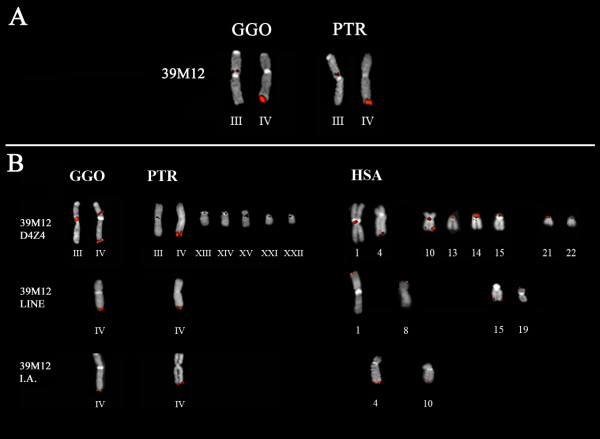
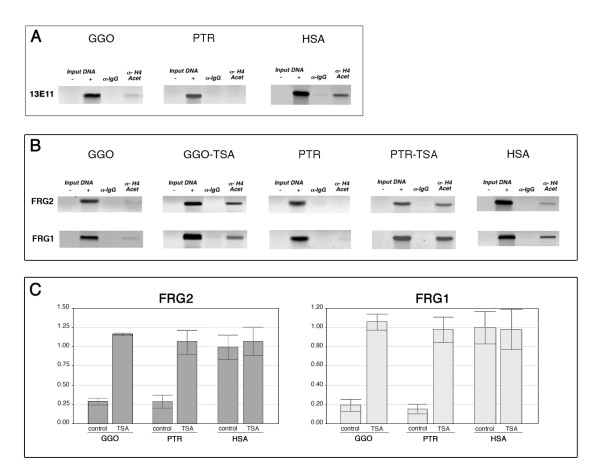
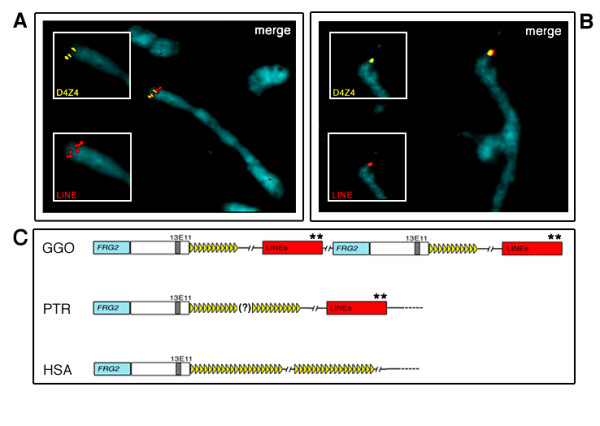
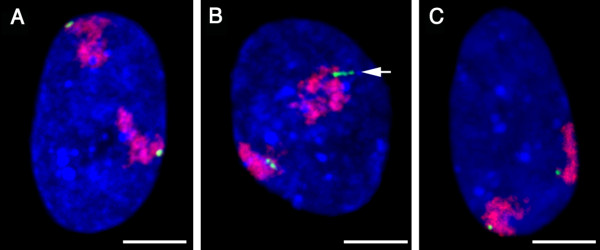
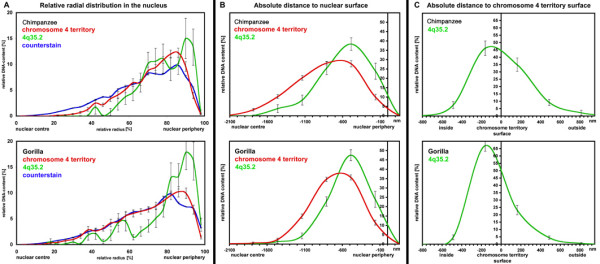
A basic block consisting of short D4Z4 arrays (10-15 repeats), 4q35.2 specific sequences, and approximately 35 kb of interspersed repeats from different LINE subfamilies was repeated at least twice in the gorilla 4qter. This genomic organisation has undergone evolutionary remodelling, leading to the single representation of both the D4Z4 array and LINE block in chimpanzee, and the loss of the LINE block in humans. The genomic remodelling has had an impact on 4qter chromatin organisation, but not its interphase nuclear topology. In comparison with humans, African apes show very low or undetectable levels of FRG1 and FRG2 histone 4 acetylation and gene transcription, although histone deacetylase inhibition restores gene transcription to levels comparable with those of human cells, thus indicating that the 4qter region is capable of acquiring a more open chromatin structure. Conversely, as in humans, the 4qter region in African apes has a very peripheral nuclear localisation.
The 4q subtelomere has undergone substantial genomic changes during evolution that have had an impact on chromatin condensation and the region's transcriptional regulation. Consequently, the 4qter genes in African apes and humans seem to be subjected to a different strategy of regulation in which LINE and D4Z4 sequences may play a pivotal role. However, the effect of peripheral nuclear anchoring of 4qter on these regulation mechanisms is still unclear. The observed differences in the regulation of 4qter gene expression between African apes and humans suggest that the human 4q35.2 locus has acquired a novel functional relevance.
为了深入了解携带面肩肱型肌营养不良(FSHD)基因座的人类4q35.2区域的功能,我们研究了非洲猿类的基因组和染色质组织以及同源区域的核拓扑结构。
一个由短D4Z4阵列(10 - 15个重复序列)、4q35.2特异性序列以及来自不同LINE亚家族的约35 kb散在重复序列组成的基本模块,在大猩猩4q末端至少重复了两次。这种基因组组织经历了进化重塑,导致黑猩猩中D4Z4阵列和LINE模块均为单拷贝形式,而人类中LINE模块缺失。基因组重塑对4q末端染色质组织产生了影响,但对其间期核拓扑结构没有影响。与人类相比,非洲猿类中FRG1和FRG2组蛋白4乙酰化水平及基因转录水平非常低或无法检测到,尽管组蛋白去乙酰化酶抑制可将基因转录恢复到与人类细胞相当的水平,这表明4q末端区域能够获得更开放的染色质结构。相反,与人类一样,非洲猿类中的4q末端区域具有非常外周的核定位。
4号染色体亚端粒在进化过程中经历了大量基因组变化,这些变化对染色质凝聚和该区域的转录调控产生了影响。因此,非洲猿类和人类的4q末端基因似乎受到不同的调控策略,其中LINE和D4Z4序列可能起关键作用。然而,4q末端外周核锚定对这些调控机制的影响仍不清楚。在非洲猿类和人类之间观察到的4q末端基因表达调控差异表明,人类4q35.2基因座获得了新的功能相关性。