Ingeneus Research, Mississauga, Ontario, Canada.
PLoS One. 2007 Mar 21;2(3):e305. doi: 10.1371/journal.pone.0000305.
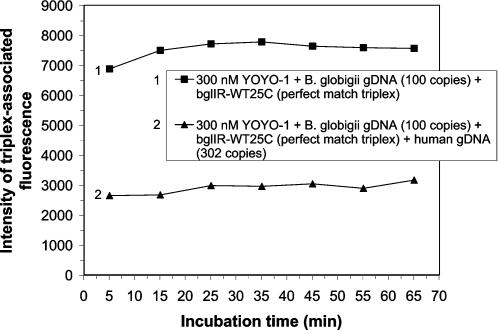
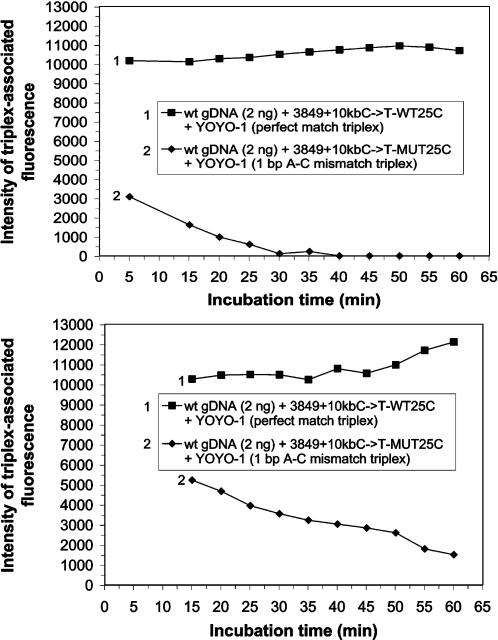
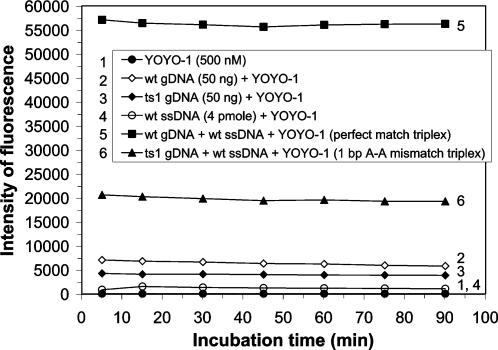
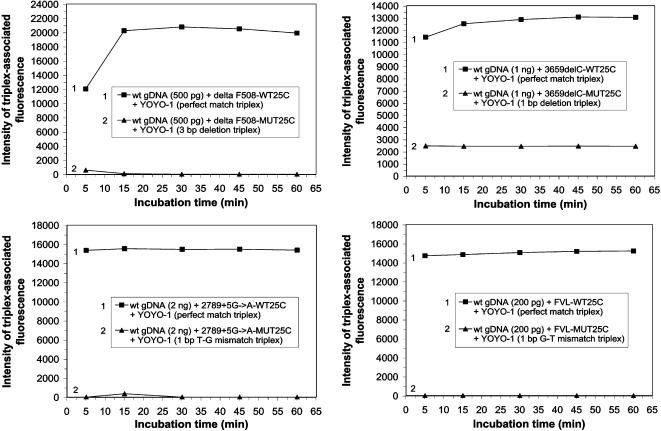
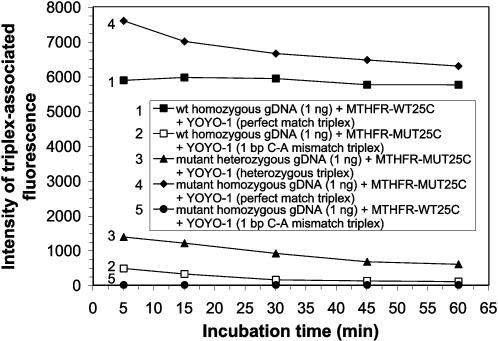
Human genomic samples are complex and are considered difficult to assay directly without denaturation or PCR amplification. We report the use of a base-specific heteropolymeric triplex, formed by native duplex genomic target and an oligonucleotide third strand probe, to assay for low copy pathogen genomes present in a sample also containing human genomic duplex DNA, or to assay human genomic duplex DNA for Single Nucleotide Polymorphisms (SNP), without PCR amplification. Wild-type and mutant probes are used to identify triplexes containing FVL G1691A, MTHFR C677T and CFTR mutations. The specific triplex structure forms rapidly at room temperature in solution and may be detected without a separation step. YOYO-1, a fluorescent bis-intercalator, promotes and signals the formation of the specific triplex. Genomic duplexes may be assayed homogeneously with single base pair resolution. The specific triple-stranded structures of the assay may approximate homologous recombination intermediates, which various models suggest may form in either the major or minor groove of the duplex. The bases of the stable duplex target are rendered specifically reactive to the bases of the probe because of the activity of intercalated YOYO-1, which is known to decondense duplex locally 1.3 fold. This may approximate the local decondensation effected by recombination proteins such as RecA in vivo. Our assay, while involving triplex formation, is sui generis, as it is not homopurine sequence-dependent, as are "canonical triplexes". Rather, the base pair-specific heteropolymeric triplex of the assay is conformation-dependent. The highly sensitive diagnostic assay we present allows for the direct detection of base sequence in genomic duplex samples, including those containing human genomic duplex DNA, thereby bypassing the inherent problems and cost associated with conventional PCR based diagnostic assays.
人类基因组样本复杂,在不进行变性或 PCR 扩增的情况下,直接分析这些样本被认为是困难的。我们报告了一种基于碱基的杂合三链体的应用,该三链体由天然双链基因组靶标和寡核苷酸第三链探针形成,用于检测样品中存在的低拷贝病原体基因组,该样品还包含人类基因组双链 DNA,或者用于检测人类基因组双链 DNA 的单核苷酸多态性(SNP),而无需进行 PCR 扩增。野生型和突变型探针用于识别包含 FVL G1691A、MTHFR C677T 和 CFTR 突变的三链体。在室温下,特异的三链体结构在溶液中迅速形成,并且可以在没有分离步骤的情况下进行检测。YOYO-1 是一种荧光双嵌入剂,可促进和信号特异三链体的形成。基因组双链体可以以单碱基对分辨率进行均相检测。该测定的特异三链体结构可能近似同源重组中间体,各种模型表明,这些中间体可能形成于双链体的主沟或小沟中。由于嵌入的 YOYO-1 的活性,双链靶标的碱基变得对探针的碱基具有特异性反应性,众所周知,YOYO-1 局部使双链体解压缩 1.3 倍。这可能近似于体内重组蛋白(如 RecA)所产生的局部去凝聚作用。我们的测定虽然涉及三链体形成,但它是独特的,因为它不是像“经典三链体”那样依赖于同聚嘌呤序列,而是依赖于测定的碱基对特异的杂合三链体的构象。我们提出的高灵敏度诊断测定法允许直接检测基因组双链体样品中的碱基序列,包括那些包含人类基因组双链 DNA 的样品,从而绕过了与传统基于 PCR 的诊断测定法相关的固有问题和成本。