Peretz Alon, Leotta Daniel F, Sullivan Jeffrey H, Trenga Carol A, Sands Fiona N, Aulet Mary R, Paun Marla, Gill Edward A, Kaufman Joel D
Department of Environmental and Occupational Health Sciences, University of Washington, Seattle, Washington, USA.
BMC Cardiovasc Disord. 2007 Mar 21;7:11. doi: 10.1186/1471-2261-7-11.
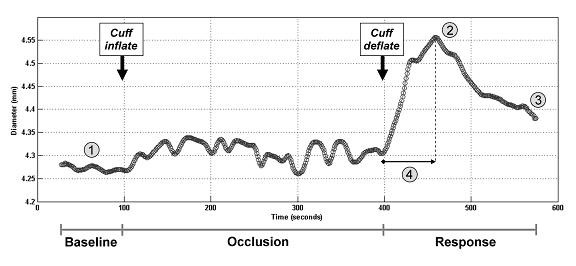
In order to establish a consistent method for brachial artery reactivity assessment, we analyzed commonly used approaches to the test and their effects on the magnitude and time-course of flow mediated dilation (FMD), and on test variability and repeatability. As a popular and noninvasive assessment of endothelial function, several different approaches have been employed to measure brachial artery reactivity with B-mode ultrasound. Despite some efforts, there remains a lack of defined normal values and large variability in measurement technique.
Twenty-six healthy volunteers underwent repeated brachial artery diameter measurements by B-mode ultrasound. Following baseline diameter recordings we assessed endothelium-dependent flow mediated dilation by inflating a blood pressure cuff either on the upper arm (proximal) or on the forearm (distal).
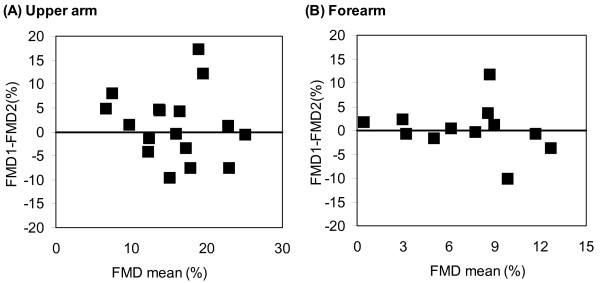
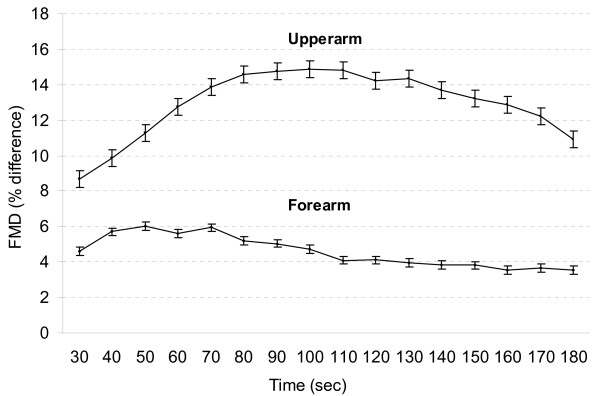
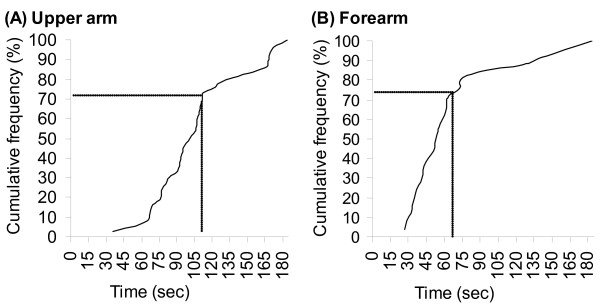
Thirty-seven measures were performed using proximal occlusion and 25 with distal occlusion. Following proximal occlusion relative to distal occlusion, FMD was larger (16.2 +/- 1.2% vs. 7.3 +/- 0.9%, p < 0.0001) and elongated (107.2 s vs. 67.8 s, p = 0.0001). Measurement of the test repeatability showed that differences between the repeated measures were greater on average when the measurements were done using the proximal method as compared to the distal method (2.4%; 95% CI 0.5-4.3; p = 0.013).
These findings suggest that forearm compression holds statistical advantages over upper arm compression. Added to documented physiological and practical reasons, we propose that future studies should use forearm compression in the assessment of endothelial function.
为了建立一种一致的肱动脉反应性评估方法,我们分析了该测试常用的方法及其对血流介导的血管舒张(FMD)的幅度和时程、测试变异性和可重复性的影响。作为一种常用的非侵入性内皮功能评估方法,已经采用了几种不同的方法通过B超测量肱动脉反应性。尽管做出了一些努力,但仍然缺乏明确的正常值,并且测量技术存在很大差异。
26名健康志愿者通过B超对肱动脉直径进行了重复测量。在记录基线直径后,我们通过在上臂(近端)或前臂(远端)充气血压袖带评估内皮依赖性血流介导的血管舒张。
使用近端阻断进行了37次测量,使用远端阻断进行了25次测量。与远端阻断相比,近端阻断后FMD更大(16.2±1.2%对7.3±0.9%,p<0.0001)且持续时间更长(107.2秒对67.8秒,p = 0.0001)。测试可重复性测量表明,与远端方法相比,使用近端方法进行测量时,重复测量之间的平均差异更大(2.4%;95%CI 0.5-4.3;p = 0.013)。
这些发现表明,前臂压迫在统计学上优于上臂压迫。结合已记录的生理和实际原因,我们建议未来的研究在评估内皮功能时应使用前臂压迫。