Fechner H, Pinkert S, Wang X, Sipo I, Suckau L, Kurreck J, Dörner A, Sollerbrant K, Zeichhardt H, Grunert H-P, Vetter R, Schultheiss H-P, Poller W
Department of Cardiology and Pneumology, Campus Benjamin Franklin, Charité - Universitätsmedizin Berlin, Berlin, Germany.
Gene Ther. 2007 Jun;14(12):960-71. doi: 10.1038/sj.gt.3302948. Epub 2007 Mar 22.
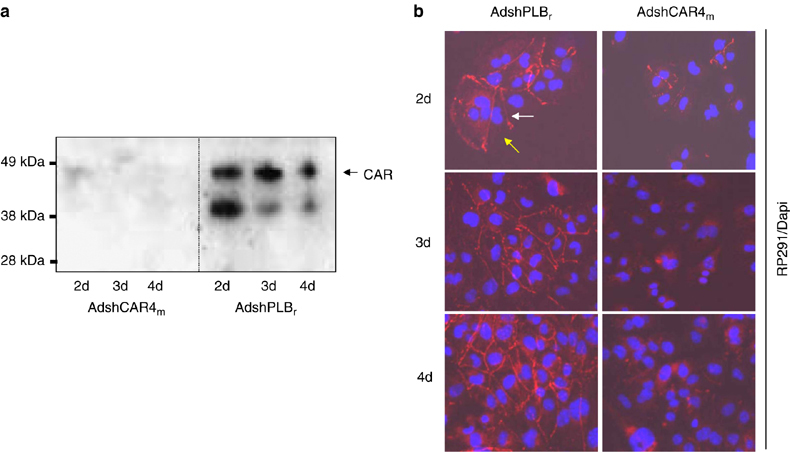
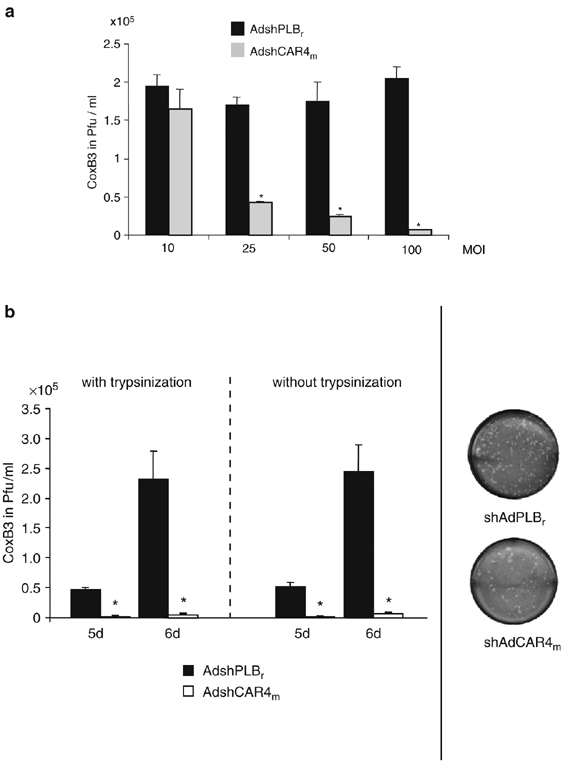
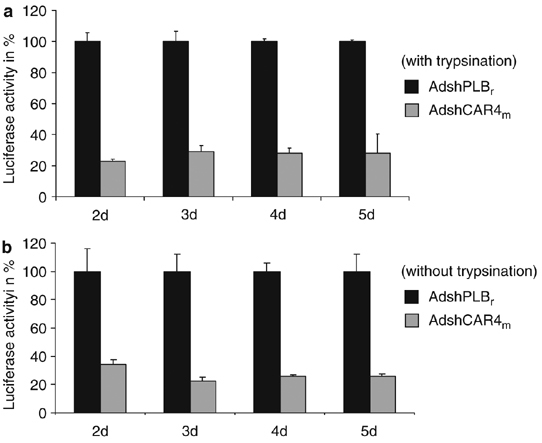
As coxsackievirus B3 (CoxB3) and adenoviruses may cause acute myocarditis and inflammatory cardiomyopathy, isolation of the common coxsackievirus-adenovirus-receptor (CAR) has provided an interesting new target for molecular antiviral therapy. Whereas many viruses show high mutation rates enabling them to develop escape mutants, mutations of their cellular virus receptors are far less likely. We report on antiviral efficacies of CAR gene silencing by short hairpin (sh)RNAs in the cardiac-derived HL-1 cell line and in primary neonatal rat cardiomyocytes (PNCMs). Treatment with shRNA vectors mediating RNA interference against the CAR resulted in almost complete silencing of receptor expression both in HL-1 cells and PNCMs. Whereas CAR was silenced in HL-1 cells as early as 24 h after vector treatment, its downregulation in PNCMs did not become significant before day 6. CAR knockout resulted in inhibition of CoxB3 infections by up to 97% in HL-1 cells and up to 90% in PNCMs. Adenovirus was inhibited by only 75% in HL-1 cells, but up to 92% in PNCMs. We conclude that CAR knockout by shRNA vectors is efficient against CoxB3 and adenovirus in primary cardiac cells, but the efficacy of this approach in vivo may be influenced by cell type-specific silencing kinetics in different tissues.
由于柯萨奇病毒B3(CoxB3)和腺病毒可能导致急性心肌炎和炎性心肌病,共同的柯萨奇病毒-腺病毒受体(CAR)的分离为分子抗病毒治疗提供了一个有趣的新靶点。尽管许多病毒显示出高突变率,使其能够产生逃逸突变体,但其细胞病毒受体的突变可能性要小得多。我们报告了短发夹(sh)RNA在心脏来源的HL-1细胞系和原代新生大鼠心肌细胞(PNCMs)中对CAR基因沉默的抗病毒效果。用介导针对CAR的RNA干扰的shRNA载体处理导致HL-1细胞和PNCMs中受体表达几乎完全沉默。在载体处理后24小时,HL-1细胞中的CAR就被沉默,而在PNCMs中,其下调直到第6天才变得显著。CAR敲除导致HL-1细胞中CoxB3感染的抑制率高达97%,在PNCMs中高达90%。腺病毒在HL-1细胞中的抑制率仅为75%,但在PNCMs中高达92%。我们得出结论,shRNA载体敲除CAR在原代心脏细胞中对CoxB3和腺病毒有效,但这种方法在体内的效果可能受不同组织中细胞类型特异性沉默动力学的影响。