
塔卡里贝沙粒病毒的体外RNA合成依赖引物,并提示了一种不同寻常的基因组复制起始模型。
Tacaribe arenavirus RNA synthesis in vitro is primer dependent and suggests an unusual model for the initiation of genome replication.
作者信息
Garcin D, Kolakofsky D
机构信息
Department of Genetics and Microbiology, University of Geneva School of Medicine, CMU, Switzerland.
出版信息
J Virol. 1992 Mar;66(3):1370-6. doi: 10.1128/JVI.66.3.1370-1376.1992.
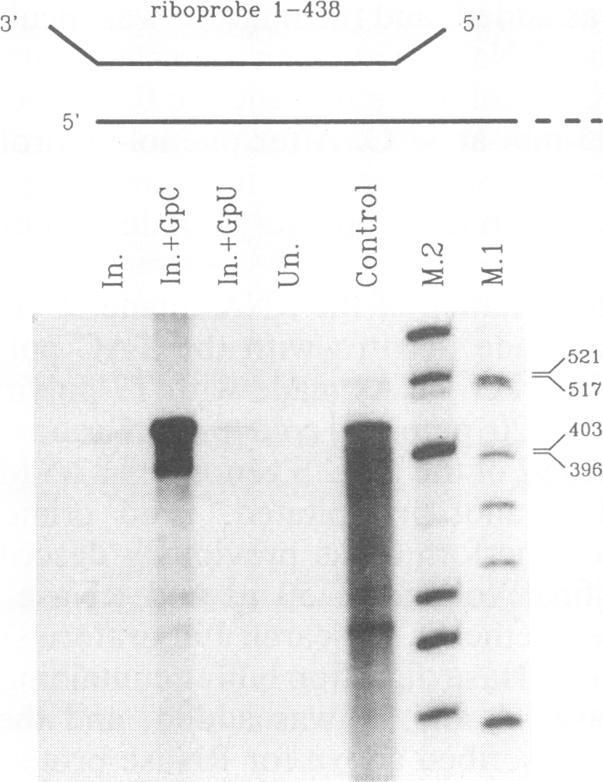
A Tacaribe virus in vitro system for RNA synthesis was established and found in large part to faithfully reproduce RNA synthesis in vivo. Similar to influenza virus and bunyavirus in vitro systems, this system was also highly dependent on added oligonucleotides. Of the eight tested, only three were active, in the order GpC greater than CpG greater than ApApC. Determination of the 5' ends of the transcripts suggested that the oligonucleotides were acting as primers. In particular, whereas stimulation with CpG (complementary to positions +1 and +2 of the template) led to RNAs whose 5' ends were at position +1 as expected, GpC stimulation led to transcripts whose 5' ends were at position -1 rather than at position +2, as GpC is complementary to positions +2 and +3 of the template. This finding suggests a model for the initiation of genome replication in which pppGpC is first made on the template at positions +2 and +3 but slips backwards on the template so that the 5' end is at position -1 before elongation can continue.
建立了一种用于RNA合成的塔卡里布病毒体外系统,发现该系统在很大程度上能够如实在体内复制RNA合成。与流感病毒和布尼亚病毒体外系统类似,该系统也高度依赖添加的寡核苷酸。在测试的8种寡核苷酸中,只有3种具有活性,活性顺序为GpC大于CpG大于ApApC。对转录本5'端的测定表明,这些寡核苷酸起着引物的作用。特别是,用CpG(与模板的+1和+2位互补)刺激会产生5'端位于+1位的RNA,这与预期一致,而GpC刺激会产生5'端位于-1位而非+2位的转录本,因为GpC与模板的+2和+3位互补。这一发现提示了一种基因组复制起始模型,即首先在模板的+2和+3位合成pppGpC,但在模板上向后滑动,使得在延伸继续之前5'端位于-1位。



 Zotero 插件