Poon Art F Y, Kosakovsky Pond Sergei L, Bennett Phil, Richman Douglas D, Leigh Brown Andrew J, Frost Simon D W
Department of Pathology, University of California San Diego, La Jolla, California, United States of America.
PLoS Pathog. 2007 Mar;3(3):e45. doi: 10.1371/journal.ppat.0030045.
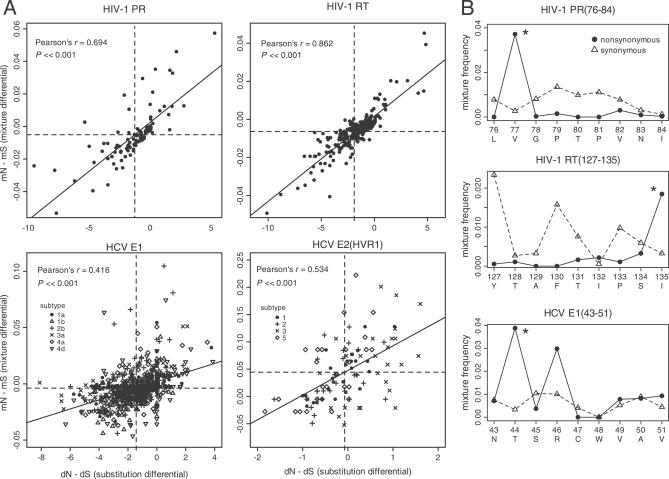
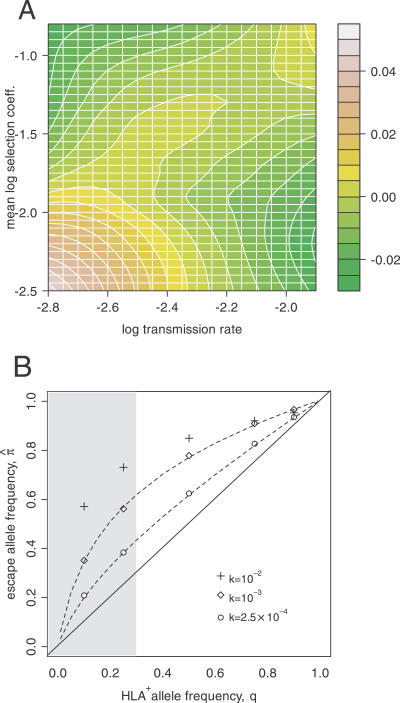
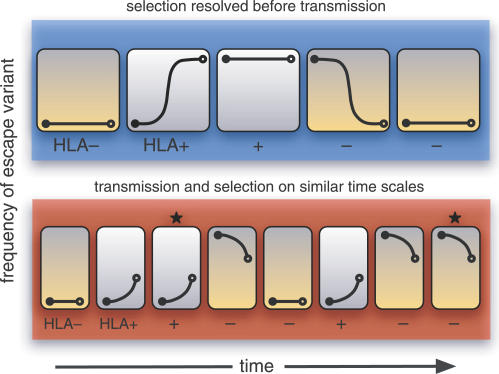
CD8(+) cytotoxic T-lymphocytes (CTLs) perform a critical role in the immune control of viral infections, including those caused by human immunodeficiency virus type 1 (HIV-1) and hepatitis C virus (HCV). As a result, genetic variation at CTL epitopes is strongly influenced by host-specific selection for either escape from the immune response, or reversion due to the replicative costs of escape mutations in the absence of CTL recognition. Under strong CTL-mediated selection, codon positions within epitopes may immediately "toggle" in response to each host, such that genetic variation in the circulating virus population is shaped by rapid adaptation to immune variation in the host population. However, this hypothesis neglects the substantial genetic variation that accumulates in virus populations within hosts. Here, we evaluate this quantity for a large number of HIV-1- (n > or = 3,000) and HCV-infected patients (n > or = 2,600) by screening bulk RT-PCR sequences for sequencing "mixtures" (i.e., ambiguous nucleotides), which act as site-specific markers of genetic variation within each host. We find that nonsynonymous mixtures are abundant and significantly associated with codon positions under host-specific CTL selection, which should deplete within-host variation by driving the fixation of the favored variant. Using a simple model, we demonstrate that this apparently contradictory outcome can be explained by the transmission of unfavorable variants to new hosts before they are removed by selection, which occurs more frequently when selection and transmission occur on similar time scales. Consequently, the circulating virus population is shaped by the transmission rate and the disparity in selection intensities for escape or reversion as much as it is shaped by the immune diversity of the host population, with potentially serious implications for vaccine design.
CD8(+)细胞毒性T淋巴细胞(CTL)在包括由1型人类免疫缺陷病毒(HIV-1)和丙型肝炎病毒(HCV)引起的病毒感染的免疫控制中发挥关键作用。因此,CTL表位的基因变异受到宿主特异性选择的强烈影响,这种选择要么是为了逃避免疫反应,要么是由于在没有CTL识别的情况下逃避突变的复制成本而发生回复突变。在强大的CTL介导的选择下,表位内的密码子位置可能会立即因每个宿主而“切换”,从而使循环病毒群体中的基因变异通过对宿主群体免疫变异的快速适应而形成。然而,这一假设忽略了宿主内病毒群体中积累的大量基因变异。在这里,我们通过筛选大量RT-PCR序列中的测序“混合物”(即模糊核苷酸)来评估大量HIV-1感染患者(n≥3000)和HCV感染患者(n≥2600)的这一数量,这些“混合物”作为每个宿主内基因变异的位点特异性标记。我们发现非同义混合物丰富,并且与宿主特异性CTL选择下的密码子位置显著相关,而宿主特异性CTL选择应该通过驱动有利变体的固定来减少宿主内变异。使用一个简单的模型,我们证明了这一明显矛盾的结果可以通过不利变体在被选择去除之前传播到新宿主来解释,当选择和传播发生在相似的时间尺度上时,这种情况更频繁发生。因此,循环病毒群体不仅受到宿主群体免疫多样性的影响,还受到传播率以及逃避或回复选择强度差异的影响,这对疫苗设计可能具有严重影响。