Dassen H, Punyadeera C, Kamps R, Klomp J, Dunselman G, Dijcks F, de Goeij A, Ederveen A, Groothuis P
Research Institute GROW, Maastricht University, Maastricht, The Netherlands.
Cell Mol Life Sci. 2007 Apr;64(7-8):1009-32. doi: 10.1007/s00018-007-6553-9.
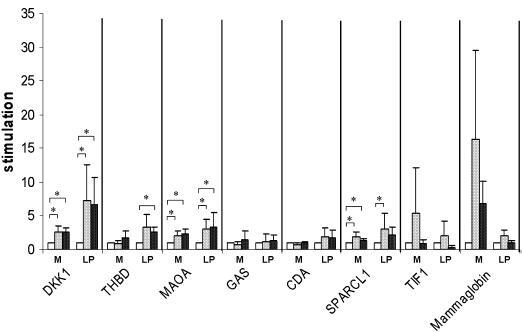
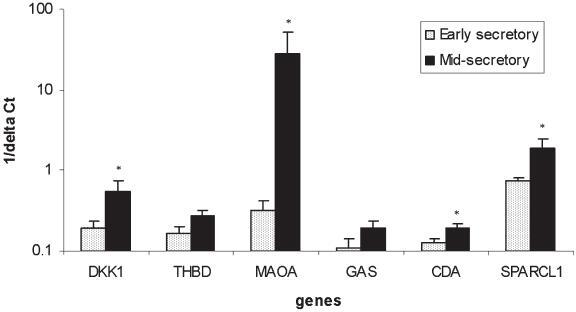
Genomic profiling was performed on explants of late proliferative phase human endometrium after 24-h treatment with progesterone (P) or oestradiol and progesterone (17beta-E(2)+P) and on explants of menstrual phase endometrium treated with 17beta-E(2)+P. Gene expression was validated with real-time PCR in the samples used for the arrays, in endometrium collected from early and mid-secretory phase endometrium, and in additional experiments performed on new samples collected in the menstrual and late proliferative phase. The results show that late proliferative phase human endometrium is more responsive to progestins than menstrual phase endometrium, that the expression of several genes associated with embryo implantation (i.e. thrombomodulin, monoamine oxidase A, SPARC-like 1) can be induced by P in vitro, and that genes that are fully dependent on the continuous presence of 17beta-E(2) during P exposure can be distinguished from those that are P-dependent to a lesser extent. Therefore, 17beta-E(2) selectively primes implantation-related genes for the effects of P.
对处于增生晚期的人子宫内膜外植体在接受孕酮(P)或雌二醇与孕酮(17β - E₂ + P)处理24小时后进行基因组分析,并对接受17β - E₂ + P处理的月经期子宫内膜外植体进行基因组分析。通过实时PCR在用于阵列分析的样本、从分泌期早期和中期子宫内膜收集的样本以及对在月经期和增生晚期收集的新样本进行的额外实验中验证基因表达。结果表明,增生晚期的人子宫内膜比月经期子宫内膜对孕激素更敏感,几种与胚胎着床相关的基因(即血栓调节蛋白、单胺氧化酶A、类SPARC 1)的表达可在体外被P诱导,并且可以区分在P暴露期间完全依赖17β - E₂持续存在的基因和那些对P依赖性较小的基因。因此,17β - E₂ 选择性地使着床相关基因对P的作用产生预适应。