Zhang Yaping, Cardell Lars-Olaf, Adner Mikael
Laboratory of Clinical and Experimental Allergy Research, Department of Otorhinolaryngology, Malmö University Hospital, Lund University, Malmö, Sweden.
Respir Res. 2007 Apr 2;8(1):29. doi: 10.1186/1465-9921-8-29.
Interleukin 1 beta (IL-1beta) is found in bronchoalveolar lavage fluids from asthmatic patients and plays an important role in normal immunoregulatory processes but also in pathophysiological inflammatory responses. The present study was designed to investigate if IL-1beta could be involved in the development of airway hyperresponsiveness and if transcriptional mechanisms, epithelium contractile factors and mitogen-activated protein kinase (MAPK) pathways are involved in IL-1beta effect.
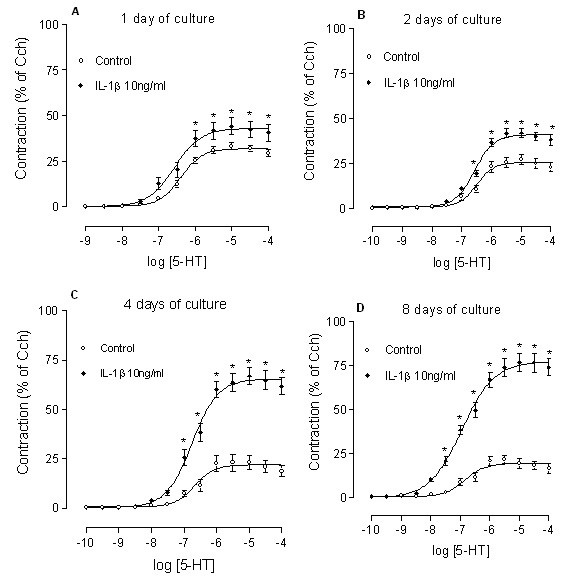
The effect of IL-1beta on 5-hydroxytryptamine (5-HT) induced bronchoconstriction was evaluated in an in-vitro model for assessment of long-term effects of inflammatory mediators on the airway smooth muscle. Murine tracheal segments were cultured up to 8 days in the absence or presence of IL-1beta with subsequent evaluation in a myograph system, along with mRNA quantification, focusing on the role of the epithelium, acetylcholine release, transcriptional mechanisms and MAPK activity.
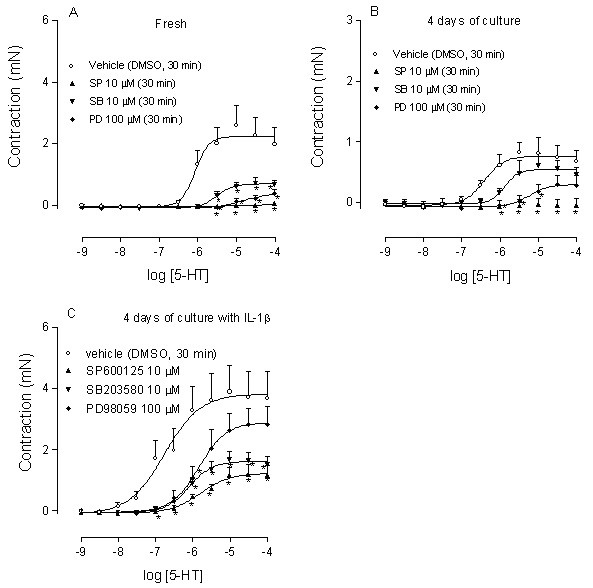
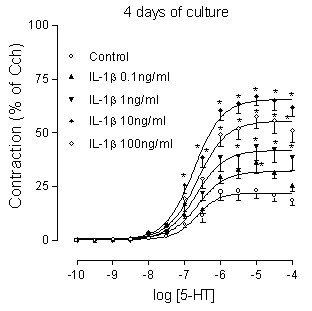
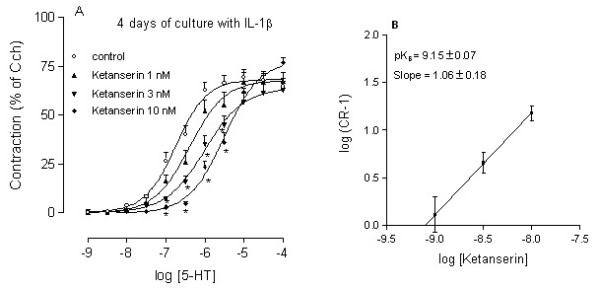
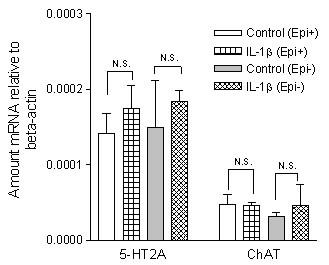
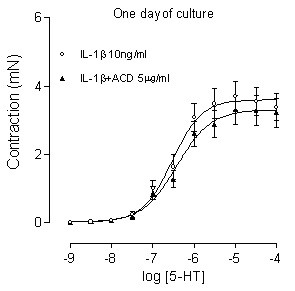
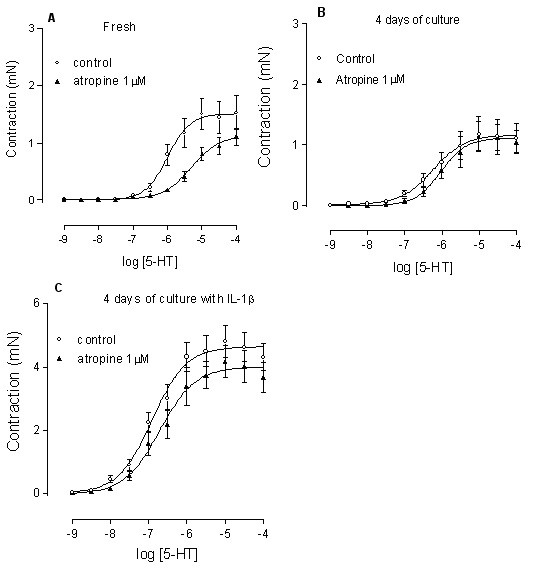
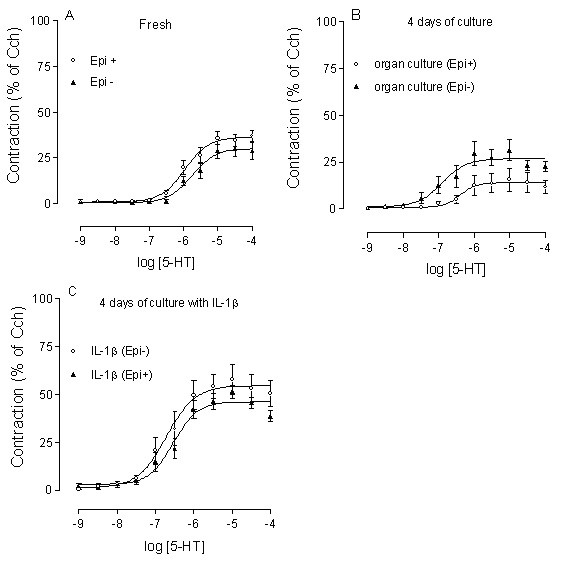
During control conditions, 5-HT induced a relatively weak contraction. Presence of IL-1beta increased this response in a time- and concentration-dependent way. The increased concentration-effect curves could be shifted rightwards in a parallel manner by ketanserin, a selective 5-HT2A receptor antagonist, indicating that the responses are mediated by 5-HT2A receptors. The mRNA levels of 5-HT2A receptors were not changed as a consequence of the IL-1beta treatment and actinomycin D, a general transcriptional inhibitor, failed to affect the contractile response, suggesting a non-transcriptional mechanism behind this phenomenon. Neither the removal of the epithelium nor the addition of atropine affected the IL-1beta induced enhancement of 5-HT2A receptor-mediated contractile response. Application of inhibitors for c-Jun N-terminal kinase (JNK), p38 and extracellular signal-regulated kinase 1 and 2 (ERK1/2) showed that the signaling pathways for JNK and ERK1/2 dominated only in cultured segments (control) whereas JNK and p38 dominated in segments treated with IL-1beta.
IL-1beta induces murine airway hyperresponsiveness, via a non-transcriptional up-regulation of 5-HT2A receptor-mediated contractile response. The increase of 5-HT contraction is unrelated to epithelial and cholinergic factors, but is dependent on IL-1beta-induced changes of MAPK pathways. The fact that IL-1beta can alter airway responses to contractile agents such as 5-HT, via alteration of the intracellular MAPK signal transduction pathways, might provide a new concept for future treatment of asthma.
白细胞介素1β(IL-1β)存在于哮喘患者的支气管肺泡灌洗液中,在正常免疫调节过程以及病理生理炎症反应中均发挥重要作用。本研究旨在调查IL-1β是否参与气道高反应性的发生发展,以及转录机制、上皮收缩因子和丝裂原活化蛋白激酶(MAPK)途径是否参与IL-1β的作用。
在一个用于评估炎症介质对气道平滑肌长期影响的体外模型中,评估IL-1β对5-羟色胺(5-HT)诱导的支气管收缩的作用。将小鼠气管段在无或有IL-1β的情况下培养长达8天,随后在肌动描记系统中进行评估,并进行mRNA定量分析,重点关注上皮的作用、乙酰胆碱释放、转录机制和MAPK活性。
在对照条件下,5-HT诱导相对较弱的收缩。IL-1β的存在以时间和浓度依赖性方式增强了这种反应。选择性5-HT2A受体拮抗剂酮色林可使浓度-效应曲线平行右移,表明这些反应是由5-HT2A受体介导的。IL-1β处理后5-HT2A受体的mRNA水平未发生变化,一般转录抑制剂放线菌素D也未能影响收缩反应,提示该现象背后存在非转录机制。去除上皮或添加阿托品均不影响IL-1β诱导的5-HT2A受体介导的收缩反应增强。应用c-Jun氨基末端激酶(JNK)、p38以及细胞外信号调节激酶1和2(ERK1/2)的抑制剂表明,JNK和ERK1/2的信号通路仅在培养的气管段(对照)中占主导地位,而在IL-1β处理的气管段中JNK和p38占主导地位。
IL-1β通过非转录上调5-HT2A受体介导的收缩反应诱导小鼠气道高反应性。5-HT收缩的增强与上皮和胆碱能因素无关,但依赖于IL-1β诱导的MAPK途径变化。IL-1β可通过改变细胞内MAPK信号转导途径来改变气道对5-HT等收缩剂的反应,这一事实可能为未来哮喘治疗提供新的思路。