Yee Janet, Tang Anita, Lau Wei-Ling, Ritter Heather, Delport Dewald, Page Melissa, Adam Rodney D, Müller Miklós, Wu Gang
Departments of Biology and Chemistry, Biochemistry Program, Trent University, Peterborough, Ontario, Canada.
BMC Mol Biol. 2007 Apr 10;8:26. doi: 10.1186/1471-2199-8-26.
Giardia intestinalis is a protist found in freshwaters worldwide, and is the most common cause of parasitic diarrhea in humans. The phylogenetic position of this parasite is still much debated. Histones are small, highly conserved proteins that associate tightly with DNA to form chromatin within the nucleus. There are two classes of core histone genes in higher eukaryotes: DNA replication-independent histones and DNA replication-dependent ones.
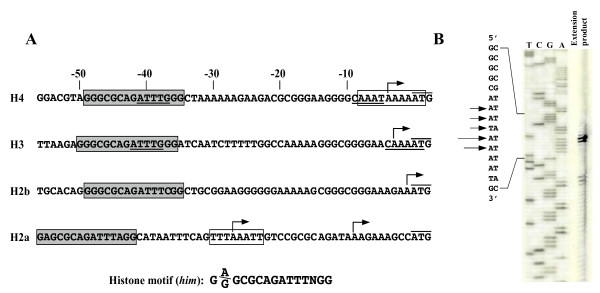
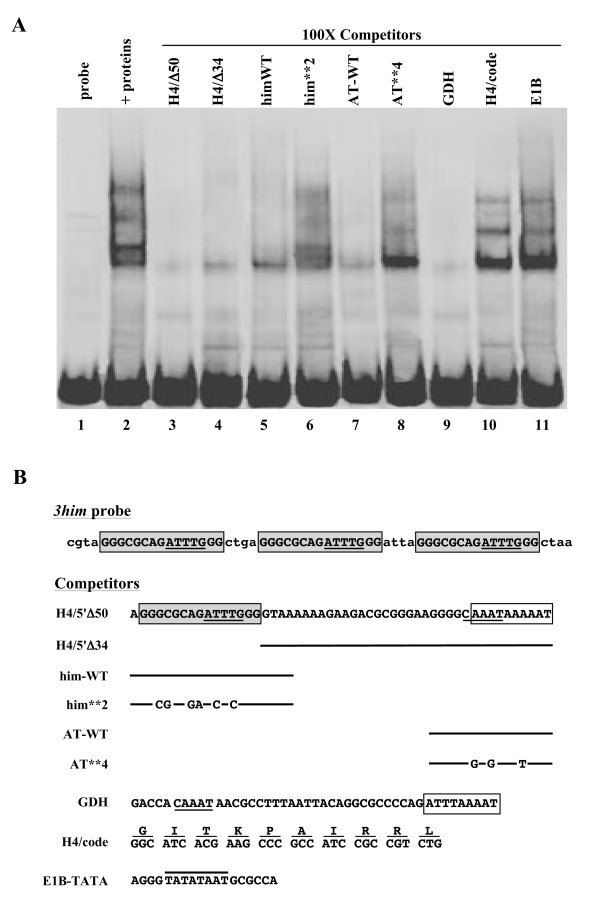
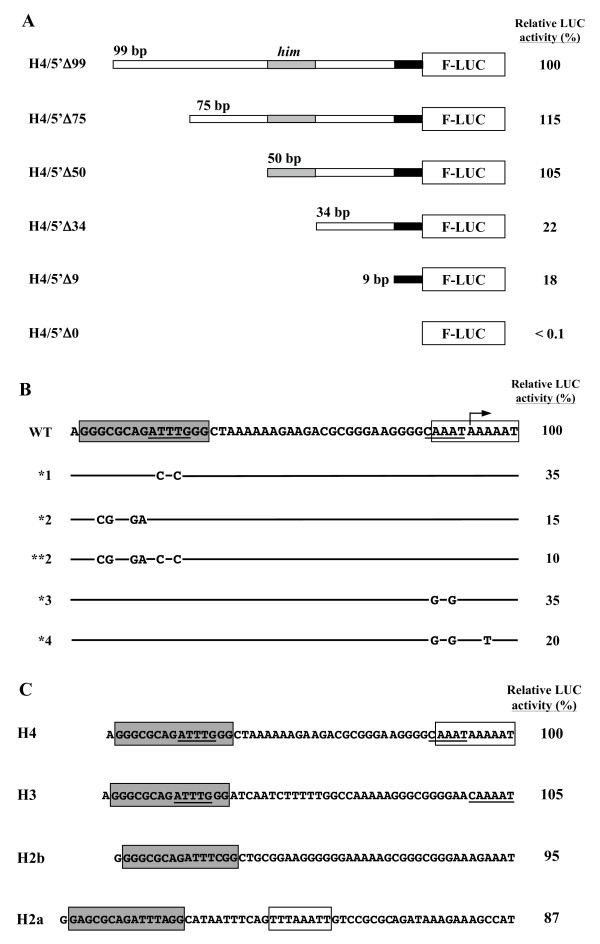
We identified two copies each of the core histone H2a, H2b and H3 genes, and three copies of the H4 gene, at separate locations on chromosomes 3, 4 and 5 within the genome of Giardia intestinalis, but no gene encoding a H1 linker histone could be recognized. The copies of each gene share extensive DNA sequence identities throughout their coding and 5' noncoding regions, which suggests these copies have arisen from relatively recent gene duplications or gene conversions. The transcription start sites are at triplet A sequences 1-27 nucleotides upstream of the translation start codon for each gene. We determined that a 50 bp region upstream from the start of the histone H4 coding region is the minimal promoter, and a highly conserved 15 bp sequence called the histone motif (him) is essential for its activity. The Giardia core histone genes are constitutively expressed at approximately equivalent levels and their mRNAs are polyadenylated. Competition gel-shift experiments suggest that a factor within the protein complex that binds him may also be a part of the protein complexes that bind other promoter elements described previously in Giardia.
In contrast to other eukaryotes, the Giardia genome has only a single class of core histone genes that encode replication-independent histones. Our inability to locate a gene encoding the linker histone H1 leads us to speculate that the H1 protein may not be required for the compaction of Giardia's small and gene-rich genome.
肠道贾第虫是一种存在于世界各地淡水中的原生生物,是人类寄生性腹泻最常见的病因。这种寄生虫的系统发育位置仍存在诸多争议。组蛋白是一类小的、高度保守的蛋白质,它们与DNA紧密结合,在细胞核内形成染色质。高等真核生物中有两类核心组蛋白基因:不依赖DNA复制的组蛋白基因和依赖DNA复制的组蛋白基因。
我们在肠道贾第虫基因组的3号、4号和5号染色体的不同位置分别鉴定出两个核心组蛋白H2a、H2b和H3基因拷贝,以及三个H4基因拷贝,但未识别到编码H1连接组蛋白的基因。每个基因的拷贝在其编码区和5'非编码区都有广泛的DNA序列同一性,这表明这些拷贝是相对较新的基因复制或基因转换产生的。转录起始位点位于每个基因翻译起始密码子上游1 - 27个核苷酸的三联体A序列处。我们确定组蛋白H4编码区起始上游50 bp的区域是最小启动子,一个高度保守的15 bp序列,称为组蛋白基序(him),对其活性至关重要。肠道贾第虫核心组蛋白基因以大致相等的水平组成性表达,其mRNA进行了多聚腺苷酸化。竞争凝胶迁移实验表明,与him结合的蛋白质复合物中的一个因子可能也是先前在贾第虫中描述的与其他启动子元件结合的蛋白质复合物的一部分。
与其他真核生物不同,肠道贾第虫基因组只有一类编码不依赖复制的组蛋白的核心组蛋白基因。我们无法定位编码连接组蛋白H1的基因,这使我们推测H1蛋白可能不是肠道贾第虫小而基因丰富的基因组压缩所必需的。