Yuan Faqing, Griffin Laura, Phelps LauraJane, Buschmann Volker, Weston Kenneth, Greenbaum Nancy L
Department of Chemistry and Biochemistry, Florida State University, Tallahassee, FL 32306, USA.
Nucleic Acids Res. 2007;35(9):2833-45. doi: 10.1093/nar/gkm134. Epub 2007 Apr 11.
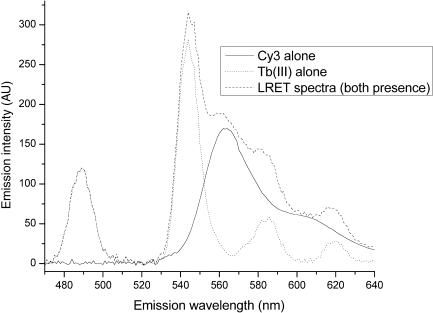
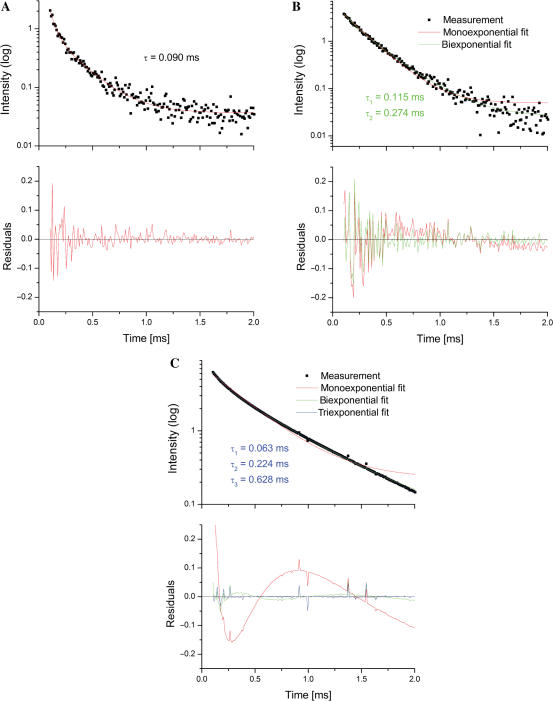
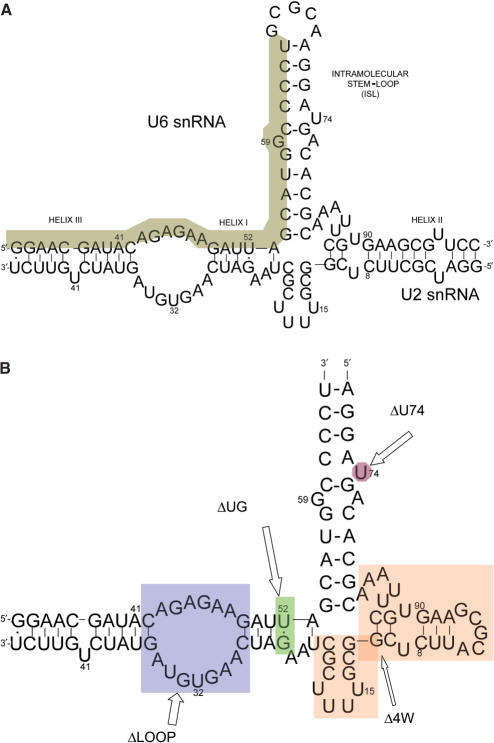
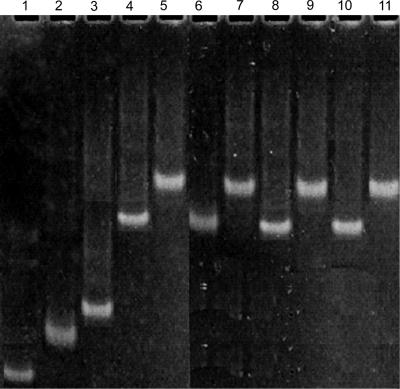
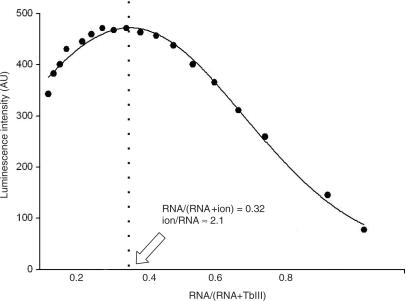
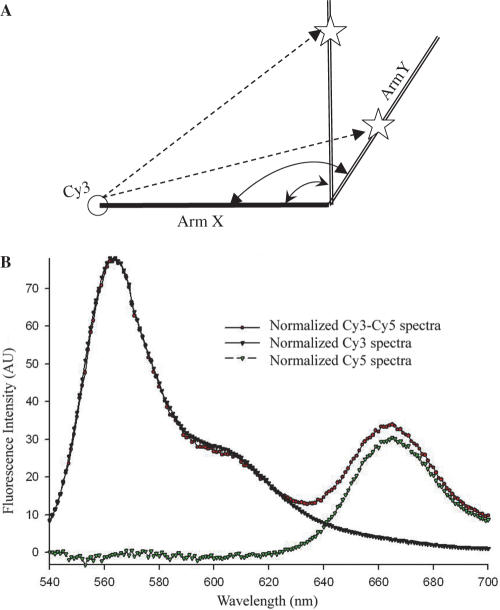
U2 and U6 snRNAs pair to form a phylogenetically conserved complex at the catalytic core of the spliceosome. Interactions with divalent metal ions, particularly Mg(II), at specific sites are essential for its folding and catalytic activity. We used a novel Förster resonance energy transfer (FRET) method between site-bound luminescent lanthanide ions and a covalently attached fluorescent dye, combined with supporting stoichiometric and mutational studies, to determine locations of site-bound Tb(III) within the human U2-U6 complex. At pH 7.2, we detected three metal-ion-binding sites in: (1) the consensus ACACAGA sequence, which forms the internal loop between helices I and III; (2) the four-way junction, which contains the conserved AGC triad; and (3) the internal loop of the U6 intra-molecular stem loop (ISL). Binding at each of these sites is supported by previous phosphorothioate substitution studies and, in the case of the ISL site, by NMR. Binding of Tb(III) at the four-way junction and the ISL sites was found to be pH-dependent, with no ion binding observed below pH 6 and 7, respectively. This pH dependence of metal ion binding suggests that the local environment may play a role in the binding of metal ions, which may impact on splicing activity.
U2和U6小核核糖核酸(snRNAs)相互配对,在剪接体的催化核心形成一个系统发育保守的复合体。在特定位点与二价金属离子,特别是镁离子(Mg(II))的相互作用对其折叠和催化活性至关重要。我们使用了一种新型的荧光共振能量转移(FRET)方法,该方法利用位点结合的发光镧系离子与共价连接的荧光染料之间的作用,并结合支持性的化学计量学和突变研究,来确定人U2-U6复合体中位点结合的铽(Tb(III))的位置。在pH 7.2时,我们在以下位置检测到三个金属离子结合位点:(1)共有序列ACACAGA,其形成螺旋I和III之间的内环;(2)包含保守AGC三联体的四向接头;(3)U6分子内茎环(ISL)的内环。之前的硫代磷酸酯取代研究支持了在这些位点的每一个的结合,就ISL位点而言,核磁共振(NMR)也提供了支持。发现Tb(III)在四向接头和ISL位点的结合是pH依赖性的,分别在pH 6和7以下未观察到离子结合。金属离子结合的这种pH依赖性表明,局部环境可能在金属离子的结合中起作用,这可能会影响剪接活性。