Miller David J, Hemmrich Georg, Ball Eldon E, Hayward David C, Khalturin Konstantin, Funayama Noriko, Agata Kiyokazu, Bosch Thomas C G
ARC Centre of Excellence in Coral Reef Studies and Comparative Genomics Centre, James Cook University, Townsville, Queensland, Australia.
Genome Biol. 2007;8(4):R59. doi: 10.1186/gb-2007-8-4-r59.
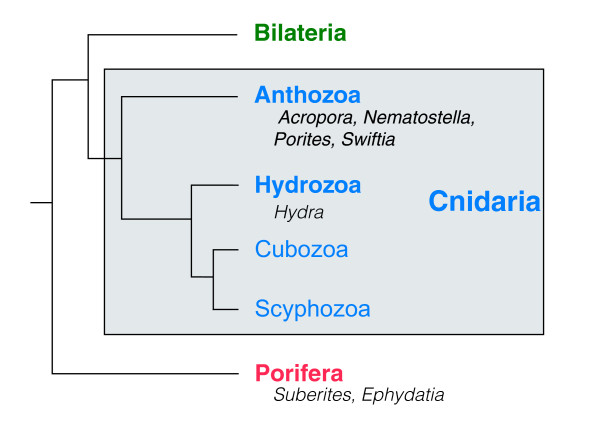
Characterization of the innate immune repertoire of extant cnidarians is of both fundamental and applied interest--it not only provides insights into the basic immunological 'tool kit' of the common ancestor of all animals, but is also likely to be important in understanding the global decline of coral reefs that is presently occurring. Recently, whole genome sequences became available for two cnidarians, Hydra magnipapillata and Nematostella vectensis, and large expressed sequence tag (EST) datasets are available for these and for the coral Acropora millepora.
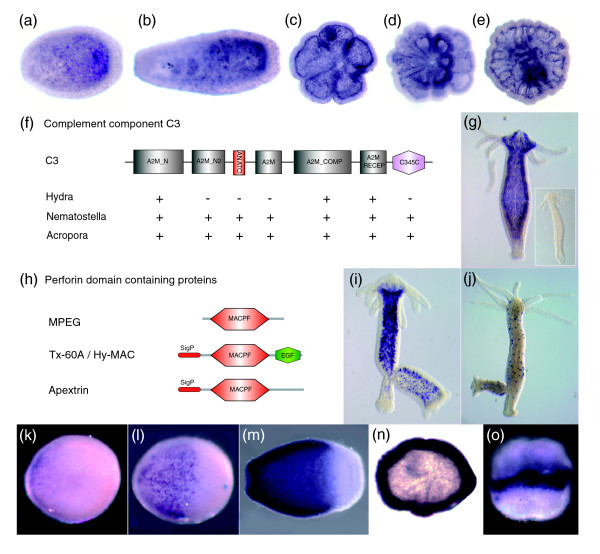
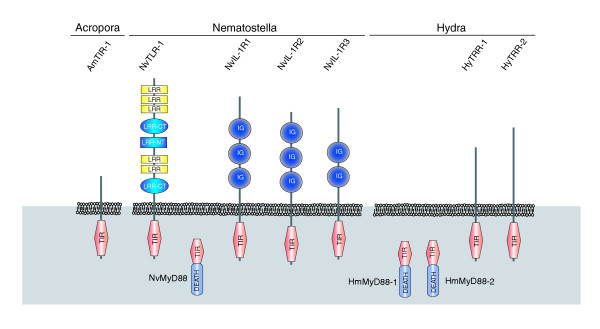
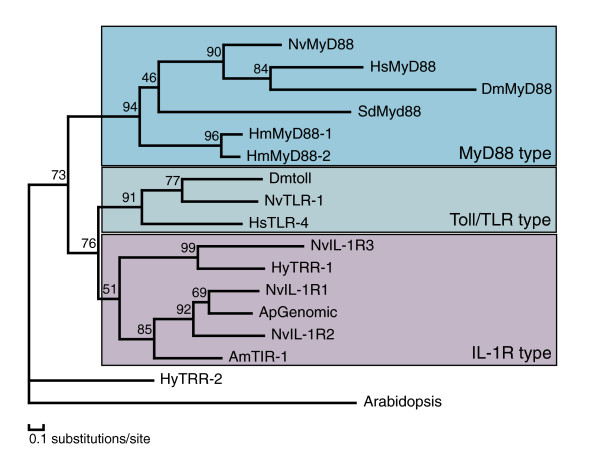
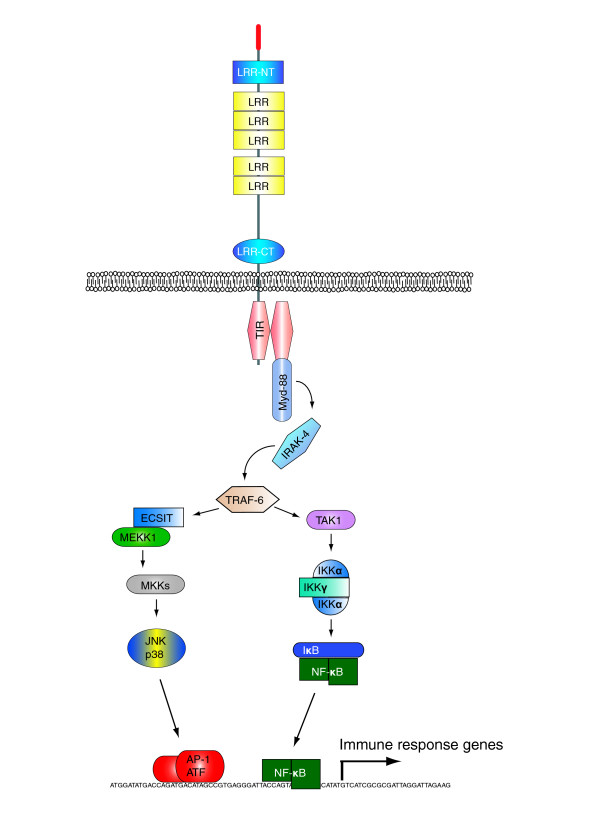
To better understand the basis of innate immunity in cnidarians, we scanned the available EST and genomic resources for some of the key components of the vertebrate innate immune repertoire, focusing on the Toll/Toll-like receptor (TLR) and complement pathways. A canonical Toll/TLR pathway is present in representatives of the basal cnidarian class Anthozoa, but neither a classic Toll/TLR receptor nor a conventional nuclear factor (NF)-kappaB could be identified in the anthozoan Hydra. Moreover, the detection of complement C3 and several membrane attack complex/perforin domain (MAC/PF) proteins suggests that a prototypic complement effector pathway may exist in anthozoans, but not in hydrozoans. Together with data for several other gene families, this implies that Hydra may have undergone substantial secondary gene loss during evolution. Such losses are not confined to Hydra, however, and at least one MAC/PF gene appears to have been lost from Nematostella.
Consideration of these patterns of gene distribution underscores the likely significance of gene loss during animal evolution whilst indicating ancient origins for many components of the vertebrate innate immune system.
现存刺胞动物先天免疫库的特征研究具有基础和应用两方面的意义——它不仅能让我们深入了解所有动物共同祖先的基本免疫“工具包”,还可能对理解当前正在发生的珊瑚礁全球衰退至关重要。最近,两种刺胞动物——巨大乳头水螅和星状海葵——的全基因组序列已可获取,并且针对这些动物以及珊瑚多孔鹿角珊瑚,也有大量的表达序列标签(EST)数据集。
为了更好地理解刺胞动物先天免疫的基础,我们在可用的EST和基因组资源中搜索了脊椎动物先天免疫库的一些关键组成部分,重点关注Toll/Toll样受体(TLR)和补体途径。在基部刺胞动物珊瑚纲的代表物种中存在典型的Toll/TLR途径,但在珊瑚纲动物水螅中既未鉴定出经典的Toll/TLR受体,也未发现传统的核因子(NF)-κB。此外,补体C3和几种膜攻击复合物/穿孔素结构域(MAC/PF)蛋白的检测表明,珊瑚纲动物中可能存在原型补体效应途径,但水螅纲动物中不存在。结合其他几个基因家族的数据,这意味着水螅在进化过程中可能经历了大量的次生基因丢失。然而,这种丢失并不局限于水螅,星状海葵中至少有一个MAC/PF基因似乎也已丢失。
对这些基因分布模式的思考强调了动物进化过程中基因丢失的可能重要性,同时也表明脊椎动物先天免疫系统的许多组成部分起源古老。