Shan Sun, Qi-Liang Mao-Ying, Hong Cao, Tingting Li, Mei Han, Haili Pan, Yan-Qing Wang, Zhi-Qi Zhao, Yu-Qiu Zhang
Institute of Neurobiology, Institutes of Brain Science, Fudan University, 138 Yixueyuan Road, Shanghai 200032, China.
Neurobiol Dis. 2007 Jun;26(3):558-68. doi: 10.1016/j.nbd.2007.02.007. Epub 2007 Feb 23.
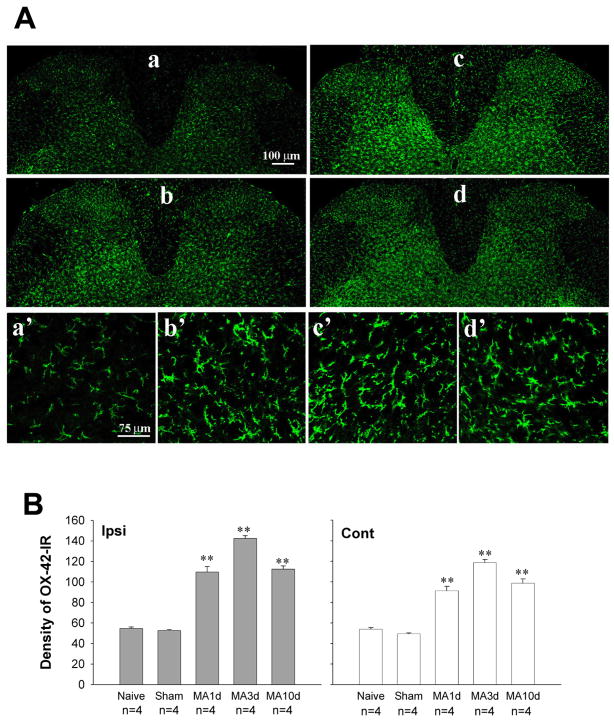
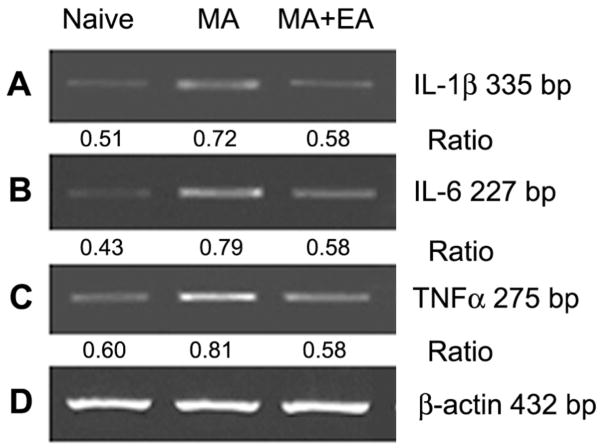
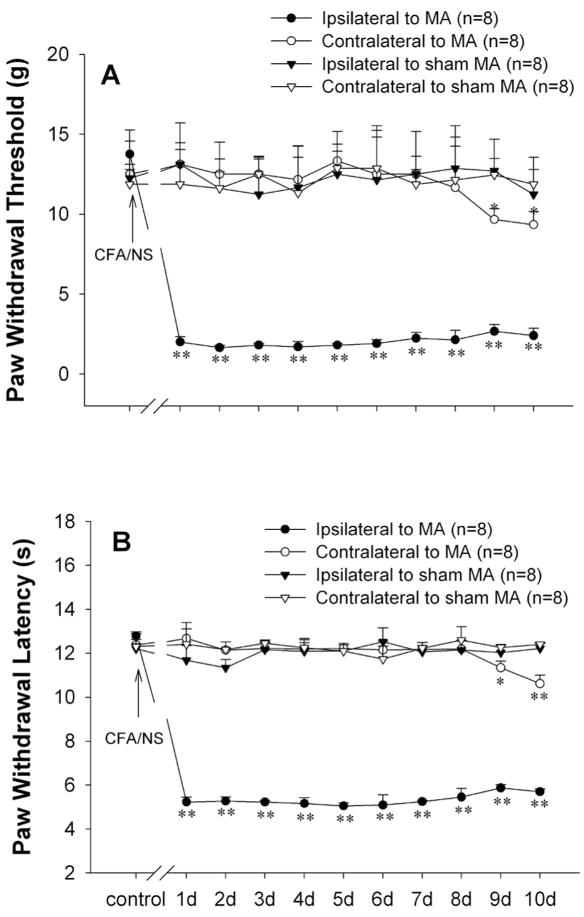
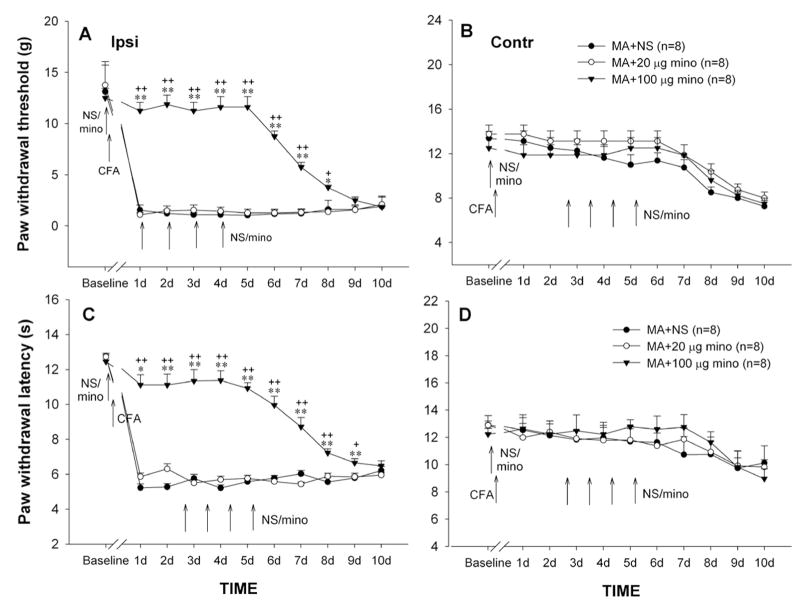
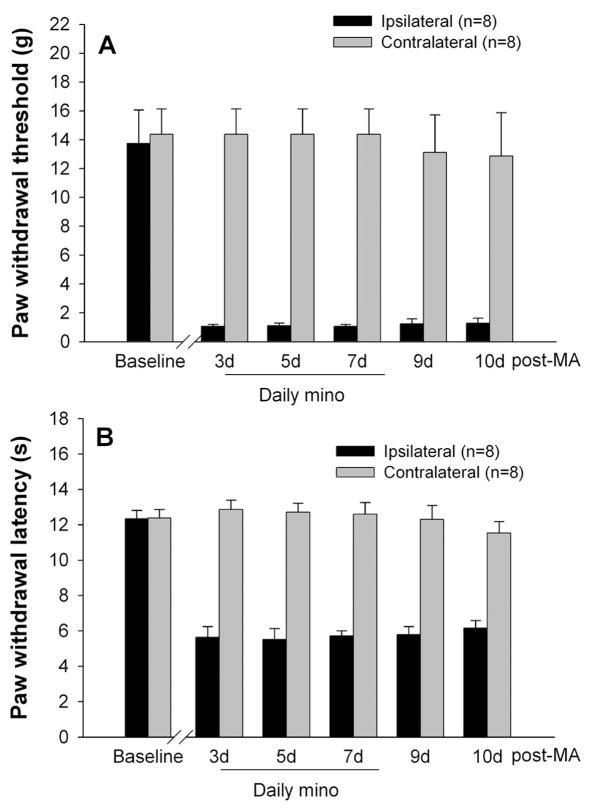
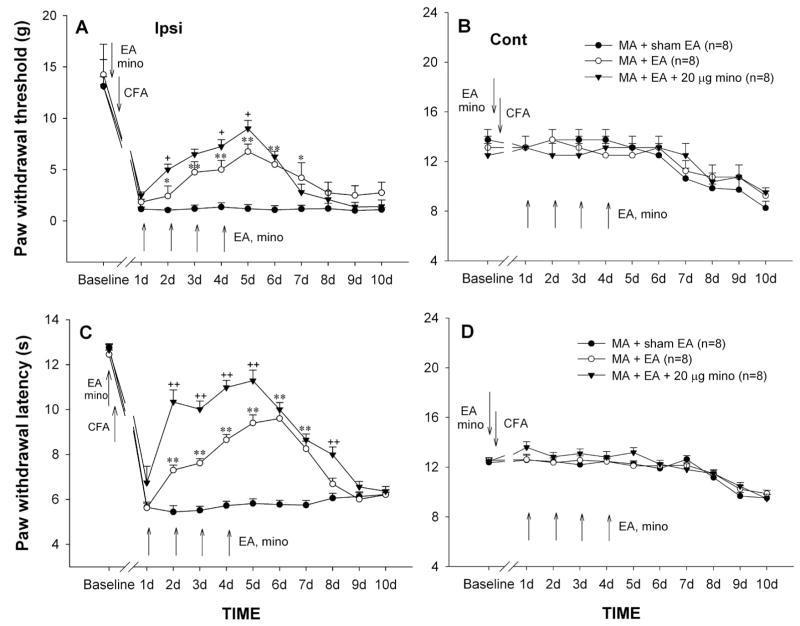
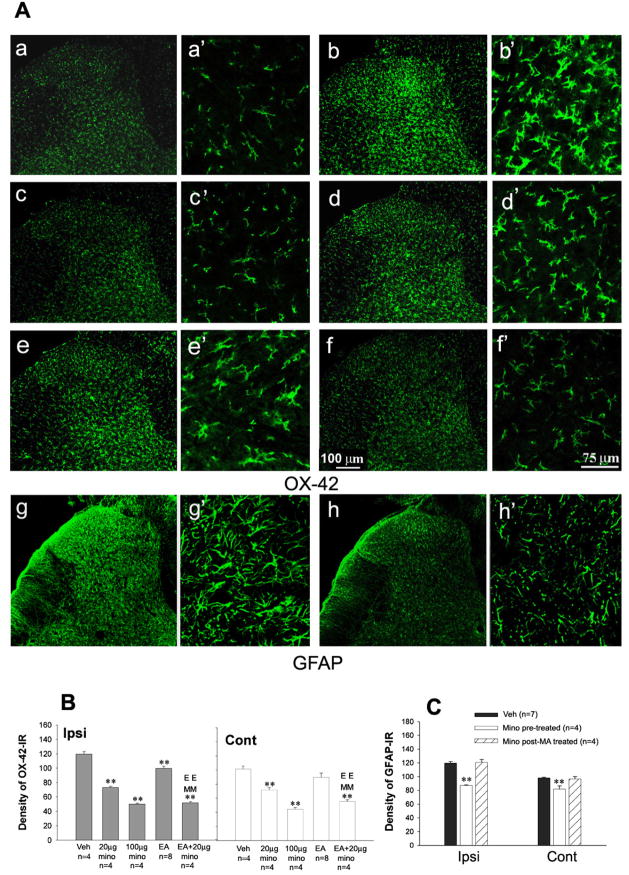
Spinal microglia play a key role for creating exaggerated pain following tissues inflammation or injury. Electroacupuncture (EA) can effectively control the exaggerated pain both in humans with inflammatory disease and animals with experimental inflammatory pain. However, little is known about the relationship between spinal glial activation and EA analgesia. Using immunohistochemistry, RT-PCR analysis, and behavioral testing, the present study demonstrated that (1) Unilateral intra-articular injection of CFA produced a robust microglial activation and the up-regulation of the tumor necrosis factor (TNF)-alpha, interleukin (IL-1beta), and IL-6 mRNA levels in the spinal cord; (2) Repeated intrathecal (i.t.) injection of minocycline (100 microg), a microglial inhibitor, or EA stimulation of ipsilateral "Huantiao"(GB30) and "Yanglingquan" (GB34) acupoints significantly suppressed CFA-induced nociceptive behavioral hypersensitivity and spinal microglial activation; (3) Combination of EA with minocycline significantly enhanced the inhibitory effects of EA on allodynia and hyperalgesia. For the first time, these data provide direct evidence for the involvement of spinal microglial functional state in anti-nociception of EA. Thus, anti-neuroinflammatory effect of EA might be considered as one of the mechanisms of its anti-arthritic pain effects, and thereby a multidisciplinary integrated approach to treating symptoms related to arthritis might be raised.
脊髓小胶质细胞在组织炎症或损伤后引发疼痛敏化中起关键作用。电针(EA)能有效控制炎症性疾病患者及实验性炎性疼痛动物的疼痛敏化。然而,关于脊髓胶质细胞激活与电针镇痛之间的关系却知之甚少。本研究运用免疫组织化学、逆转录-聚合酶链反应(RT-PCR)分析及行为学测试,结果表明:(1)单侧关节腔内注射弗氏完全佐剂(CFA)可引起脊髓小胶质细胞显著激活,并使脊髓中肿瘤坏死因子(TNF)-α、白细胞介素(IL)-1β及IL-6的mRNA水平上调;(2)反复鞘内注射小胶质细胞抑制剂米诺环素(100μg)或电针刺激同侧“环跳”(GB30)和“阳陵泉”(GB34)穴位,可显著抑制CFA诱导的伤害性行为过敏及脊髓小胶质细胞激活;(3)电针与米诺环素联合使用可显著增强电针对异常性疼痛和痛觉过敏的抑制作用。这些数据首次为脊髓小胶质细胞功能状态参与电针镇痛提供了直接证据。因此,电针的抗神经炎症作用可能被视为其抗关节炎疼痛作用的机制之一,从而可能提出一种多学科综合方法来治疗与关节炎相关的症状。