Wilson Charles R E, Gaffan David, Mitchell Anna S, Baxter Mark G
Department of Experimental Psychology, Oxford University, South Parks Road, Oxford OX1 3UD, United Kingdom.
Eur J Neurosci. 2007 Apr;25(8):2514-22. doi: 10.1111/j.1460-9568.2007.05468.x.
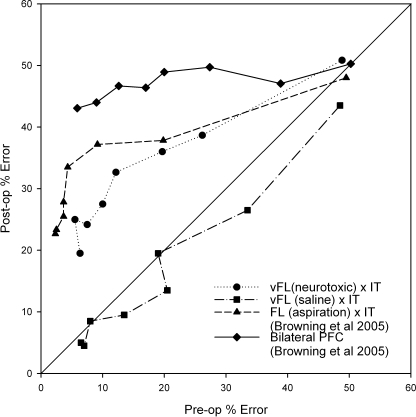
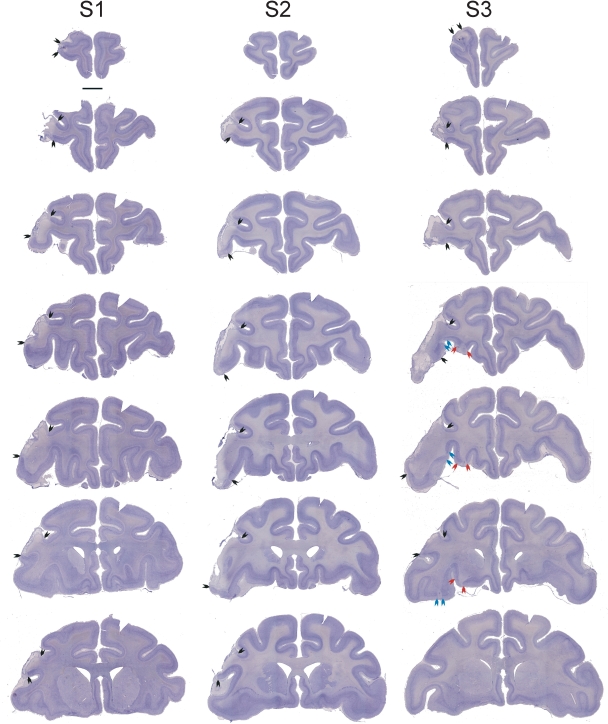
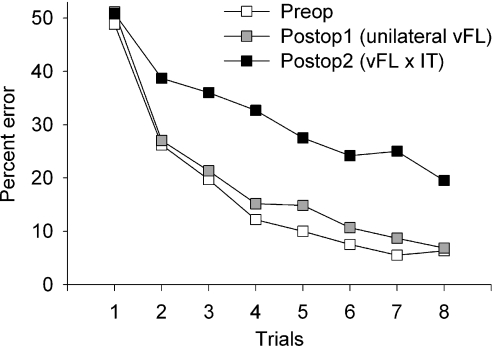
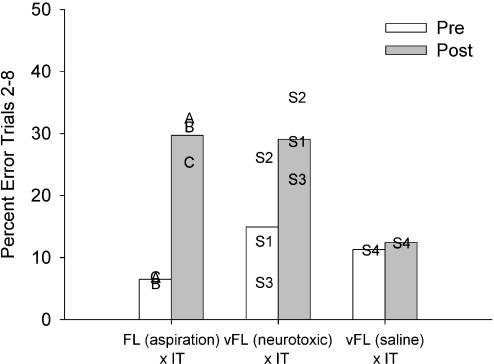
Disconnection of the frontal lobe from the inferotemporal cortex produces deficits in a number of cognitive tasks that require the application of memory-dependent rules to visual stimuli. The specific regions of frontal cortex that interact with the temporal lobe in performance of these tasks remain undefined. One capacity that is impaired by frontal-temporal disconnection is rapid learning of new object-in-place scene problems, in which visual discriminations between two small typographic characters are learned in the context of different visually complex scenes. In the present study, we examined whether neurotoxic lesions of ventrolateral prefrontal cortex in one hemisphere, combined with ablation of inferior temporal cortex in the contralateral hemisphere, would impair learning of new object-in-place scene problems. Male macaque monkeys learned 10 or 20 new object-in-place problems in each daily test session. Unilateral neurotoxic lesions of ventrolateral prefrontal cortex produced by multiple injections of a mixture of ibotenate and N-methyl-D-aspartate did not affect performance. However, when disconnection from inferotemporal cortex was completed by ablating this region contralateral to the neurotoxic prefrontal lesion, new learning was substantially impaired. Sham disconnection (injecting saline instead of neurotoxin contralateral to the inferotemporal lesion) did not affect performance. These findings support two conclusions: first, that the ventrolateral prefrontal cortex is a critical area within the frontal lobe for scene memory; and second, the effects of ablations of prefrontal cortex can be confidently attributed to the loss of cell bodies within the prefrontal cortex rather than to interruption of fibres of passage through the lesioned area.
额叶与颞下皮质的连接中断会导致一系列认知任务出现缺陷,这些任务需要将依赖记忆的规则应用于视觉刺激。在执行这些任务时,额叶皮质中与颞叶相互作用的特定区域仍不明确。额叶 - 颞叶连接中断会损害的一种能力是快速学习新的物体 - 位置场景问题,即在不同视觉复杂场景的背景下学习两个小印刷字符之间的视觉辨别。在本研究中,我们研究了一侧半球腹外侧前额叶皮质的神经毒性损伤与对侧半球颞下皮质的切除相结合,是否会损害新的物体 - 位置场景问题的学习。雄性猕猴在每个每日测试环节中学习10个或20个新的物体 - 位置问题。通过多次注射鹅膏蕈氨酸和N - 甲基 - D - 天冬氨酸的混合物产生的腹外侧前额叶皮质单侧神经毒性损伤并不影响表现。然而,当通过切除与神经毒性前额叶损伤对侧的该区域来完成与颞下皮质的连接中断时,新的学习受到显著损害。假连接(在颞下损伤对侧注射生理盐水而非神经毒素)不影响表现。这些发现支持两个结论:第一,腹外侧前额叶皮质是额叶内对场景记忆至关重要的区域;第二,前额叶皮质切除的影响可以可靠地归因于前额叶皮质内细胞体的丧失,而不是由于通过损伤区域的纤维通路中断。