Gross Joachim, Schnitzler Alfons, Timmermann Lars, Ploner Markus
Department of Neurology, Heinrich-Heine-University, Düsseldorf, Germany.
PLoS Biol. 2007 May;5(5):e133. doi: 10.1371/journal.pbio.0050133.
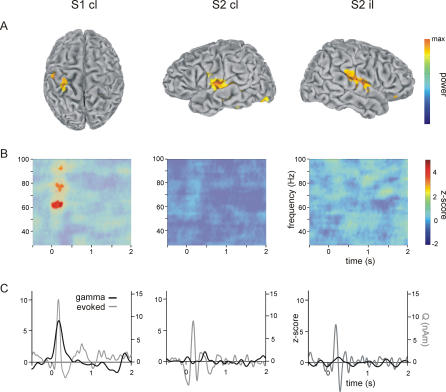
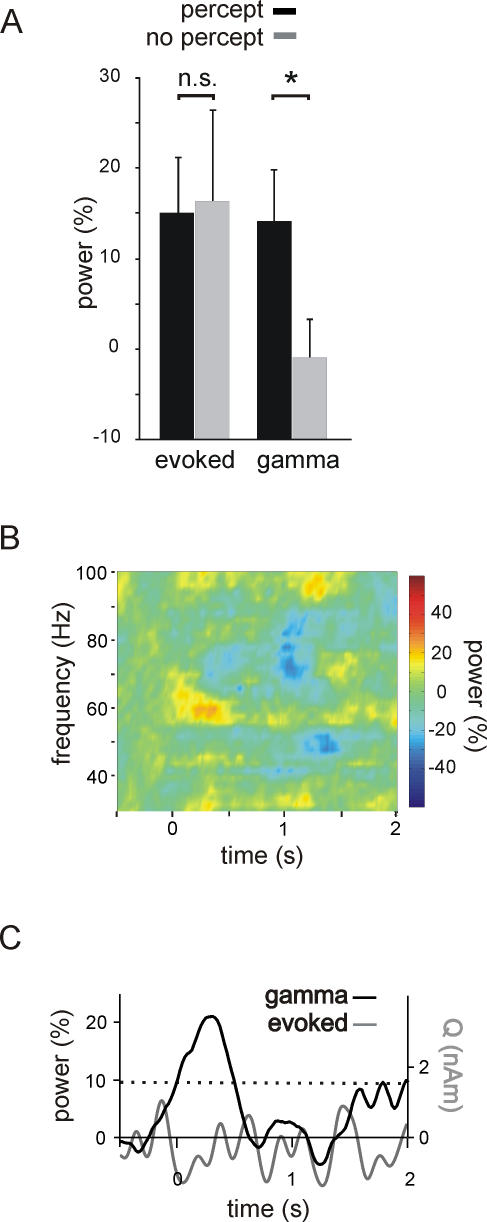
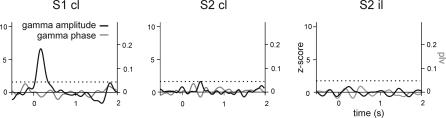
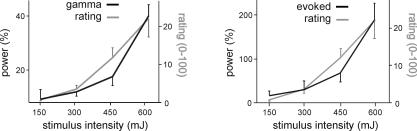
Successful behavior requires selection and preferred processing of relevant sensory information. The cortical representation of relevant sensory information has been related to neuronal oscillations in the gamma frequency band. Pain is of invariably high behavioral relevance and, thus, nociceptive stimuli receive preferred processing. Here, by using magnetoencephalography, we show that selective nociceptive stimuli induce gamma oscillations between 60 and 95 Hz in primary somatosensory cortex. Amplitudes of pain-induced gamma oscillations vary with objective stimulus intensity and subjective pain intensity. However, around pain threshold, perceived stimuli yielded stronger gamma oscillations than unperceived stimuli of equal stimulus intensity. These results show that pain induces gamma oscillations in primary somatosensory cortex that are particularly related to the subjective perception of pain. Our findings support the hypothesis that gamma oscillations are related to the internal representation of behaviorally relevant stimuli that should receive preferred processing.
成功的行为需要对相关感觉信息进行选择和优先处理。相关感觉信息的皮层表征与γ频段的神经元振荡有关。疼痛始终具有高度的行为相关性,因此,伤害性刺激会得到优先处理。在这里,通过使用脑磁图,我们表明选择性伤害性刺激会在初级体感皮层中诱发60至95赫兹的γ振荡。疼痛诱发的γ振荡幅度随客观刺激强度和主观疼痛强度而变化。然而,在疼痛阈值附近,与同等刺激强度下未被感知的刺激相比,被感知的刺激产生更强的γ振荡。这些结果表明,疼痛在初级体感皮层中诱发γ振荡,这与疼痛的主观感知特别相关。我们的发现支持这样一种假设,即γ振荡与行为相关刺激的内部表征有关,这些刺激应得到优先处理。