Stern Anna, Laughlin Gail A, Bergstrom Jaclyn, Barrett-Connor Elizabeth
Department of Family and Preventive Medicine, School of Medicine, University of California, San Diego, 9500 Gilman Drive, La Jolla, California 92093-0607, USA.
Eur J Endocrinol. 2007 May;156(5):555-62. doi: 10.1530/EJE-06-0753.
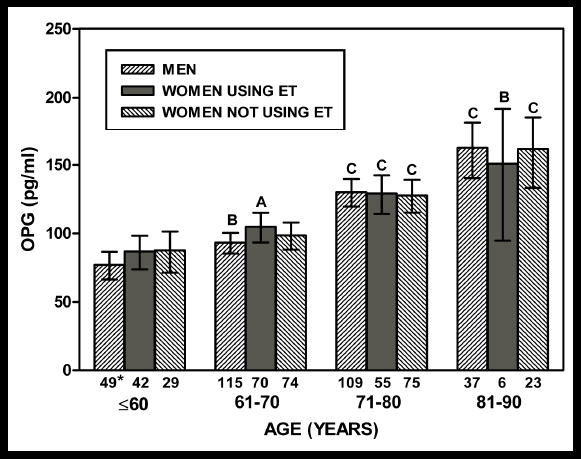
The role of osteoprotegerin (OPG) and its receptor activator of nuclear factor kappaB legend (RANKL) in the regulation of bone in humans remain unclear. We examined the sex-specific associations of serum OPG, RANKL, and their ratio with bone mineral density (BMD) in older adults.
Participants were 681 community-dwelling adults, ages 45-90 years, who had serum OPG and RANKL measured and bone density scans in 1988-1991, with follow-up scans 5 and/or 10 years later.
Analyses were sex-specific; women using and not using estrogen were evaluated separately. Cross-sectional analyses used multivariable regression models; longitudinal analyses used repeated measures mixed effects models.
In cross-sectional analyses, age- and weight-adjusted serum OPG levels were significantly positively associated with BMD at the lumbar spine in men, and at the femoral neck, total hip, and lumbar spine in women using estrogen, but not in non-users of estrogen. RANKL concentrations were significantly and inversely associated with BMD in men only, and at the total hip. Neither OPG nor RANKL was significantly associated with bone loss. Results for the RANKL/OPG ratio were the same as those for RANKL alone.
These results suggest a modulatory effect of both endogenous and exogenous sex hormones on the biologic interaction of OPG, RANKL, and bone.
骨保护素(OPG)及其核因子κB受体活化因子配体(RANKL)在人体骨骼调节中的作用仍不明确。我们研究了老年人血清OPG、RANKL及其比值与骨密度(BMD)的性别特异性关联。
参与者为681名年龄在45 - 90岁的社区居住成年人,他们在1988 - 1991年测量了血清OPG和RANKL并进行了骨密度扫描,5年和/或10年后进行了随访扫描。
分析按性别进行;分别评估使用和未使用雌激素的女性。横断面分析使用多变量回归模型;纵向分析使用重复测量混合效应模型。
在横断面分析中,年龄和体重调整后的血清OPG水平在男性中与腰椎骨密度显著正相关,在使用雌激素的女性中与股骨颈、全髋和腰椎骨密度显著正相关,但在未使用雌激素的女性中无此关联。RANKL浓度仅在男性中以及在全髋与骨密度显著负相关。OPG和RANKL均与骨质流失无显著关联。RANKL/OPG比值的结果与单独的RANKL相同。
这些结果表明内源性和外源性性激素对OPG、RANKL与骨骼的生物学相互作用具有调节作用。