Ogino Shuji, Kawasaki Takako, Kirkner Gregory J, Ohnishi Mutsuko, Fuchs Charles S
Department of Medical Oncology, Dana-Farber Cancer Institute, Boston, MA 02115, USA.
BMC Cancer. 2007 May 2;7:72. doi: 10.1186/1471-2407-7-72.
The CpG island methylator phenotype (CIMP) with widespread promoter methylation is a distinct epigenetic phenotype in colorectal cancer, associated with microsatellite instability-high (MSI-high) and BRAF mutations. 18q loss of heterozygosity (LOH) commonly present in colorectal cancer with chromosomal instability (CIN) is associated with global hypomethylation in tumor cell. A recent study has shown an inverse correlation between CIN and CIMP (determined by MINTs, p16, p14 and MLH1 methylation) in colorectal cancer. However, no study has examined 18q LOH in relation to CIMP-high, CIMP-low (less extensive promoter methylation) and CIMP-0 (CIMP-negative), determined by quantitative DNA methylation analysis.
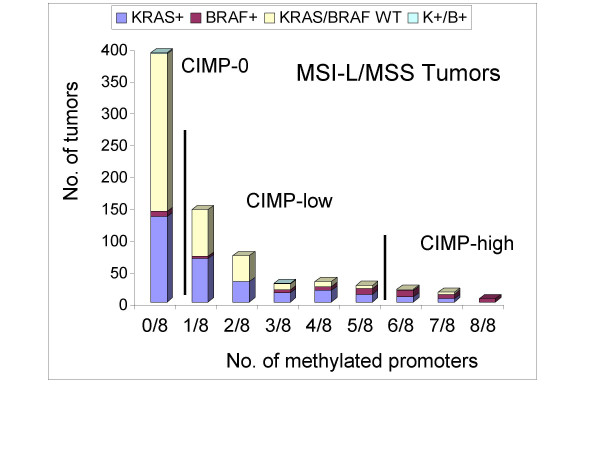
Utilizing MethyLight technology (real-time PCR), we quantified DNA methylation in 8 CIMP-specific promoters {CACNA1G, CDKN2A (p16), CRABP1, IGF2, MLH1, NEUROG1, RUNX3 and SOCS1} in 758 non-MSI-high colorectal cancers obtained from two large prospective cohorts. Using four 18q microsatellite markers (D18S55, D18S56, D18S67 and D18S487) and stringent criteria for 18q LOH, we selected 374 tumors (236 LOH-positive tumors with > or = 2 markers showing LOH; and 138 LOH-negative tumors with > or = 3 informative markers and no LOH).
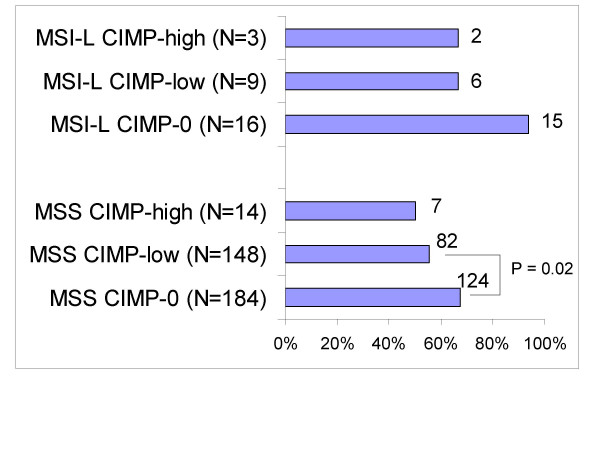
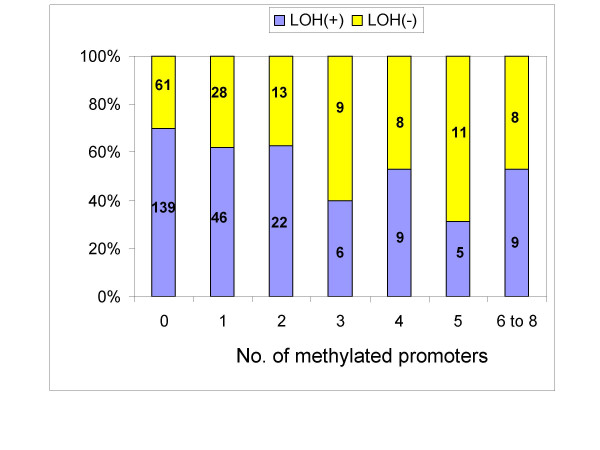
CIMP-0 (0/8 methylated promoters) was significantly more common in 18q LOH-positive tumors (59% = 139/236, p = 0.002) than 18q LOH-negative tumors (44% = 61/138), while CIMP-low/high (1/8-8/8 methylated promoters) was significantly more common (56%) in 18q LOH-negative tumors than 18q LOH-positive tumors (41%). These relations persisted after stratification by sex, location, or the status of MSI, p53 expression (by immunohistochemistry), or KRAS/BRAF mutation.
18q LOH is correlated positively with CIMP-0 and inversely with CIMP-low and CIMP-high. Our findings provide supporting evidence for relationship between CIMP-0 and 18q LOH as well as a molecular difference between CIMP-0 and CIMP-low in colorectal cancer.
具有广泛启动子甲基化的CpG岛甲基化表型(CIMP)是结直肠癌中一种独特的表观遗传表型,与微卫星高度不稳定(MSI-high)及BRAF突变相关。18号染色体杂合性缺失(LOH)常见于具有染色体不稳定(CIN)的结直肠癌中,与肿瘤细胞的整体低甲基化有关。最近一项研究显示,结直肠癌中CIN与CIMP(由MINTs、p16、p14和MLH1甲基化确定)呈负相关。然而,尚无研究通过定量DNA甲基化分析来检测18q LOH与高CIMP、低CIMP(启动子甲基化程度较低)及CIMP-0(CIMP阴性)之间的关系。
利用甲基化荧光定量技术(实时PCR),我们对从两个大型前瞻性队列中获取的758例非MSI-high结直肠癌中8个CIMP特异性启动子(CACNA1G、CDKN2A(p16)、CRABP1、IGF2、MLH1、NEUROG1、RUNX3和SOCS1)的DNA甲基化进行了定量分析。使用4个18号染色体微卫星标记(D18S55、D18S56、D18S67和D18S487)以及严格的18q LOH标准,我们筛选出374例肿瘤(236例LOH阳性肿瘤,有≥2个标记显示LOH;138例LOH阴性肿瘤,有≥3个信息性标记且无LOH)。
CIMP-0(0/8个甲基化启动子)在18q LOH阳性肿瘤中(59% = 139/236,p = 0.002)比18q LOH阴性肿瘤(44% = 61/138)更为常见,而低/高CIMP(1/8 - 8/8个甲基化启动子)在18q LOH阴性肿瘤中(56%)比18q LOH阳性肿瘤(41%)更为常见。在按性别、肿瘤位置、MSI状态、p53表达(通过免疫组织化学)或KRAS/BRAF突变进行分层后,这些关系依然存在。
18q LOH与CIMP-0呈正相关,与低CIMP和高CIMP呈负相关。我们的研究结果为CIMP-0与18q LOH之间的关系以及结直肠癌中CIMP-0与低CIMP之间的分子差异提供了支持性证据。