Tahiri Youssef, Karpe Fredrik, Tan Garry D, Cianflone Katherine
Medicine, McGill University, Montreal, H3A 1A1, Canada.
Nutr Metab (Lond). 2007 May 9;4:11. doi: 10.1186/1743-7075-4-11.
We evaluated plasma ASP and its precursor C3 in type 2 diabetic men with/without rosiglitazone (ROSI) treatment compared to healthy non-obese men. We tested (1) whether plasma ASP or C3 are altered postprandially in subcutaneous adipose tissue or forearm muscle effluent assessed by arteriovenous (A-V) differences in healthy lean men and older obese diabetic men and (2) whether treatment with ROSI changes the arteriovenous gradient of ASP and/or C3.
In this ongoing placebo-controlled, crossover, double-blinded study, AV differences following a mixed meal were measured in diabetic men (n = 6) as compared to healthy men (n = 9).
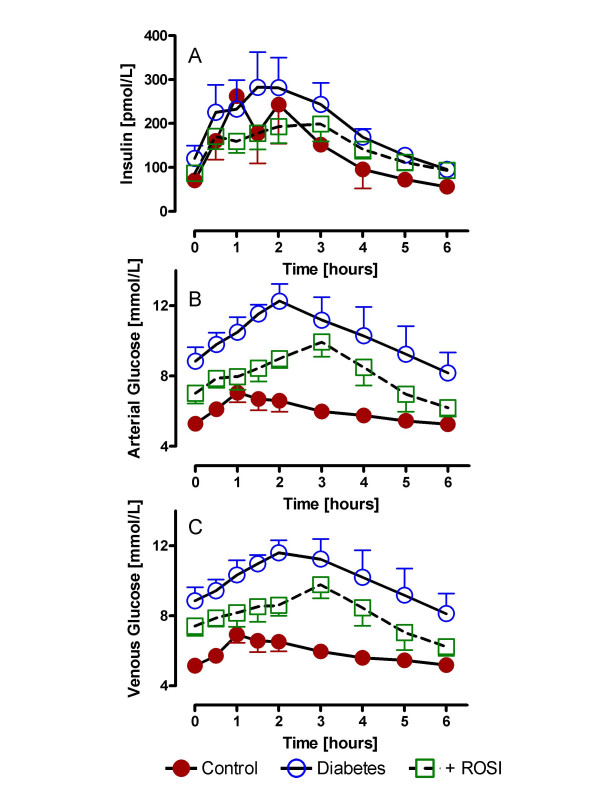
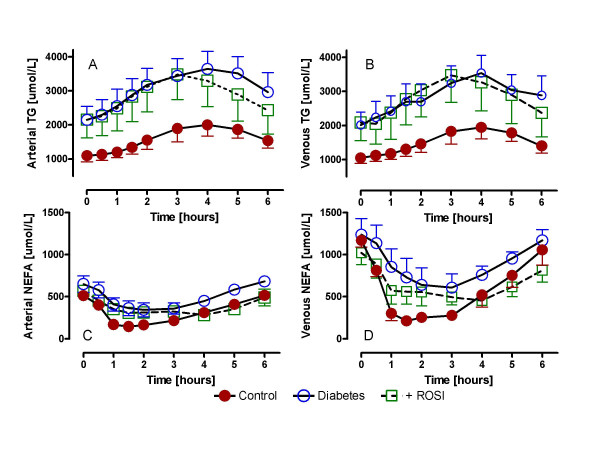
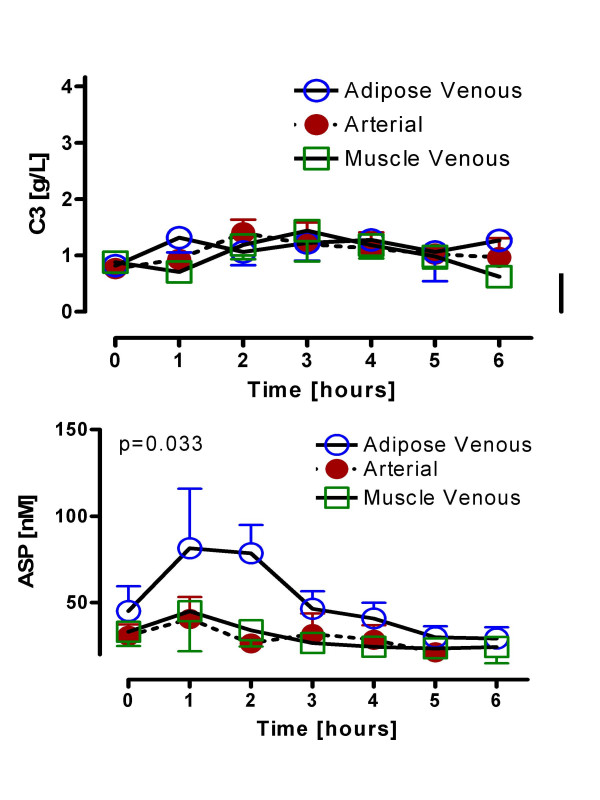
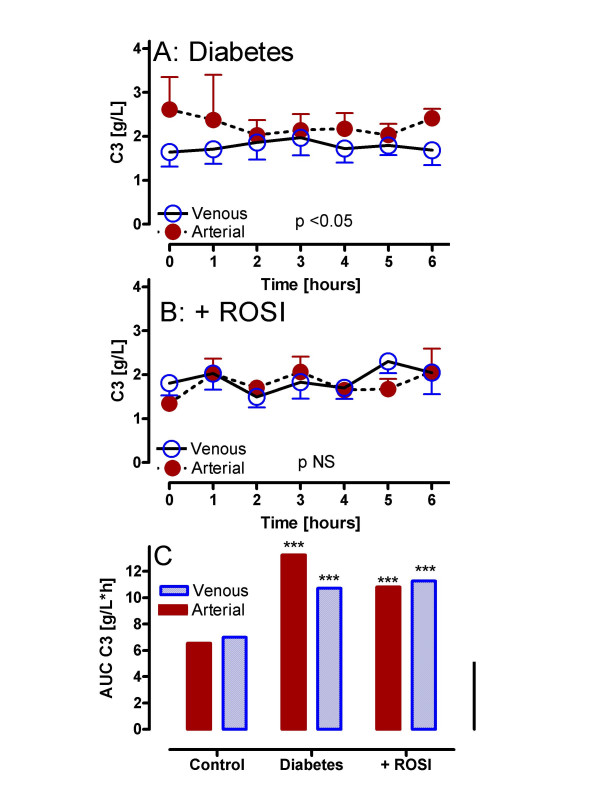
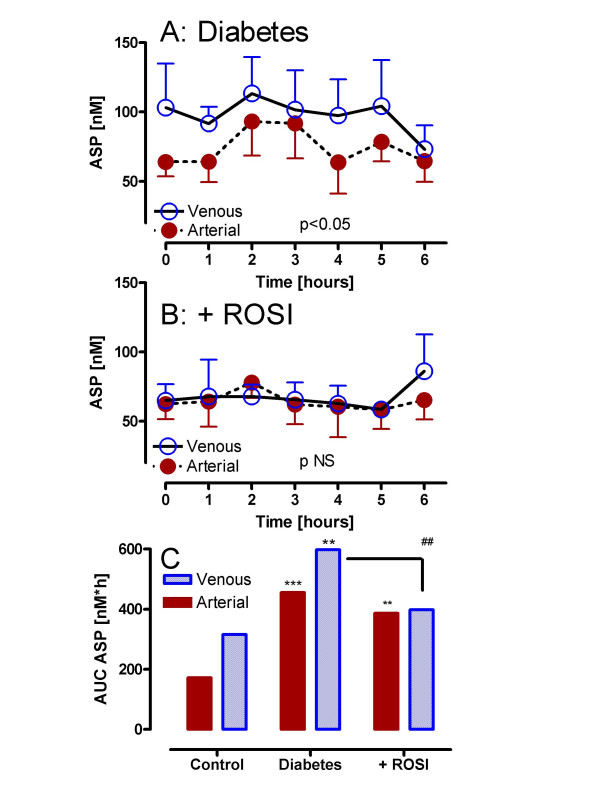
Postprandial arterial and adipose venous TG and venous NEFA were increased in diabetics vs. controls (p < 0.05-0.0001). ROSI treatment decreased postprandial arterial TG (p < 0.001), adipose venous NEFA (p < 0.005), reduced postprandial glucose (p < 0.0001) and insulin concentrations (p < 0.006). In healthy men, there was no change in postprandial C3, but an increase in adipose venous ASP vs. arterial ASP (p < 0.02), suggesting ASP production, with no change in forearm muscle. In older, obese diabetic subjects, arterial C3 was greater than in controls (p < 0.001). Arterial C3 was greater than venous C3 (p < 0.05), an effect that was lost with ROSI treatment. In diabetics, postprandial venous ASP was greater than arterial (p < 0.05), indicating ASP production, an effect that was lost with ROSI treatment (p < 0.01).
Increased postprandial venous production of ASP is specific for adipose tissue (absent in forearm muscle). Increased postprandial C3 and ASP in diabetic subjects is consistent with an ASP resistant state, this state is partially normalized by treatment with ROSI.
我们评估了2型糖尿病男性在接受/未接受罗格列酮(ROSI)治疗时血浆ASP及其前体C3的情况,并与健康非肥胖男性进行比较。我们测试了:(1)在健康瘦男性和老年肥胖糖尿病男性中,通过动静脉(A-V)差异评估的皮下脂肪组织或前臂肌肉流出物中,血浆ASP或C3在餐后是否发生变化;(2)ROSI治疗是否会改变ASP和/或C3的动静脉梯度。
在这项正在进行的安慰剂对照、交叉、双盲研究中,测量了糖尿病男性(n = 6)与健康男性(n = 9)混合餐后的A-V差异。
与对照组相比,糖尿病患者餐后动脉和脂肪静脉中的甘油三酯(TG)以及静脉中的非酯化脂肪酸(NEFA)增加(p < 0.05 - 0.0001)。ROSI治疗降低了餐后动脉TG(p < 0.001)、脂肪静脉NEFA(p < 0.005),降低了餐后血糖(p < 0.0001)和胰岛素浓度(p < 0.006)。在健康男性中,餐后C3无变化,但脂肪静脉ASP相对于动脉ASP增加(p < 0.02),提示有ASP产生,前臂肌肉中无变化。在老年肥胖糖尿病受试者中,动脉C3高于对照组(p < 0.001)。动脉C3高于静脉C3(p < 0.05),ROSI治疗后这种效应消失。在糖尿病患者中,餐后静脉ASP高于动脉(p < 0.05),提示有ASP产生,ROSI治疗后这种效应消失(p < 0.01)。
餐后静脉中ASP产生增加是脂肪组织特有的(前臂肌肉中不存在)。糖尿病受试者餐后C3和ASP增加与ASP抵抗状态一致,ROSI治疗可部分纠正这种状态。