Jin Minghao, Yuan Quan, Li Songhua, Travis Gabriel H
Jules Stein Eye Institute, University of California, Los Angeles, School of Medicine, Los Angeles, California 90095, USA.
J Biol Chem. 2007 Jul 20;282(29):20915-24. doi: 10.1074/jbc.M701432200. Epub 2007 May 15.
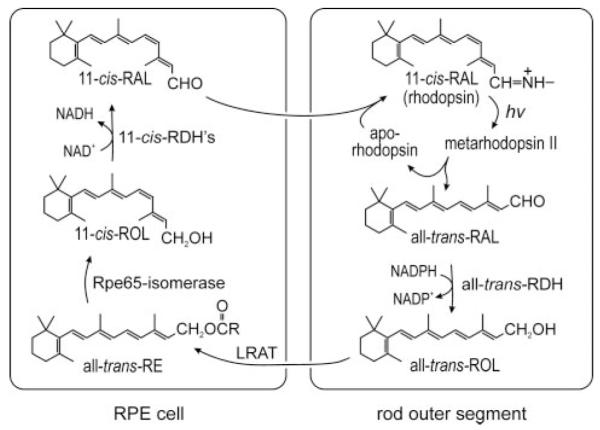
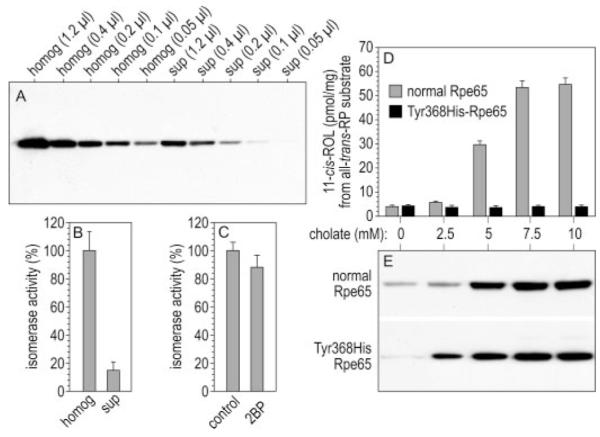
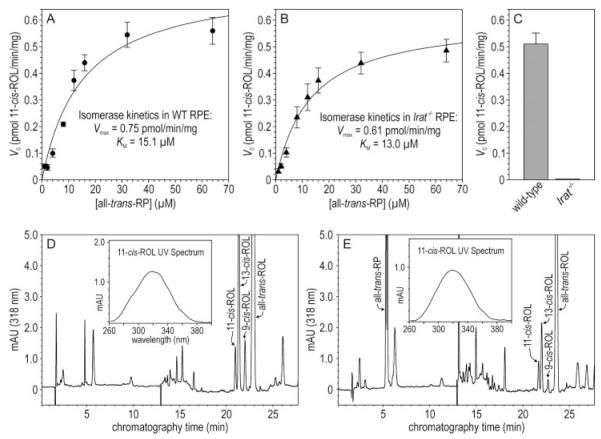
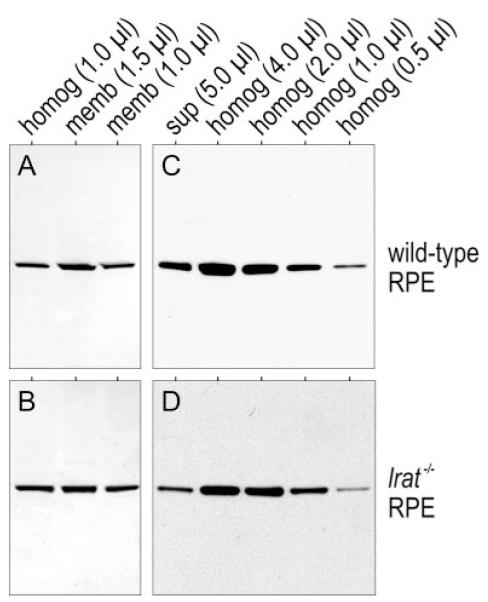
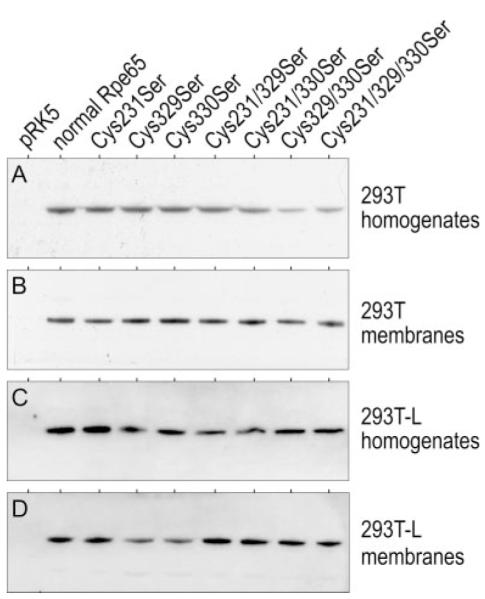
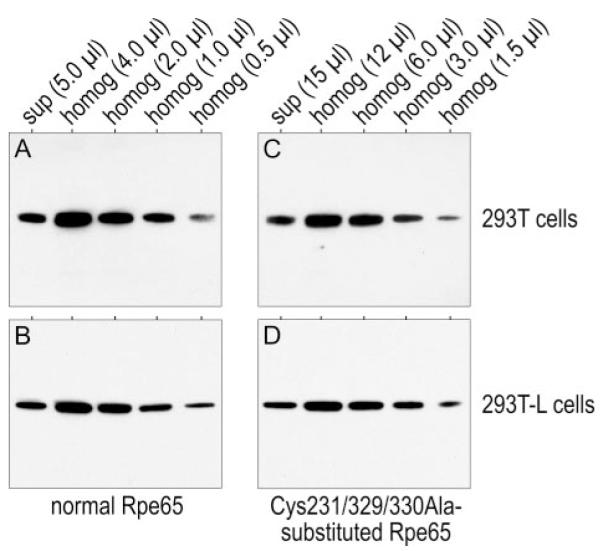
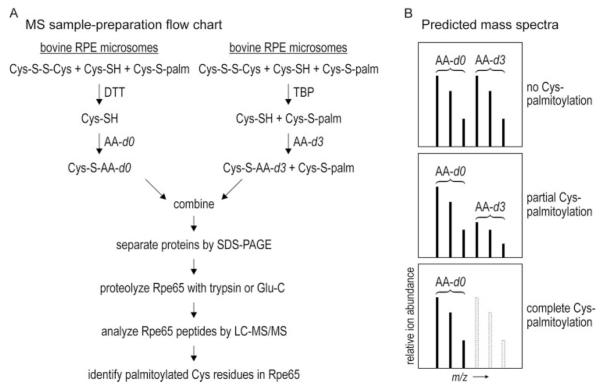
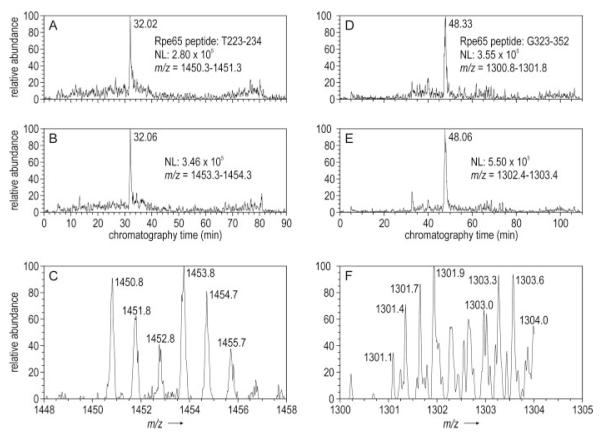
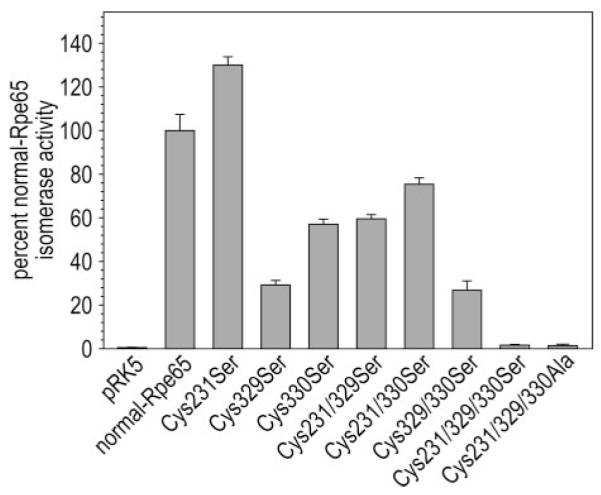
Absorption of a photon by a vertebrate opsin pigment induces 11-cis to all-trans isomerization of its retinaldehyde chromophore. Restoration of light sensitivity to the bleached opsin requires chemical re-isomerization of the chromophore via an enzyme pathway called the visual cycle. The retinoid isomerase in this pathway is Rpe65, a membrane-associated protein in the retinal pigment epithelium (RPE) with no predicted membrane-spanning segments. It has been suggested that Rpe65 is S-palmitoylated by lecithin:retinol acyl transferase (LRAT) on Cys(231), Cys(329), and Cys(330), and that this palmitoylation is required for isomerase activity and the association of Rpe65 with membranes. Here we show that the affinity of Rpe65 for membranes is similar in wild-type and lrat(-/-) mice. The isomerase activity of Rpe65 is also similar in both strains when all-trans-retinyl palmitate is used as substrate. With all-trans-retinol substrate, isomerase activity is present in wild-type but undetectable in RPE homogenates from lrat(-/-) mice. Substitution of Cys(231), Cys(329), and Cys(330) with Ser or Ala did not affect the affinity of Rpe65 for membranes. Further, these Cys residues are not palmitoylated in Rpe65 by mass spectrometric analysis. Global inhibition of protein palmitoylation by 2-bromopalmitate did not affect the solubility or isomerase activity of Rpe65. Finally, we show that soluble and membrane-associated Rpe65 possesses similar isomerase specific activities. These results indicate that LRAT is not required for isomerase activity beyond synthesis of retinyl-ester substrate, and that the association of Rpe65 with membranes is neither dependent upon LRAT nor the result of S-palmitoylation. The affinity of Rpe65 for membranes is probably an intrinsic feature of this protein.
脊椎动物视蛋白色素吸收一个光子会诱导其视黄醛发色团从11 -顺式异构化为全反式。恢复对漂白视蛋白的光敏感性需要通过一种称为视觉循环的酶途径使发色团进行化学重新异构化。该途径中的类视黄醇异构酶是Rpe65,它是视网膜色素上皮(RPE)中的一种膜相关蛋白,没有预测的跨膜片段。有人提出Rpe65在半胱氨酸(Cys)(231)、半胱氨酸(329)和半胱氨酸(330)上被卵磷脂:视黄醇酰基转移酶(LRAT)进行S -棕榈酰化,并且这种棕榈酰化是异构酶活性以及Rpe65与膜结合所必需的。在此我们表明,在野生型和lrat(-/-)小鼠中,Rpe65对膜的亲和力相似。当使用全反式视黄醇棕榈酸酯作为底物时,Rpe65的异构酶活性在两种品系中也相似。使用全反式视黄醇作为底物时,野生型中存在异构酶活性,但在lrat(-/-)小鼠的RPE匀浆中无法检测到。用丝氨酸或丙氨酸取代半胱氨酸(231)、半胱氨酸(329)和半胱氨酸(330)并不影响Rpe65对膜的亲和力。此外,通过质谱分析,这些半胱氨酸残基在Rpe65中未被棕榈酰化。用2 -溴棕榈酸酯全局抑制蛋白质棕榈酰化并不影响Rpe65的溶解性或异构酶活性。最后,我们表明可溶性和膜相关的Rpe65具有相似的异构酶比活性。这些结果表明,除了视黄醇酯底物的合成之外,异构酶活性不需要LRAT,并且Rpe65与膜的结合既不依赖于LRAT也不是S -棕榈酰化的结果。Rpe65对膜的亲和力可能是该蛋白的一个固有特性。