Liu Jian-Zhong, Wang Min
Key Laboratory of Gene Engineering of Ministry of Education and Biotechnology Research Center, State Key Laboratory of Biocontrol, Zhongshan University, Guangzhou, PR China.
BMC Biotechnol. 2007 May 18;7:23. doi: 10.1186/1472-6750-7-23.
Enzymes show relative instability in solvents or at elevated temperature and lower activity in organic solvent than in water. These limit the industrial applications of enzymes.
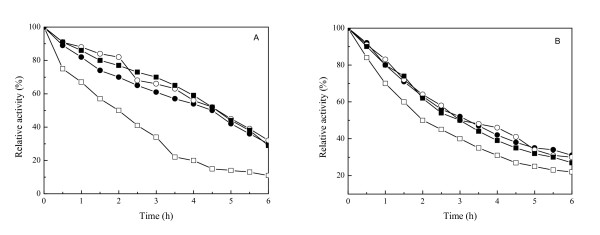
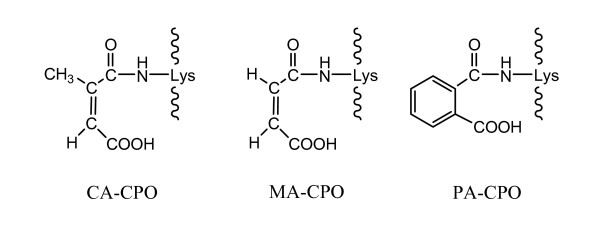
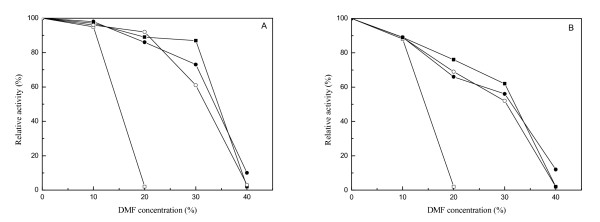
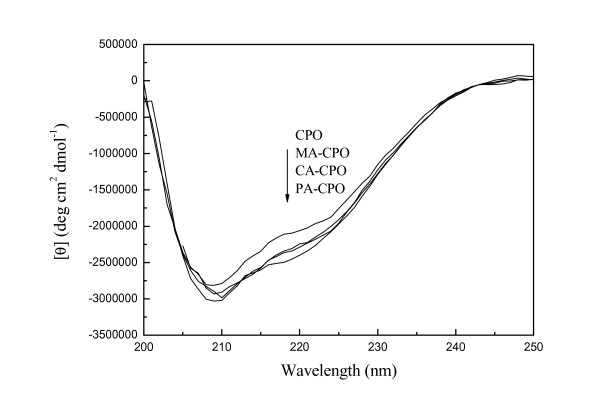
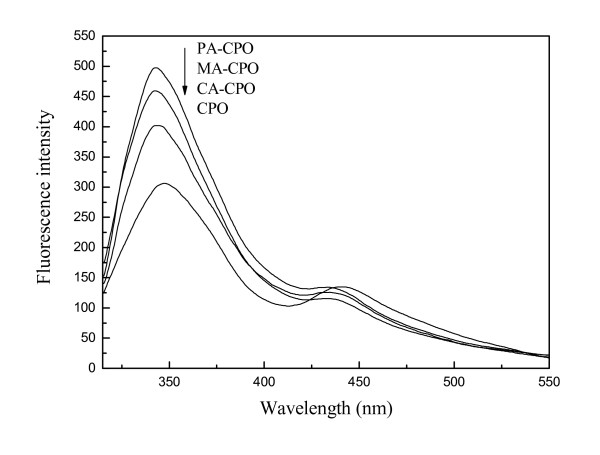
In order to improve the activity and stability of chloroperoxidase, chloroperoxidase was modified by citraconic anhydride, maleic anhydride or phthalic anhydride. The catalytic activities, thermostabilities and organic solvent tolerances of native and modified enzymes were compared. In aqueous buffer, modified chloroperoxidases showed similar Km values and greater catalytic efficiencies kcat/Km for both sulfoxidation and oxidation of phenol compared to native chloroperoxidase. Of these modified chloroperoxidases, citraconic anhydride-modified chloroperoxidase showed the greatest catalytic efficiency in aqueous buffer. These modifications of chloroperoxidase increased their catalytic efficiencies for sulfoxidation by 12%26% and catalytic efficiencies for phenol oxidation by 7%53% in aqueous buffer. However, in organic solvent (DMF), modified chloroperoxidases had lower Km values and higher catalytic efficiencies kcat/Km than native chloroperoxidase. These modifications also improved their thermostabilities by 1~2-fold and solvent tolerances of DMF. CD studies show that these modifications did not change the secondary structure of chloroperoxidase. Fluorescence spectra proved that these modifications changed the environment of tryptophan.
Chemical modification of epsilon-amino groups of lysine residues of chloroperoxidase using citraconic anhydride, maleic anhydride or phthalic anhydride is a simple and powerful method to enhance catalytic properties of enzyme. The improvements of the activity and stability of chloroperoxidase are related to side chain reorientations of aromatics upon both modifications.
酶在溶剂中或高温下表现出相对不稳定性,且在有机溶剂中的活性低于在水中的活性。这些限制了酶的工业应用。
为了提高氯过氧化物酶的活性和稳定性,用柠康酸酐、马来酸酐或邻苯二甲酸酐对氯过氧化物酶进行修饰。比较了天然酶和修饰酶的催化活性、热稳定性和有机溶剂耐受性。在水性缓冲液中,与天然氯过氧化物酶相比,修饰后的氯过氧化物酶在亚砜氧化和苯酚氧化反应中表现出相似的Km值和更高的催化效率kcat/Km。在这些修饰的氯过氧化物酶中,柠康酸酐修饰的氯过氧化物酶在水性缓冲液中表现出最高的催化效率。这些对氯过氧化物酶的修饰使其在水性缓冲液中的亚砜氧化催化效率提高了12%26%,苯酚氧化催化效率提高了7%53%。然而,在有机溶剂(二甲基甲酰胺)中,修饰后的氯过氧化物酶的Km值更低,催化效率kcat/Km比天然氯过氧化物酶更高。这些修饰还将它们的热稳定性提高了1至2倍,并增强了对二甲基甲酰胺的溶剂耐受性。圆二色性研究表明,这些修饰没有改变氯过氧化物酶的二级结构。荧光光谱证明这些修饰改变了色氨酸的环境。
用柠康酸酐、马来酸酐或邻苯二甲酸酐对氯过氧化物酶赖氨酸残基的ε-氨基进行化学修饰是一种简单而有效的提高酶催化性能的方法。氯过氧化物酶活性和稳定性的提高与两种修饰后芳香族侧链的重新取向有关。