Kim Young-Ae, Xiao Dong, Xiao Hui, Powolny Anna A, Lew Karen L, Reilly Megan L, Zeng Yan, Wang Zhou, Singh Shivendra V
Department of Pharmacology and Urology, University of Pittsburgh Cancer Institute, University of Pittsburgh School of Medicine, Pittsburgh, Pennsylvania 15213, USA.
Mol Cancer Ther. 2007 May;6(5):1599-609. doi: 10.1158/1535-7163.MCT-06-0754.
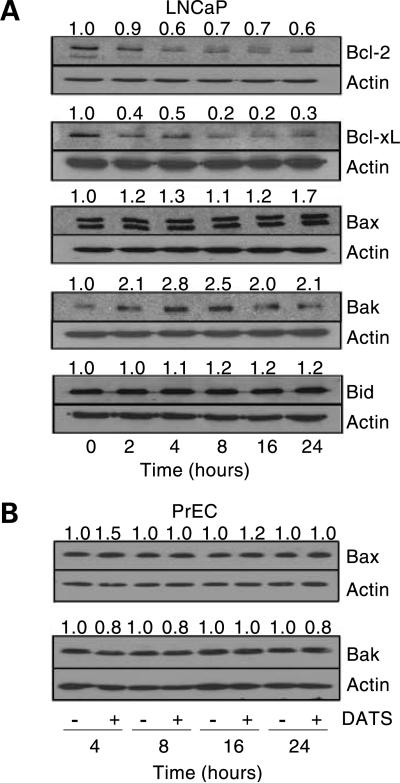
Garlic constituent diallyl trisulfide (DATS) inhibits growth of cancer cells in vitro and in vivo by causing apoptosis, but the sequence of events leading to cell death is not fully understood. We now show that DATS treatment triggers mitochondria-mediated apoptosis program in human prostate cancer cells (LNCaP, LNCaP-C81, LNCaP-C4-2) irrespective of their androgen responsiveness. Interestingly, a normal prostate epithelial cell line (PrEC) is significantly more resistant to apoptosis induction by DATS compared with prostate cancer cells. The DATS-induced apoptosis in LNCaP cells correlated with the collapse of mitochondrial membrane potential, modest increase in protein level of Bak, and down-regulation of Bcl-2 and Bcl-xL protein levels. The DATS-induced apoptosis was significantly attenuated by knockdown of Bax and Bak proteins, but not by ectopic expression of either Bcl-2 or Bcl-xL. The DATS treatment caused generation of reactive oxygen species (ROS) in LNCaP cells, but not in PrEC, which was attenuated by pretreatment with antioxidant N-acetylcysteine. The N-acetylcysteine pretreatment conferred significant protection against DATS-mediated disruption of the mitochondrial membrane potential and apoptosis. In conclusion, the present study reveals that the mitochondria-mediated cell death by DATS is associated with ROS generation and regulated by Bax/Bak but independent of Bcl-2 or Bcl-xL.
大蒜成分二烯丙基三硫化物(DATS)通过诱导细胞凋亡在体外和体内抑制癌细胞生长,但导致细胞死亡的事件顺序尚未完全明确。我们现在表明,无论人前列腺癌细胞(LNCaP、LNCaP - C81、LNCaP - C4 - 2)的雄激素反应性如何,DATS处理都会触发线粒体介导的凋亡程序。有趣的是,与前列腺癌细胞相比,正常前列腺上皮细胞系(PrEC)对DATS诱导的凋亡具有显著更高的抗性。DATS诱导LNCaP细胞凋亡与线粒体膜电位的崩溃、Bak蛋白水平适度增加以及Bcl - 2和Bcl - xL蛋白水平下调相关。通过敲低Bax和Bak蛋白,DATS诱导的凋亡显著减弱,但通过异位表达Bcl - 2或Bcl - xL则不然。DATS处理在LNCaP细胞中导致活性氧(ROS)生成,但在PrEC中则不然,抗氧化剂N - 乙酰半胱氨酸预处理可使其减弱。N - 乙酰半胱氨酸预处理对DATS介导的线粒体膜电位破坏和凋亡具有显著保护作用。总之,本研究表明,DATS介导的线粒体介导的细胞死亡与ROS生成相关,并受Bax/Bak调节,但独立于Bcl - 2或Bcl - xL。