Pessoa-Filho Marco, Beló André, Alcochete António A N, Rangel Paulo H N, Ferreira Márcio E
Departamento de Biologia Celular, IB--Universidade de Brasília (UnB) Campus Universitario, Asa Norte, Brasilia, DF, Brazil.
BMC Plant Biol. 2007 May 21;7:23. doi: 10.1186/1471-2229-7-23.
This study aimed to analyze the efficiency of three new microsatellite multiplex panels, which were designed to evaluate a total of 16 loci of the rice genome, based on single PCR reactions of each panel. A sample of 548 accessions of traditional upland rice landraces collected in Brazil in the last 25 years was genotyped, a database of allelic frequencies was established, estimates of genetic parameters were performed and analysis of genetic structure of the collection was developed.
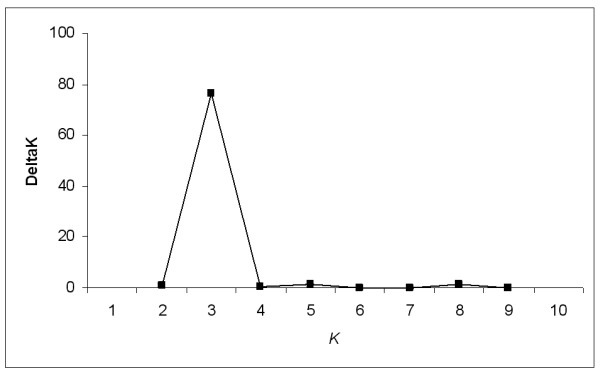
The three panels yielded a combined matching probability of 6.4 x 10⁻²¹, polymorphism information content (PIC) of 0.637, and a combined power of exclusion greater than 99.99%. A few samples presented a genetic background of indica rice. The 16 SSR loci produced a total of 229 alleles. Gene diversity values averaged 0.667, and PIC values averaged 0.637. Genetic structure analysis of the collection using a Bayesian approach detected three possible major clusters, with an overall FST value of 0.177. Important inputs on the knowledge about upland rice germplasm differentiations which happened in Brazil in the last few centuries were also achieved and are discussed.
The three multiplex panels described here represent a powerful tool for rice genetic analysis, offering a rapid and efficient option for rice germplasm characterization. The data gathered demonstrates the feasibility of genotyping extensive germplasm collections using panels of multiplexed microsatellite markers. It contributes to the advancement of research on large scale characterization and management of germplasm banks, as well as identification, protection and assessments of genetic relationship of rice germplasm.
本研究旨在分析三种新的微卫星多重检测板的效率,这些检测板旨在通过每个检测板的单重PCR反应评估水稻基因组的总共16个位点。对过去25年在巴西收集的548份传统陆稻地方品种样本进行基因分型,建立等位基因频率数据库,进行遗传参数估计,并开展该收集品的遗传结构分析。
这三种检测板产生的联合匹配概率为6.4×10⁻²¹,多态性信息含量(PIC)为0.637,联合排除力大于99.99%。少数样本呈现籼稻的遗传背景。16个SSR位点共产生229个等位基因。基因多样性值平均为0.667,PIC值平均为0.637。使用贝叶斯方法对该收集品进行的遗传结构分析检测到三个可能的主要聚类,总体FST值为0.177。还获得并讨论了关于过去几个世纪在巴西发生的陆稻种质分化的重要知识输入。
这里描述的三种多重检测板是水稻遗传分析的有力工具,为水稻种质鉴定提供了快速有效的选择。所收集的数据证明了使用多重微卫星标记检测板对大量种质收集品进行基因分型的可行性。它有助于推进种质库大规模鉴定和管理的研究,以及水稻种质的鉴定、保护和遗传关系评估。